


A two-stage partial nitritation-denitritation/anammox (PN-DN/A) process to treat high-solid anaerobic digestion (HSAD) reject water: Verification based on pilot-scale and full-scale projects
- PMID: 38414757
- PMCID: PMC10897884
- DOI: 10.1016/j.wroa.2024.100213
A two-stage partial nitritation-denitritation/anammox (PN-DN/A) process to treat high-solid anaerobic digestion (HSAD) reject water: Verification based on pilot-scale and full-scale projects
Abstract
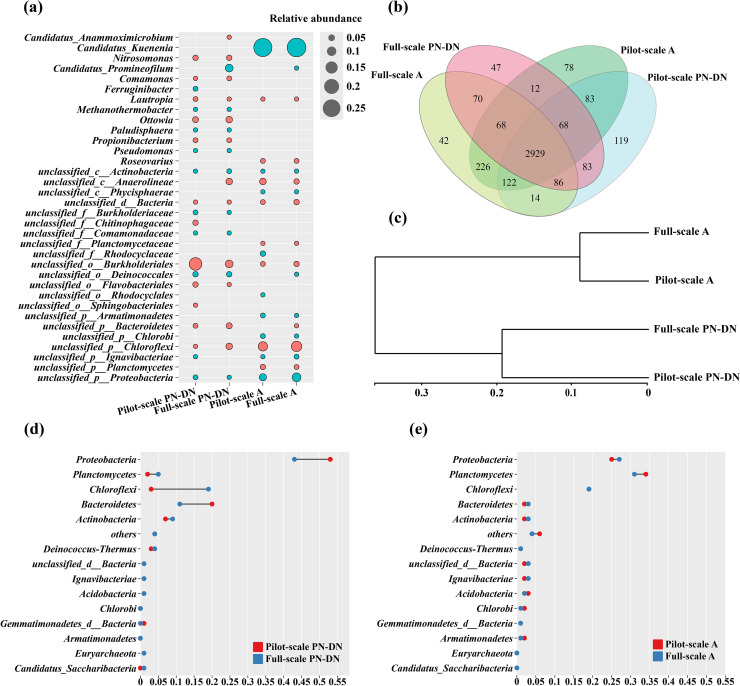
High-solid anaerobic digestion (HSAD) reject water, distinguished by elevated levels of chemical oxygen demand (COD), NH4+-N and an imbalanced COD/TIN, presents a significant challenge for treatment through conventional partial nitritation/ anammox (PN/A) process. This study introduced a revised two-stage PN/A process, namely partial nitritation/denitritation-anammox (PN-DN/A) process. Its effectiveness was investigated through both pilot-scale (12 t/d) and full-scale (400 t/d) operations, showcasing stable operation with an impressive total removal rate of over 90 % for total inorganic nitrogen (TIN) and exceeding 60 % for COD. Notably, 30 % of TIN was eliminated through heterotrophic denitritation in partial nitritation-denitritation (PN-DN) stage, while approximately 55 % of TIN removal occurred in the anammox stage with anaerobic ammonium oxidizing bacteria (AnAOB) enrichment (Candidatus Kuenenia, 25.9 % and 26.6 % relative abundance for pilot and full scale). In the PN-DN stage, aerobic-anaerobic alternation promoted organics elimination (around 50 % COD) and balanced nitrogen species. Microbial and metagenomic analysis verified the coupling between autotrophic and heterotrophic denitritation and demonstrated that PN-DN stage acted as a protective buffer for anammox stage. This comprehensive study highlights the PN-DN/A process's efficacy in stably treating HSAD reject water.
Keywords: AD reject water; Anammox; Full-scale; High solid anaerobic digestion; PN/A.
© 2024 The Author(s).
Conflict of interest statement
The authors declare that they have no known competing financial interests or personal relationships that could have appeared to influence the work reported in this paper.
Figures




References
-
- Ali M., Okabe S. Anammox-based technologies for nitrogen removal: advances in process start-up and remaining issues. Chemosphere. 2015;141:144–153. - PubMed
-
- Cao S., Yan W., Yu L., Zhang L., Lay W., Zhou Y. Challenges of THP-AD centrate treatment using partial nitritation-anammox (PN/A) - inhibition, biomass washout, low alkalinity, recalcitrant and more. Water Res. 2021;203 - PubMed
-
- Chen C., Sun F., Zhang H., Wang J., Shen Y., Liang X. Evaluation of COD effect on anammox process and microbial communities in the anaerobic baffled reactor (ABR) Bioresour. Technol. 2016;216:571–578. - PubMed
-
- Chen H., Li X., Liu G., Zhu J., Ma X., Piao C., You S., Wang K. Decoding the carbon and nitrogen metabolism mechanism in anammox system treating pharmaceutical wastewater with varying COD/N ratios through metagenomic analysis. Chem. Eng. J. 2023;457
-
- Connan R., Dabert P., Khalil H., Bridoux G., Béline F., Magrí A. Batch enrichment of anammox bacteria and study of the underlying microbial community dynamics. Chem. Eng. J. 2016;297:217–228.
LinkOut - more resources
Full Text Sources
