


Association between systemic immune inflammation index, systemic inflammation response index and adult psoriasis: evidence from NHANES
- PMID: 38415255
- PMCID: PMC10896999
- DOI: 10.3389/fimmu.2024.1323174
Association between systemic immune inflammation index, systemic inflammation response index and adult psoriasis: evidence from NHANES
Abstract
Background: The systemic immune-inflammation index (SII) and systemic inflammation response index (SIRI) are both novel biomarkers and predictors of inflammation. Psoriasis is a skin disease characterized by chronic inflammation. This study aimed to investigate the potential association between SII, SIRI, and adult psoriasis.
Methods: Data of adults aged 20 to 80 years from the National Health and Nutrition Examination Survey (NHANES) (2003-2006, 2009-2014) were utilized. The K-means method was used to group SII and SIRI into low, medium, and high-level clusters. Additionally, SII or SIRI levels were categorized into three groups: low (1st-3rd quintiles), medium (4th quintile), and high (5th quintile). The association between SII-SIRI pattern, SII or SIRI individually, and psoriasis was assessed using multivariate logistic regression models. The results were presented as odds ratios (ORs) and confidence intervals (CIs). Restricted cubic spline (RCS) regression, subgroup, and interaction analyses were also conducted to explore the potential non-linear and independent relationships between natural log-transformed SII (lnSII) levels or SIRI levels and psoriasis, respectively.
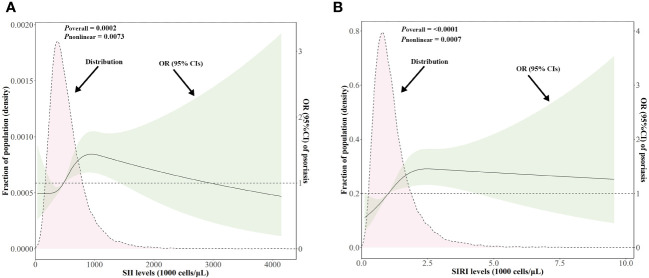
Results: Of the 18208 adults included in the study, 511 (2.81%) were diagnosed with psoriasis. Compared to the low-level group of the SII-SIRI pattern, participants in the medium-level group had a significantly higher risk for psoriasis (OR = 1.40, 95% CI: 1.09, 1.81, p-trend = 0.0031). In the analysis of SII or SIRI individually, both SII and SIRI were found to be positively associated with the risk of psoriasis (high vs. low group OR = 1.52, 95% CI: 1.18, 1.95, p-trend = 0.0014; OR = 1.48, 95% CI: 1.12, 1.95, p-trend = 0.007, respectively). Non-linear relationships were observed between lnSII/SIRI and psoriasis (both p-values for overall < 0.05, p-values for nonlinearity < 0.05). The association between SII levels and psoriasis was stronger in females, obese individuals, people with type 2 diabetes, and those without hypercholesterolemia.
Conclusion: We observed positive associations between SII-SIRI pattern, SII, SIRI, and psoriasis among U.S. adults. Further well-designed studies are needed to gain a better understanding of these findings.
Keywords: NHANES; adults; psoriasis; systemic immune-inflammation index; systemic inflammation response index.
Copyright © 2024 Ma, Cui, Cai, Yang, Wang, Chen, Chen, Peng, Qin, Ding, Wang, Yu and Shi.
Conflict of interest statement
The authors declare that the research was conducted in the absence of any commercial or financial relationships that could be construed as a potential conflict of interest.
Figures



References
Publication types
MeSH terms
LinkOut - more resources
Full Text Sources
Medical
Miscellaneous
