


Intolerance of Uncertainty and Worry Prospectively Predict COVID-19 Anxiety and Distress: A 4-Year Longitudinal Study
- PMID: 38418043
- PMCID: PMC10902602
- DOI: 10.1016/j.beth.2023.07.009
Intolerance of Uncertainty and Worry Prospectively Predict COVID-19 Anxiety and Distress: A 4-Year Longitudinal Study
Abstract
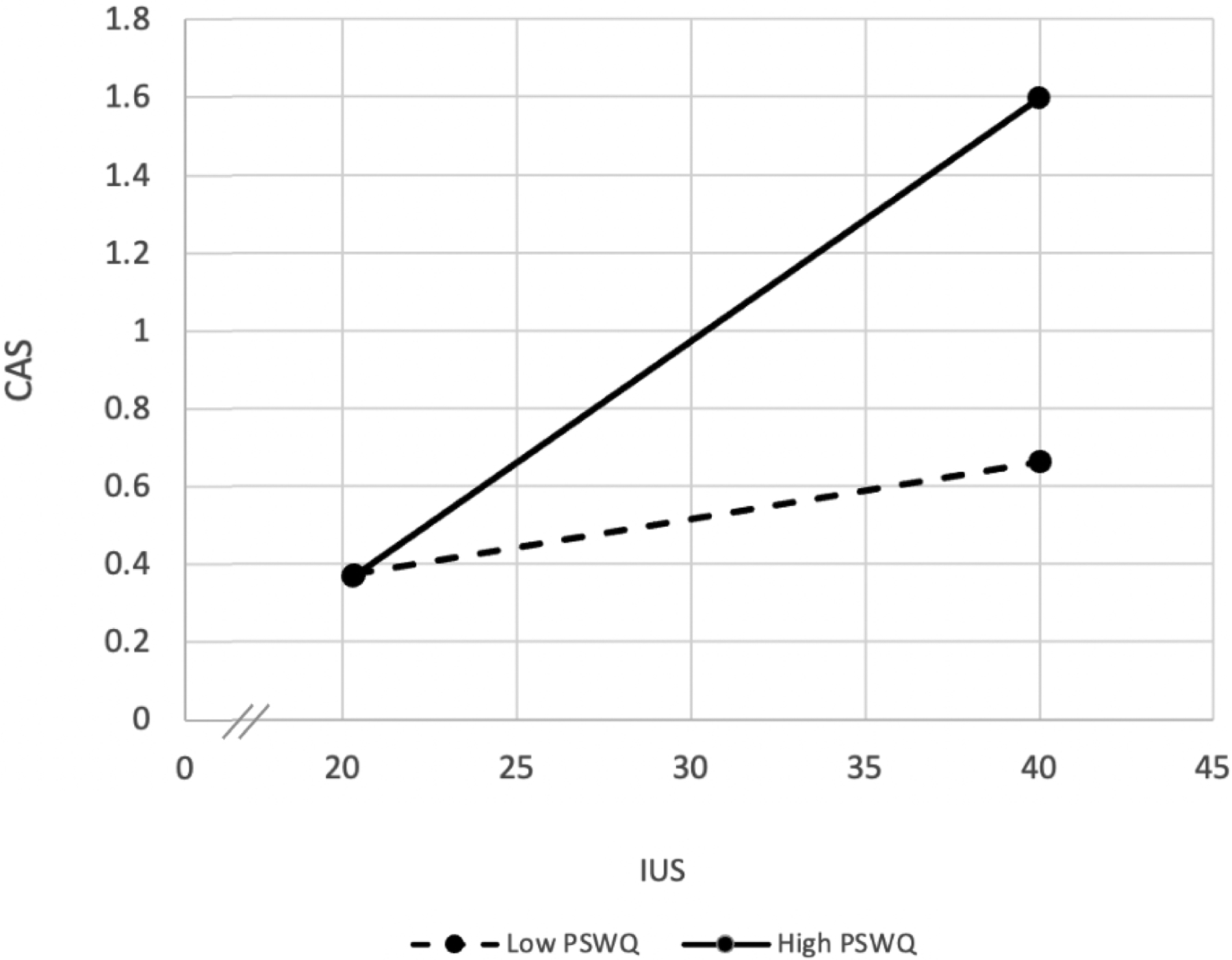
The COVID-19 pandemic precipitated an uptick in poor mental health outcomes, including coronavirus-related anxiety and distress. Preliminary research has shown that intolerance of uncertainty (IU) and worry proneness, two transdiagnostic risk factors for anxiety and related disorders, are associated cross-sectionally with pandemic-related fear and distress. However, the extent to which IU and worry proneness prospectively predict coronavirus-related anxiety and distress is unclear. Whether IU and worry may also interact in prospectively predicting coronavirus-related anxiety and distress is also unknown. To address this knowledge gap, the present study examined IU and trait worry as prospective predictors of the level and trajectory of coronavirus anxiety and COVID stress syndrome over time, as well as the extent to which worry moderated the relation between IU and pandemic-related outcomes. Participants (n = 310) who completed self-report measures of IU and trait worry in 2016 were contacted following the onset of COVID-19 in 2020 and completed biweekly measures of coronavirus anxiety and COVID stress syndrome for 30 weeks. Multilevel models revealed that IU assessed in 2016 significantly predicted the severity of both coronavirus anxiety and COVID stress syndrome throughout the study period in 2020. Worry also moderated the link between IU and coronavirus anxiety, such that individuals with high levels of trait worry and high IU in 2016 experienced the most coronavirus anxiety in 2020. Results suggest that IU and worry functioned as independent and interactive vulnerability factors for subsequent adverse psychological reactions to COVID-19. Clinical implications and future directions are discussed.
Keywords: anxiety; coronavirus; intolerance of uncertainty; stress; worry.
Copyright © 2023. Published by Elsevier Ltd.
Conflict of interest statement
The authors have no conflicts of interest to declare.
Figures
References
-
- Asmundson GJG, Rachor G, Drakes DH, Boehme BAE, Paluszek MM, & Taylor S (2022). How does COVID stress vary across the anxiety-related disorders? Assessing factorial invariance and changes in COVID Stress Scale scores during the pandemic. Journal of Anxiety Disorders, 87, 102554. 10.1016/j.janxdis.2022.102554 - DOI - PMC - PubMed
-
- Bardeen JR, Fergus TA, & Wu KD (2013). The Interactive Effect of Worry and Intolerance of Uncertainty on Posttraumatic Stress Symptoms. Cognitive Therapy and Research, 37(4), 742–751. 10.1007/s10608-012-9512-1 - DOI
-
- Behar E, Alcaine O, Zuellig AR, & Borkovec TD (2003). Screening for generalized anxiety disorder using the Penn State Worry Questionnaire: A receiver operating characteristic analysis. Journal of Behavior Therapy and Experimental Psychiatry, 34(1), 25–43. 10.1016/S0005-7916(03)00004-1 - DOI - PubMed
-
- Belen H (2021). The Impacts of Propensity to Worry and Fear of COVID-19 on Mental Health of University Students. International Journal of Psychology and Educational Studies, Special Issue, 57–66.
-
- Bendau A, Kunas SL, Wyka S, Petzold MB, Plag J, Asselmann E, & Ströhle A (2021). Longitudinal changes of anxiety and depressive symptoms during the COVID-19 pandemic in Germany: The role of pre-existing anxiety, depressive, and other mental disorders. Journal of Anxiety Disorders, 79, 102377. 10.1016/j.janxdis.2021.102377 - DOI - PMC - PubMed
Publication types
MeSH terms
Supplementary concepts
Grants and funding
LinkOut - more resources
Full Text Sources
Medical
Miscellaneous
