


Implementation of early prophylaxis for deep-vein thrombosis in intracerebral hemorrhage patients: an observational study from the Chinese Stroke Center Alliance
- PMID: 38419108
- PMCID: PMC10900581
- DOI: 10.1186/s12959-024-00592-w
Implementation of early prophylaxis for deep-vein thrombosis in intracerebral hemorrhage patients: an observational study from the Chinese Stroke Center Alliance
Abstract
Background: There is substantial evidence to support the use of several methods for preventing deep-vein thrombosis (DVT) following intracerebral hemorrhage (ICH). However, the extent to which these measures are implemented in clinical practice and the factors influencing patients' receipt of preventive measures remain unclear. Therefore, we aimed to evaluate the rate of the early implementation of DVT prophylaxis and the factors associated with its success in patients with ICH.
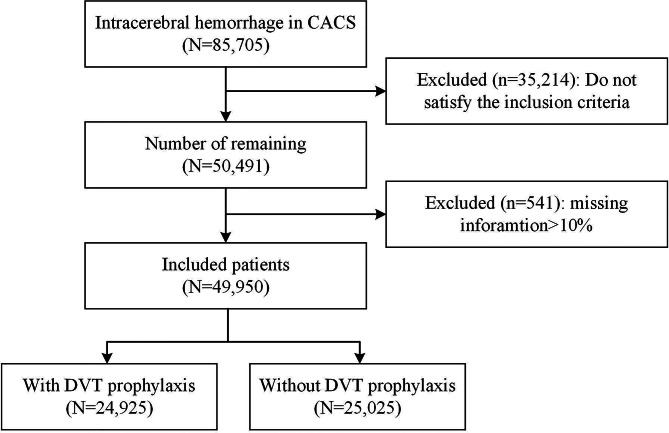
Methods: This study enrolled 49,950 patients with spontaneous ICH from the Chinese Stroke Center Alliance (CSCA) between August 2015 and July 2019. Early DVT prophylaxis implementation was defined as an intervention occurring within 48 h after admission. Univariate and multivariate logistic regression analyses were conducted to identify the rate and factors associated with the implementation of early prophylaxis for DVT in patients with ICH.
Results: Among the 49,950 ICH patients, the rate of early DVT prophylaxis implementation was 49.9%, the rate of early mobilization implementation was 29.49%, and that of pharmacological prophylaxis was 2.02%. Factors associated with an increased likelihood of early DVT prophylaxis being administered in the multivariable model included receiving early rehabilitation therapy (odds ratio [OR], 2.531); admission to stroke unit (OR 2.231); admission to intensive care unit (OR 1.975); being located in central (OR 1.879) or eastern regions (OR 1.529); having a history of chronic obstructive pulmonary disease (OR 1.292), ischemic stroke (OR 1.245), coronary heart disease or myocardial infarction (OR 1.2); taking antihypertensive drugs (OR 1.136); and having a higher Glasgow Coma Scale (GCS) score (OR 1.045). Conversely, being male (OR 0.936), being hospitalized in tertiary hospitals (OR 0.778), and having a previous intracranial hemorrhage (OR 0.733) were associated with a lower likelihood of early DVT prophylaxis being administered in patients with ICH.
Conclusions: The implementation rate of early DVT prophylaxis among Chinese patients with ICH was subpar, with pharmacological prophylaxis showing the lowest prevalence. Various controllable factors exerted an impact on the implementation of early DVT prophylaxis in this population.
Keywords: Chinese stroke center alliance; Deep-vein thrombosis; Early prophylaxis; Factors; Intracerebral hemorrhage.
© 2024. The Author(s).
Conflict of interest statement
The authors declare no competing interests.
Figures
Similar articles
-
Early thrombosis prophylaxis with enoxaparin is not associated with hematoma expansion in patients with spontaneous intracerebral hemorrhage.Eur J Neurol. 2019 Feb;26(2):333-341. doi: 10.1111/ene.13830. Epub 2018 Dec 6. Eur J Neurol. 2019. PMID: 30308696
-
Risks, Benefits, and the Optimal Time to Resume Deep Vein Thrombosis Prophylaxis in Patients with Intracranial Hemorrhage.Cureus. 2019 Oct 2;11(10):e5827. doi: 10.7759/cureus.5827. Cureus. 2019. PMID: 31754562 Free PMC article.
-
A novel risk score to predict deep vein thrombosis after spontaneous intracerebral hemorrhage.Front Neurol. 2022 Oct 28;13:930500. doi: 10.3389/fneur.2022.930500. eCollection 2022. Front Neurol. 2022. PMID: 36388194 Free PMC article.
-
What is the optimal pharmacological prophylaxis for the prevention of deep-vein thrombosis and pulmonary embolism in patients with acute ischemic stroke?Thromb Res. 2007;119(3):265-74. doi: 10.1016/j.thromres.2006.03.010. Epub 2006 May 3. Thromb Res. 2007. PMID: 16674999 Review.
-
Patients with venous thromboembolism after spontaneous intracerebral hemorrhage: a review.Thromb J. 2021 Nov 27;19(1):93. doi: 10.1186/s12959-021-00345-z. Thromb J. 2021. PMID: 34838069 Free PMC article. Review.
Cited by
-
Construction of an early warning model for venous thromboembolism risk in patients with severe cerebral hemorrhage based on ultrasound spontaneous imaging.Front Neurol. 2025 Jun 4;16:1562963. doi: 10.3389/fneur.2025.1562963. eCollection 2025. Front Neurol. 2025. PMID: 40534751 Free PMC article.
-
Hemophilia B With Intracranial Hemorrhage Rehabilitation in High-Dependency Unit: A Case Report.Clin Case Rep. 2025 Apr 21;13(4):e70470. doi: 10.1002/ccr3.70470. eCollection 2025 Apr. Clin Case Rep. 2025. PMID: 40264735 Free PMC article.
References
-
- Mertins T, Nilius H, Boss R, Knuchel M, Signorell A, Huber CA, Blozik E, Kremer HJ, Bachmann LM, Nagler M. Secondary prevention of venous thromboembolism: predictors and outcomes of guideline adherence in a long-term prospective cohort study. Front Cardiovasc Med. 2022;9:963528. doi: 10.3389/fcvm.2022.963528. - DOI - PMC - PubMed
-
- van Asch CJ, Luitse MJ, Rinkel GJ, van der Tweel I, Algra A, Klijn CJ. Incidence, case fatality, and functional outcome of intracerebral haemorrhage over time, according to age, sex, and ethnic origin: a systematic review and meta-analysis. Lancet Neurol. 2010;9:167–76. doi: 10.1016/S1474-4422(09)70340-0. - DOI - PubMed
LinkOut - more resources
Full Text Sources
