. 2024 Feb 28;6(1):8.
doi: 10.1186/s42523-024-00299-3.

Virome characterization of diarrheic red-crowned crane (G. japonensis)

Affiliations

Virome characterization of diarrheic red-crowned crane (G. japonensis)

Ning Cui et al. Anim Microbiome. .

Abstract

Background: The red-crowned crane is one of the vulnerable bird species. Although the captive population has markedly increased over the last decade, infectious diseases can lead to the death of young red-crowned cranes while few virological studies have been conducted.

Methods: Using a viral metagenomics approach, we analyzed the virome of tissues of the dead captive red-crowned crane with diarrhea symptoms in Dongying Biosphere Reserve, Shandong Province, China and feces of individual birds breeding at the corresponding captive breeding center, which were pooled separately.

Results: There is much more DNA and RNA viruses in the feces than that of the tissues. RNA virus belonging to the families Picornaviridae, and DNA viruses belonging to the families Parvoviridae, associated with enteric diseases were detected in the tissues and feces. Genomes of the picornavirus, genomovirus, and parvovirus identified in the study were fully characterized, which further suggested that infectious viruses of these families were possibly presented in the diseased red-crowned crane.

Conclusion: RNA virus belonging to the families Picornaviridae, and DNA viruses belonging to the families Genomoviridae and Parvoviridae were possibly the causative agent for diarrhea of red-crowned crane. This study has expanded our understanding of the virome of red-crowned crane and provides a baseline for elucidating the etiology for diarrhea of the birds.

Keywords: Grus japonensis; Diarrhea; Genomovirus; Megrivirus A; Parvovirus; Virome.


Conflict of interest statement

The authors declare that they have no competing interests.

Figures
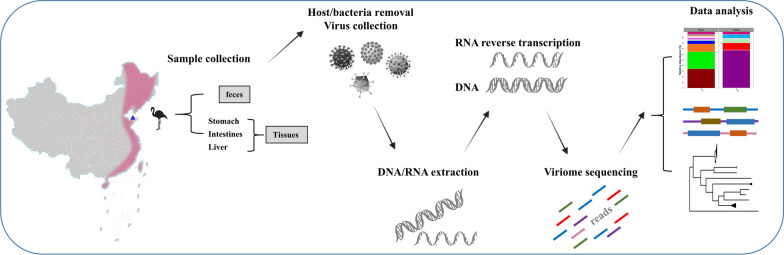
Fig. 1
Fig. 1
Graphical scheme and flow chart of experiment design for virus discovery. Tissues and feces samples were collected from Dongying Biosphere Reserve, Shandong Province, China in spring, 2022. The samples were pooled separately and subjected for the following host/bacteria removal and virus collection, DNA/RNA extraction, viriome sequencing and final bioinformatics analysis
Fig. 2
Fig. 2
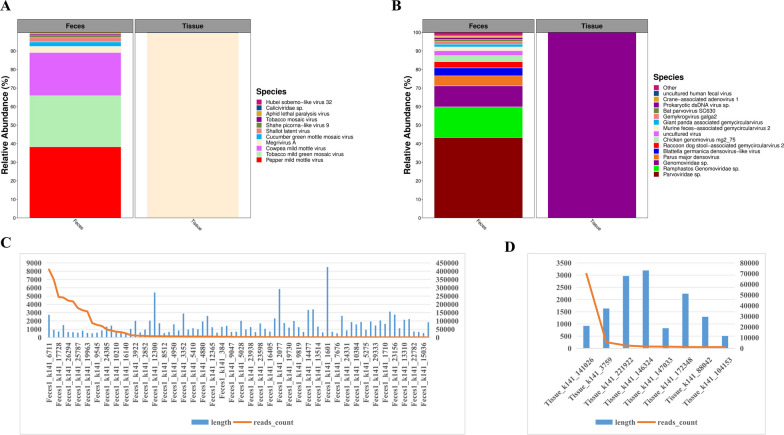
Overview of the virus composition. Relative abundance of RNA viruses (A) and DNA viruses (B), novel viral reads (C, D) in the feces and tissues respectively based on the viral contig numbers
Fig. 3
Fig. 3
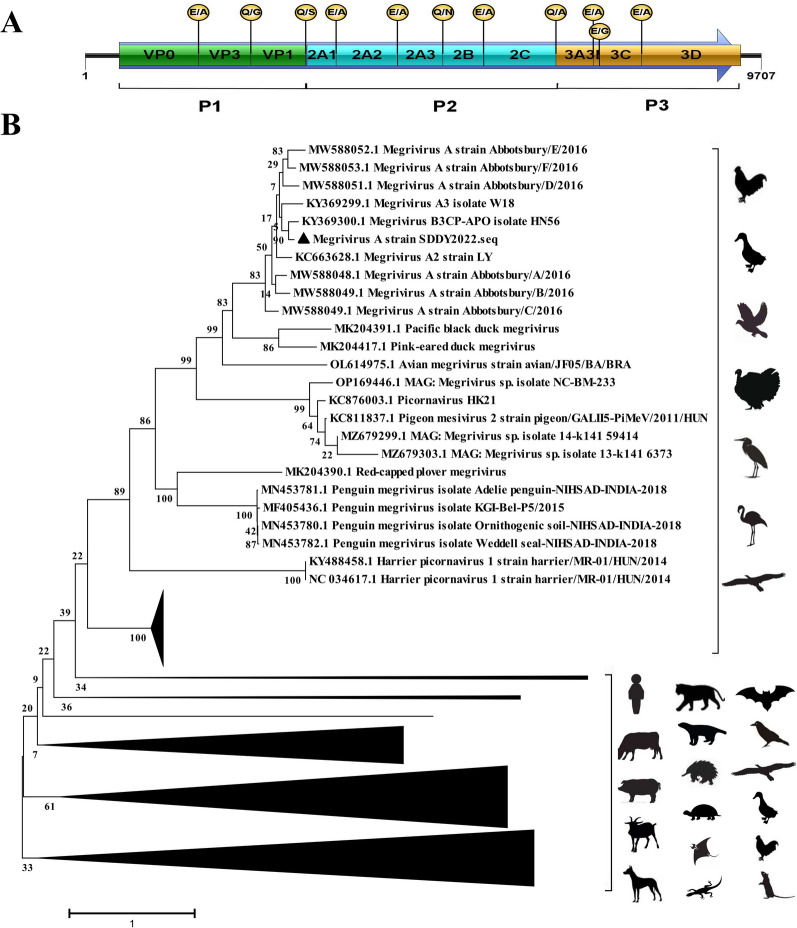
Genomic organization and phylogenetic analysis of the Megrivirus A of PicornaviridaeA Genomic organization of the Megrivirus A strain indicating open reading frames (ORFs). The predicated polypeptides were shown below the gene box and the the predicted cleavage sites are shown above the gene box. B Phylogenetic relationships of Megrivirus A with other viruses in the Picornaviridae family based on the complete genomes. Phylogenetic tree was constructed using the MEGA6 program using the Neighbouring method with a bootstrap of 1000 replicates. Virus identified in this study is denoted with a black filled triangle
Fig. 4
Fig. 4
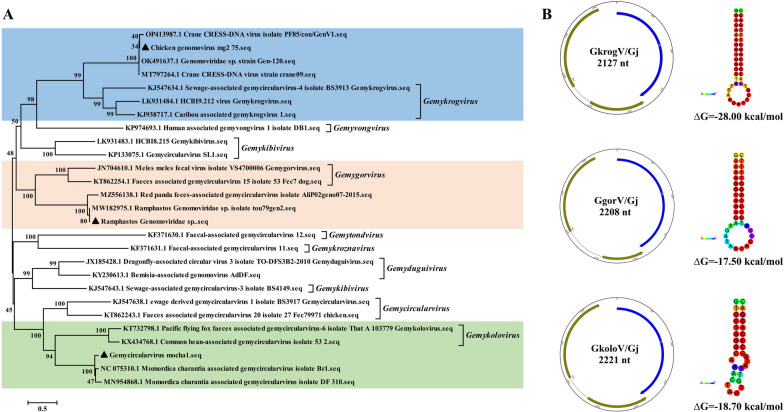
Phylogenetic analysis and genomic features of the identified three genomoviruses. A Phylogenetic relationships of the identified genomoviruses with other viruses of ten genera of the family Genomoviridae based on the complete genomes. Phylogenetic tree was constructed using the MEGA6 program using the Neighbouring method with a bootstrap of 1000 replicates. Viruses identified in this study are denoted with a black filled triangle. B Genomic organization indicating ORFs and stem-loop structures of the identified genomoviruses
Fig. 5
Fig. 5
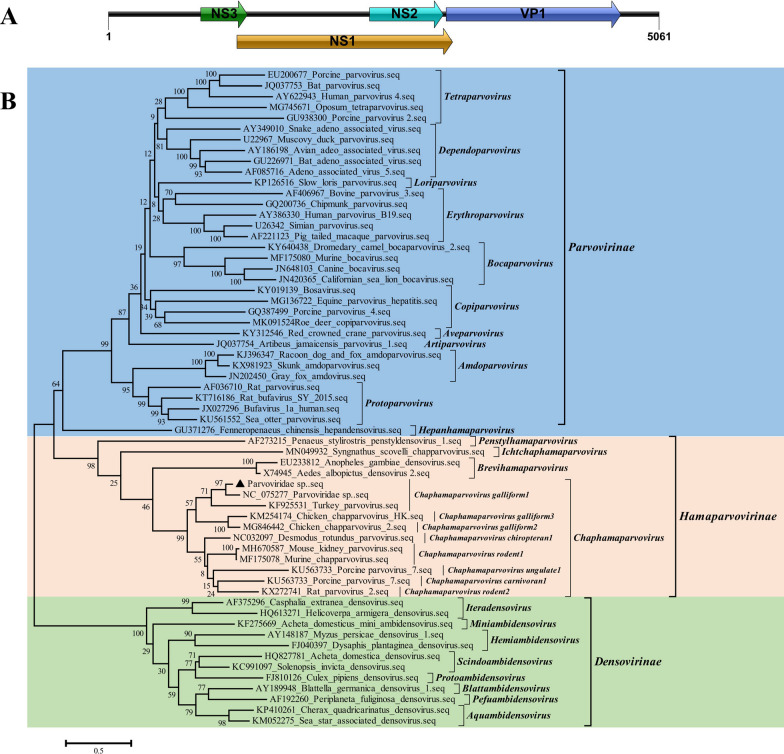
Genomic organization and phylogenetic analysis of the parvovirus. A Genomic organization of the identified parvovirus indicating ORFs. B Phylogenetic relationships of parvovirus with representative strains of the family Parvoviridae based on the complete sequence of NS1 gene. Phylogenetic tree was constructed using the MEGA6 program using the Neighbouring method with a bootstrap of 1000 replicates. Virus identified in this study is denoted with a black filled triangle

References

    1. Gao Z, Song H, Dong H, Ji X, Lei Z, Tian Y, Wu Y, Zou H. Comparative analysis of intestinal flora between rare wild red-crowned crane and white-naped crane. Front Microbiol. 2022;13:1007884. doi: 10.3389/fmicb.2022.1007884. - DOI - PMC - PubMed
    1. Zhou D, Wang Z, Gao J, Zhang H, Jiang M. Population size and distribution patterns of captive red-crowned cranes (Grus japonensis) in zoos in China. J Ecol Rural Environ. 2014;30(6):731–5.
    1. Fanke J, Wibbelt G, Krone O. Mortality factors and diseases in free-ranging Eurasian cranes (Grus grus) in Germany. J Wildl Dis. 2011;47(3):627–37. doi: 10.7589/0090-3558-47.3.627. - DOI - PubMed
    1. Harvey E, Holmes EC. Diversity and evolution of the animal virome. Nat Rev Microbiol. 2022;20(6):321–34. doi: 10.1038/s41579-021-00665-x. - DOI - PubMed
    1. Wang Y, Yang S, Liu D, Zhou C, Li W, Lin Y, Wang X, Shen Q, Wang H, Li C, et al. The fecal virome of red-crowned cranes. Arch Virol. 2019;164(1):3–16. doi: 10.1007/s00705-018-4037-x. - DOI - PMC - PubMed

LinkOut - more resources