. 2024;9(2):172-183.
doi: 10.1038/s41560-023-01421-6. Epub 2024 Jan 4.

Multifunctional sulfonium-based treatment for perovskite solar cells with less than 1% efficiency loss over 4,500-h operational stability tests

Affiliations

Multifunctional sulfonium-based treatment for perovskite solar cells with less than 1% efficiency loss over 4,500-h operational stability tests

Jiajia Suo et al. Nat Energy. 2024.

Abstract

The stabilization of grain boundaries and surfaces of the perovskite layer is critical to extend the durability of perovskite solar cells. Here we introduced a sulfonium-based molecule, dimethylphenethylsulfonium iodide (DMPESI), for the post-deposition treatment of formamidinium lead iodide perovskite films. The treated films show improved stability upon light soaking and remains in the black α phase after two years ageing under ambient condition without encapsulation. The DMPESI-treated perovskite solar cells show less than 1% performance loss after more than 4,500 h at maximum power point tracking, yielding a theoretical T80 of over nine years under continuous 1-sun illumination. The solar cells also display less than 5% power conversion efficiency drops under various ageing conditions, including 100 thermal cycles between 25 °C and 85 °C and an 1,050-h damp heat test.

Keywords: Energy; Solar cells.


Conflict of interest statement

Competing interestsS.D.S. is a co-founder of Swift Solar Inc. The remaining authors declare no competing interests.

Figures
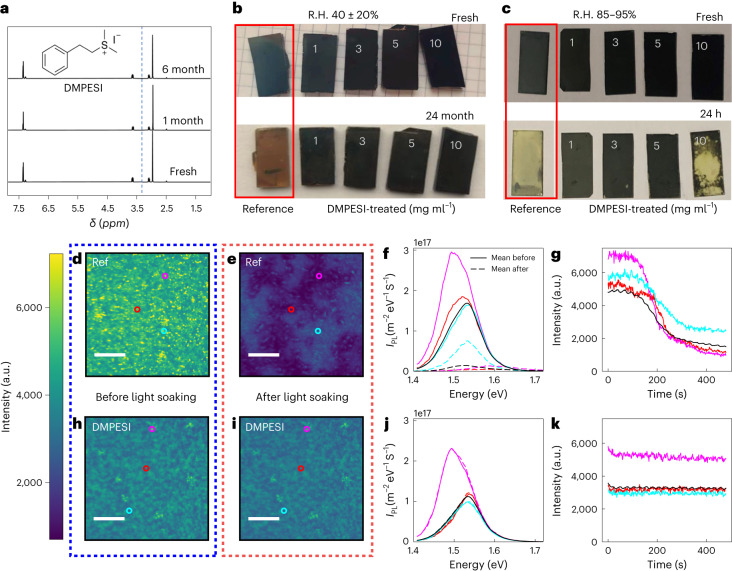
Fig. 1
Fig. 1. Stability of DMPESI molecule and treated perovskite films under moisture and light-soaking conditions.
a, 1H NMR spectra of DMPESI in anhydrous DMSO-d6 after six months of storage in ambient air. The H2O peak in DMSO-d6 is at 3.3 ppm (vertical dashed blue line): the signal is absent in the samples. The chemical structure of DMPESI is shown. b, Photographs of fresh and 24-month aged unencapsulated perovskite film (1.0 cm by 2.0 cm) without and with DMPESI treatment of different concentrations (from left to right: reference, 1 mg ml−1, 3 mg ml−1, 5 mg ml−1, 10 mg ml−1) in ambient air with R.H. 40 ± 20%. c, Photographs of fresh and 24 h aged unencapsulated perovskite film (1.0 cm by 2.0 cm) without and with DMPESI treatment of different concentrations (from left to right: reference, 1 mg ml−1, 3 mg ml−1, 5 mg ml−1, 10 mg ml−1) in high humid condition of R.H. 85∼95%. (d,e,h,i) Hyperspectral photoluminescence microscopy of FAPbI3 reference and DMPESI-treated films, scale bar = 15 μm. d,e, Photoluminescence (PL) map of reference FAPbI3 film before (d) and after (e) 10 minutes of light soaking in air at 1-sun illumination intensity with a 405 nm continuous wave laser. f, PL spectra before (solid lines) and after (dashed lines) light from the coloured points marked in panels d and e. The mean PL spectrum of the region is marked in black. IPL is PL intensity. g, Photoluminescence intensity changes with light soaking of the marked regions in d and the average of the image (black). h,i, Photoluminescence intensity map of DMPESI-treated film before (h) and after (i) 10 minutes of light soaking (1-sun equivalent). j, PL spectra before (solid lines) and after (dashed lines) light soaking of the marked regions in h and i. k, PL intensity changes with light soaking of the marked regions in h and the average of the image (black).
Fig. 2
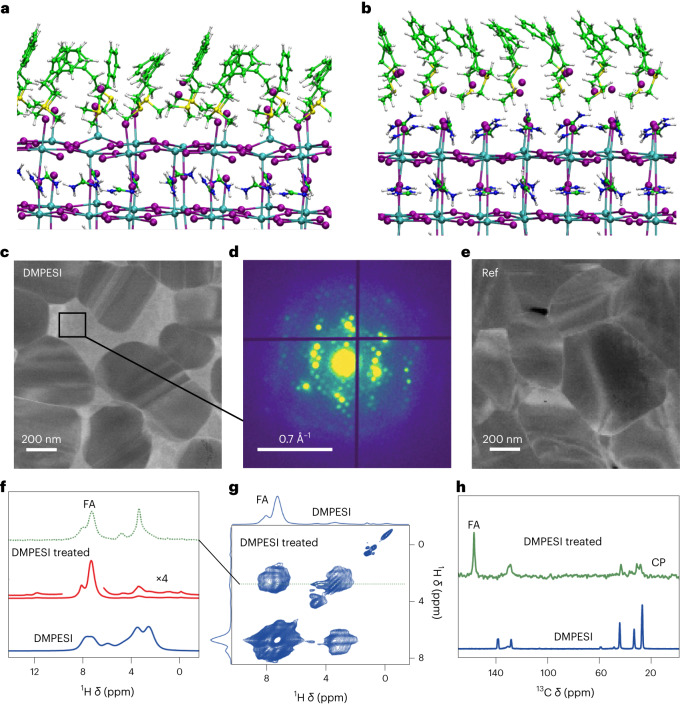
Fig. 2. Microstructure of the perovskite films and interactions between DMPESI and FAPbI3.
a,b, DMPESI/FAPbI3 perovskite full-coverage interface DFT models at PbI2- (a) and FAI-terminated (b) surfaces. The following colour code is used for the atomic representations: purple, I; cyan, Pb; blue, N; yellow, S; green, C; white, H. c, Annular dark-field image reconstructed from SED data of DMPESI-treated perovskite film. d, The ED patterns extracted from intragranular region are shown. e, Annular dark-field image reconstructed from SED data of reference film. Atomic-level interaction between FAPbI3 and DMPESI from solid-state NMR. f, Quantitative 1H MAS NMR spectra of DMPESI (blue) and DMPESI-treated FAPbI3 prepared as spin-coated thin films (red). g, 1H–1H spin-diffusion spectrum of DMPESI-treated FAPbI3 prepared as spin-coated thin films (50 kHz MAS, 23 T). The horizontal cross section at 3.4 ppm (dashed line) is shown in green. The spectrum of DMPESI is shown in green in panel f. h, 1H–13C cross polarization MAS spectra of DMPESI and DMPESI-treated FAPbI3 prepared as a drop-cast film. FA is formamidinium, CP is cross polarization, ×4 is 4 times intensity of the signal.
Fig. 3
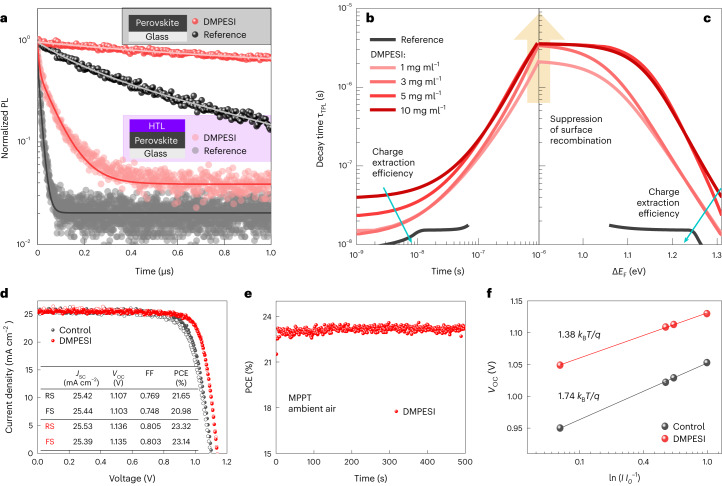
Fig. 3. Optoelectronic properties of perovskite films and photovoltaic devices performance.
a, Transient PL decays of reference and DMPESI-passivated (3 mg ml−1) perovskite films on glass with and without HTL. The fits are obtained from the multi-exponential decay function, which were used to calculate the differential lifetimes. The saturated coloured balls correspond to PL decays of perovskite on glass (shown in grey box) with (red) and without (black) DMPESI. The non-saturated coloured circles correspond to PL decays of perovskite on glass with an HTL on top (shown in lilac box). b,c, Differential decay time of passivated perovskite films with HTL plotted as a function of time after excitation (b) and quasi-Fermi level splitting (c). As the concentration of the DMPESI increases, the suppression of the surface recombination increases as well (up to 3 mg ml−1), but the charge extraction efficiency decreases. d, JV curves of the control (black) and (3 mg ml−1) DMPESI-treated (red) devices, reverse scan (RS) and forward scan (FS) are indicated as solid symbols and open symbols, respectively. Inserted table summarized the corresponding photovoltaic parameters. e, PCE of the device employing DMPESI (3 mg ml−1) treatment device at maximum power point as a function of time at room temperature (r.t.), under ambient condition, without encapsulation. f, VOC versus logarithm of light intensity of the solar cells with and without DMPESI treatment with corresponding linear fits, from which the slopes determined by the ideality factors (1.38 for DMPESI and 1.74 for control) were found. kB is the Boltzmann constant, T is the temperature and q is the elementary charge.
Fig. 4
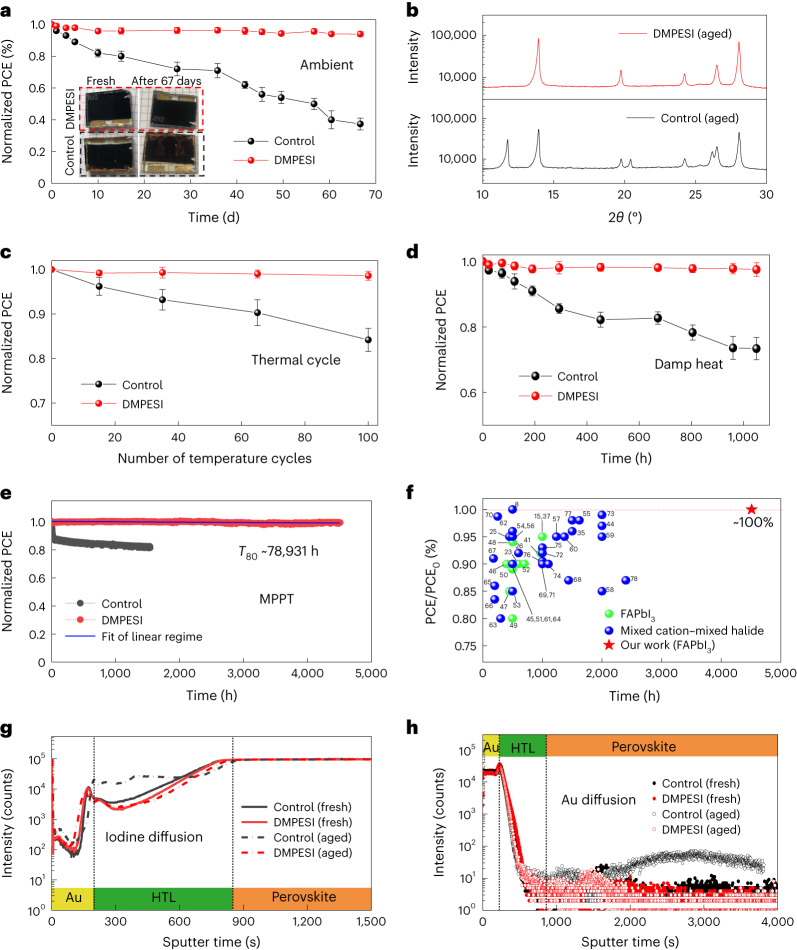
Fig. 4. Durability of the PSCs.
a, Dark shelf stability of unencapsulated control and DMPESI-treated PSCs and inserted photos are the devices before and after ageing in ambient condition at r.t. with R.H. around 20–40%, five devices for each condition, the initial device PCEs are 23.02 ± 0.26% (DMPESI treated) and 21.03 ± 0.48% (control). b, XRD patterns of shelf-aged control and DMPESI-treated PSCs. c, Temperature cycling (25–85 °C) test of encapsulated control and treated devices, five devices for each condition. d, Damp heat test (85 °C, 85% R.H.) of the encapsulated control and treated devices, five devices for each condition. The initial PCEs of temperature cycling and damp heat tested devices are 22.24 ± 0.22% (DMPESI treated) and 20.12 ± 0.42% (control). Data are presented as mean values ± SEM for a, c and d. e, Long-term operational stability of the unencapsulated control and treated devices under MPPT with continuous 1-sun illumination under N2 flow at room temperature. The linear fitting of DMPESI-treated device maximum power point stability, the initial device PCE is 22.68% (DMPESI treated) and 20.43% (control). f, Operational stability of state-of-the-art highly efficient (PCE > 22%) PSCs extracted from literature,,,,,,,,– (perovskite composition based on FAPbI3 marked in green dots; mixed cation–mixed halide marked in blue dots; our work marked in red star).ToF-SIMS depth profiles of the fresh and aged (control and treated) devices of g, I and h, Au. Source data

References

    1. Best Research-Cell Efficiency Chart (NREL, 2022); www.nrel.gov/pv/cell-efficiency.html
    1. Su H, et al. Stable perovskite solar cells with 23.12% efficiency and area over 1 cm2 by an all-in-one strategy. Sci. China Chem. 2022;65:1321–1329. doi: 10.1007/s11426-022-1244-y. - DOI
    1. Ding Y, et al. Single-crystalline TiO2 nanoparticles for stable and efficient perovskite modules. Nat. Nanotechnol. 2022;17:598–605. doi: 10.1038/s41565-022-01108-1. - DOI - PubMed
    1. Kim M, et al. Conformal quantum dot–SnO2 layers as electron transporters for efficient perovskite solar cells. Science. 2022;375:302–306. doi: 10.1126/science.abh1885. - DOI - PubMed
    1. Walker, E. and Thoubboron, K. Solar Panel Warranties: What to Know (Energysage, 2022); https://news.energysage.com/shopping-solar-panels-pay-attention-to-solar...