


Causal association between depression and intracranial aneurysms: a bidirectional two-sample Mendelian randomization study
- PMID: 38419712
- PMCID: PMC10899323
- DOI: 10.3389/fneur.2024.1346703
Causal association between depression and intracranial aneurysms: a bidirectional two-sample Mendelian randomization study
Abstract
Background: Although observational studies have suggested a bidirectional relation between depression and intracranial aneurysms (IAs), their causal relations remain unclear. Thus we aimed to assess the causal association between depression and IAs.
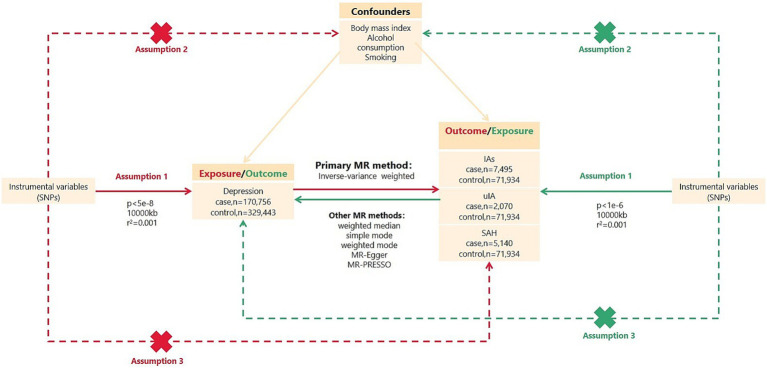
Methods: We conducted a bidirectional two-sample Mendelian randomization (MR) study using summary-level data from publicly available genome-wide association studies of depression (n = 500,199), IAs (n = 79,429), unruptured intracranial aneurysm (uIA) (n = 74,004), and subarachnoid hemorrhage (SAH) (n = 77,074). MR analyses included the inverse-variance weighted (IVW) method as the primary analytic, plus weighted-median, simple mode, weighted mode, MR-Egger, and MR PRESSO.
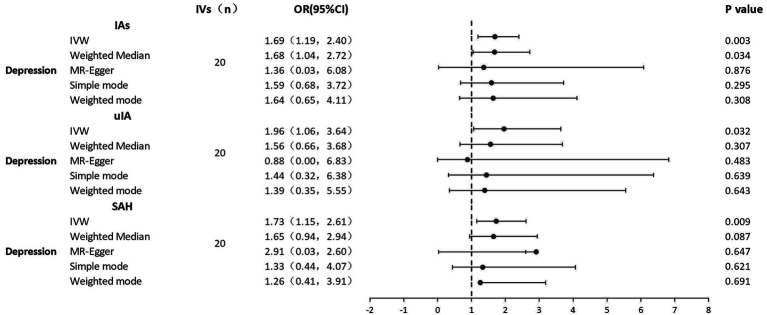
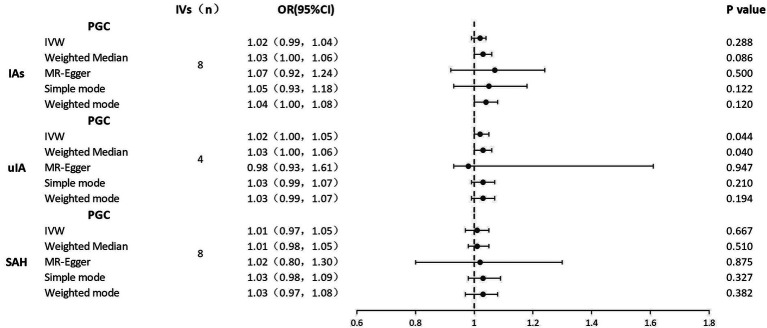
Results: Genetically predicted depression was strongly positively related to IAs (odds ratio [OR] = 1.69, 95% confidence interval [CI] 1.19-2.39, p = 0.003), uIA (OR = 1.96, 95% CI 1.06-3.64, p = 0.032), and SAH (OR = 1.73, 95% CI 1.14-2.61, p = 0.009). Reverse MR analyses showed that while genetically predicted uIA was positively related to depression (OR = 1.02, 95% CI 1.00-1.05, p = 0.044), no causal relations were observed for either IAs or SAH for depression.
Conclusion: Our findings provide evidence of a causal effect of depression on IAs, uIA, and SAH. For the reverse MR analyses, we found a causal impact of uIA on depression, but no causal influence of either IAs or SAH for depression.
Keywords: Mendelian randomization; causal association; depression; intracranial aneurysms; subarachnoid hemorrhage.
Copyright © 2024 Wu, Sun and Ma.
Conflict of interest statement
The authors declare that the research was conducted in the absence of any commercial or financial relationships that could be construed as a potential conflict of interest.
Figures
References
LinkOut - more resources
Full Text Sources
