


Pediatric obstructive sleep apnea diagnosis: leveraging machine learning with linear discriminant analysis
- PMID: 38419971
- PMCID: PMC10899433
- DOI: 10.3389/fped.2024.1328209
Pediatric obstructive sleep apnea diagnosis: leveraging machine learning with linear discriminant analysis
Abstract
Objective: The objective of this study was to investigate the effectiveness of a machine learning algorithm in diagnosing OSA in children based on clinical features that can be obtained in nonnocturnal and nonmedical environments.
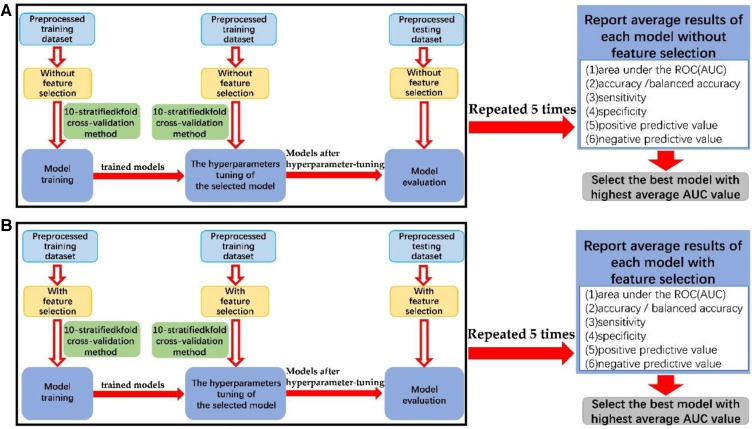
Patients and methods: This study was conducted at Beijing Children's Hospital from April 2018 to October 2019. The participants in this study were 2464 children aged 3-18 suspected of having OSA who underwent clinical data collection and polysomnography(PSG). Participants' data were randomly divided into a training set and a testing set at a ratio of 8:2. The elastic net algorithm was used for feature selection to simplify the model. Stratified 10-fold cross-validation was repeated five times to ensure the robustness of the results.
Results: Feature selection using Elastic Net resulted in 47 features for AHI ≥5 and 31 features for AHI ≥10 being retained. The machine learning model using these selected features achieved an average AUC of 0.73 for AHI ≥5 and 0.78 for AHI ≥10 when tested externally, outperforming models based on PSG questionnaire features. Linear Discriminant Analysis using the selected features identified OSA with a sensitivity of 44% and specificity of 90%, providing a feasible clinical alternative to PSG for stratifying OSA severity.
Conclusions: This study shows that a machine learning model based on children's clinical features effectively identifies OSA in children. Establishing a machine learning screening model based on the clinical features of the target population may be a feasible clinical alternative to nocturnal OSA sleep diagnosis.
Keywords: artificial intelligence; children; computer-aided diagnosis; machine learning; obstructive sleep apnea.
© 2024 Qin, Zhang, Li, Xu, Zhang, Wang, Zheng, Ji, Mei, Kong, Jia, Lei, Qi, Ji, Ni, Wang and Tai.
Conflict of interest statement
The authors declare that the research was conducted in the absence of any commercial or financial relationships that could be construed as a potential conflict of interest.
Figures
References
-
- Roche J, Isacco L, Masurier J, Pereira B, Mougin F, Chaput JP, et al. Are obstructive sleep apnea and sleep improved in response to multidisciplinary weight loss interventions in youth with obesity? A systematic review and meta-analysis. Int J Obes (Lond). (2020) 44:753–70. 10.1038/s41366-019-0497-7 - DOI - PubMed
LinkOut - more resources
Full Text Sources
Miscellaneous
