


The effect of repeated baking of porcelain on its bonding strength to a Co-Cr alloy 3D-printed by selective laser melting
- PMID: 38419985
- PMCID: PMC10897619
- DOI: 10.1016/j.sdentj.2023.11.002
The effect of repeated baking of porcelain on its bonding strength to a Co-Cr alloy 3D-printed by selective laser melting
Abstract
Objectives: This study aimed to evaluate the effect of multiple baking cycles of porcelain on its shear bond strength to a cobalt-chromium (Co-Cr) alloy that is three-dimensionally printed using Selective Laser Melting (SLM) technique.
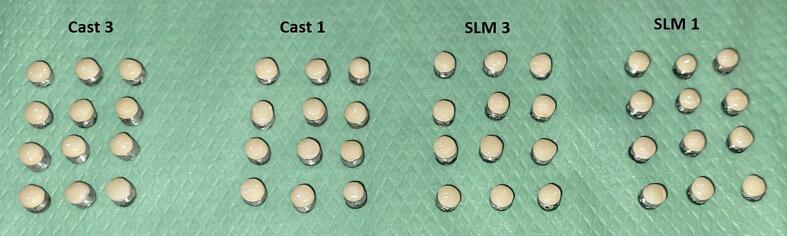
Materials and methods: The research sample comprised forty-eight discs measuring 5 mm × 3 mm, divided into four groups according to: the manufacturing method (SLM, casting) and the number of porcelain baking cycles (1, 3) as follows: Group A: Co-Cr alloy by SLM with one baking cycle; Group B: Co-Cr alloy by SLM with three baking cycles; Group C: Ni-Cr alloy by casting with one baking cycle; Group D: Ni-Cr alloy by casting with three baking cycles. Then, porcelain was melted on disks, shear testing was performed and the values of the Shear Bond Strength (SBS) in MegaPascals (MPa) were calculated.
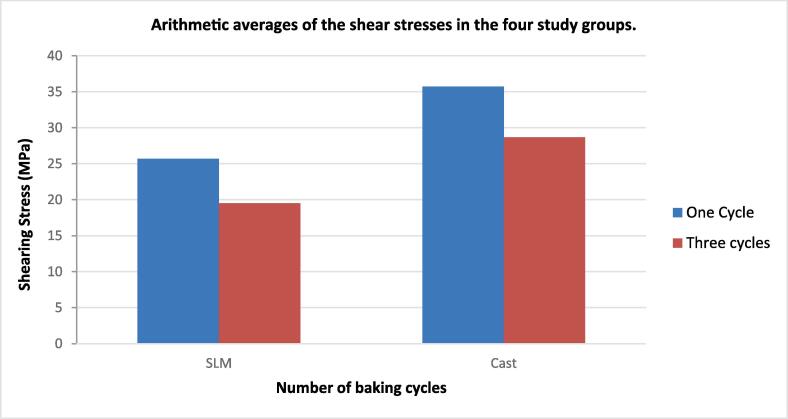
Results: The mean SBS values for each group were (A: 25.69 - B: 19.51 - C: 35.72 - D: 28.67 MPa). Statistical analysis showed that the manufacturing method and the number of porcelain baking cycles had a significant influence on shear bond durability (P > 0.05): the strength of this bond decreased when baking cycles increased. The Co-Cr samples manufactured by SLM also showed a decrease in binding strength compared to the Ni-Cr samples made by casting.
Conclusion: Repeated baking of porcelain reduces the strength of the porcelain bond with the Co-Cr alloy made by Selective Laser Melting (SLM) technique.
Keywords: Cobalt-Chromium (Co-Cr) alloy; Repeated porcelain baking; Selective Laser Melting (SLM).
© 2023 THE AUTHORS.
Conflict of interest statement
The authors declare that they have no known competing financial interests or personal relationships that could have appeared to influence the work reported in this paper.
Figures


References
-
- Alghazzawi T.F. Advancements in CAD/CAM technology: options for practical implementation. J. Prosthodont. Res. 2016;60:72–84. - PubMed
-
- Anwar M., Tripathi A., Kar S.K., Sekhar K.C. Effect of PFM firing cycles on the mechanical properties, phase composition, and microstructure of nickel-chromium alloy. J. Prosthodont. 2015;24:634–641. - PubMed
-
- Ashtiani A.H., Mardasi N., Fathi A. Effect of multiple firings on the shear bond strength of presintered cobalt-chromium alloy and veneering ceramic. J. Prosthet. Dent. 2021;126:803.e1–803.e6. - PubMed
-
- Bahri D., Sadrnezhaad S.K., Koosha S., Najmoddin N. Shear bond strength of porcelain veneering to nickel-chromium, chromium-cobalt, zirconia and lithium disilicate. J. Iran Dent. Assoc. 2020;32(1):12–20.
-
- Chen W.C., Teng F.Y., Hung C.C. Characterization of Ni-Cr alloys using different casting techniques and molds. Mater. Sci. Eng. C Mater. Biol. Appl. 2014;35:231–238. - PubMed
LinkOut - more resources
Full Text Sources
