Validity and reliability of the Questionnaire of Olfactory Disorders for Italian-speaking patients with olfactory dysfunction
- PMID: 38420720
- PMCID: PMC10914352
- DOI: 10.14639/0392-100X-N2736
Validity and reliability of the Questionnaire of Olfactory Disorders for Italian-speaking patients with olfactory dysfunction
Abstract
Objective: To translate and validate an Italian version of the Questionnaire of Olfactory Disorders (IT-QOD).
Materials and methods: This is a prospective, multicentre study that involved patients with olfactory dysfunction (OD). Both cases and controls underwent administration of the IT-QOD, Sino-Nasal Outcome Test-22 (SNOT-22) and psychophysical evaluation of orthonasal and retronasal olfactory function.
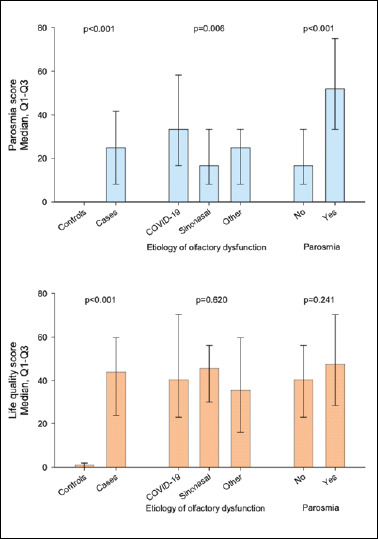
Results: The IT-QOD was administered to 96 patients and 38 controls. The Cronbach's alpha exceeded 0.90, indicating satisfactory internal consistency. The test-retest reliability was found to be high for both parosmia (rs = 0.944) and life quality (rs = 0.969). Patients with OD had significantly higher IT-QOD scores compared to healthy individuals (p < 0.001), indicating strong internal validity. The external validity was also satisfactory, as shown by the significant correlation with SNOT-22 (rs = -0.54) and the threshold, discrimination, and identification score (rs = -0.63).
Conclusions: The IT-QOD was demonstrated to be reliable and valid to assess the impact of OD on the quality of life of Italian-speaking patients.
Keywords: anosmia; maxillo-facial surgery; olfactory dysfunction; olfactory loss; otorhinolaryngology; parosmia; quality of life; rhinology.
Copyright © 2024 Società Italiana di Otorinolaringoiatria e Chirurgia Cervico-Facciale, Rome, Italy.
Conflict of interest statement
The authors declare no conflict of interest.
This research did not receive any specific grant from fund-ing agencies in the public, commercial, or not-for-profit sectors.
Figures
References
-
- Boesveldt S, Postma EM, Boak D, et al. Anosmia – a clinical review. Chem Senses 2017;42:513-523. https://doi.org/10.1093/chemse/bjx025 10.1093/chemse/bjx025 - DOI - PMC - PubMed
-
- Whitcroft KL, Altundag A, Balungwe P, et al. Position paper on olfactory dysfunction: 2023. Rhinology 2023. Jul 16 [Online ahead of print]. https://doi.org/10.4193/Rhin22.483 10.4193/Rhin22.483 - DOI - PubMed
-
- Vaira LA, Lechien JR, Deiana G, et al. Prevalence of olfactory dysfunction in D614G, alpha, delta and omicron waves: a psychophysical case-control study. Rhinology 2023;61:32-38. https://doi.org/10.4193/Rhin22.294 10.4193/Rhin22.294 - DOI - PubMed
-
- Boscolo-Rizzo P, Polesel J, Vaira LA. Smell and taste dysfunction after COVID-19. BMJ 2022;378:o1653. https://doi.org/10.1136/bmj.o1653 10.1136/bmj.o1653 - DOI - PubMed
-
- Croy I, Hummel T. Olfaction as a marker for depression. J Neurol 2017;264:631-638. https://doi.org/10.1007/s00415-016-8227-8 10.1007/s00415-016-8227-8 - DOI - PubMed
Publication types
MeSH terms
LinkOut - more resources
Full Text Sources
Medical