Identification of intratumor bacteria-associated prognostic risk score in adrenocortical carcinoma
- PMID: 38421176
- PMCID: PMC10986527
- DOI: 10.1128/spectrum.03727-23
Identification of intratumor bacteria-associated prognostic risk score in adrenocortical carcinoma
Abstract
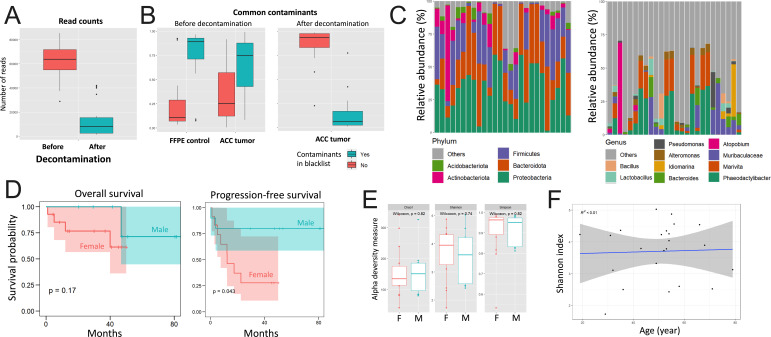
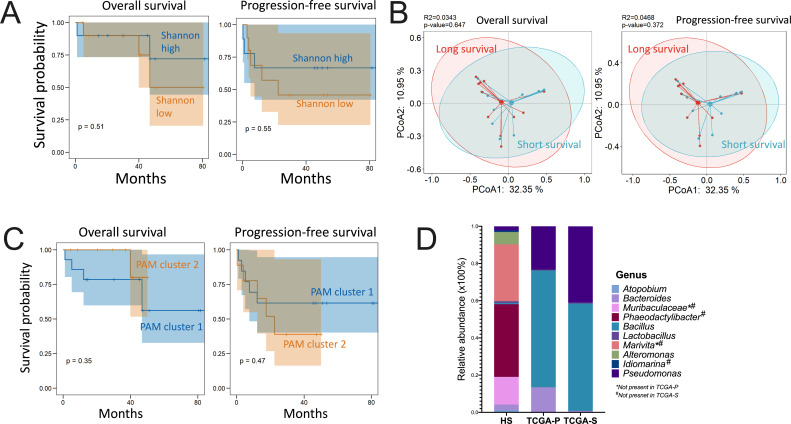
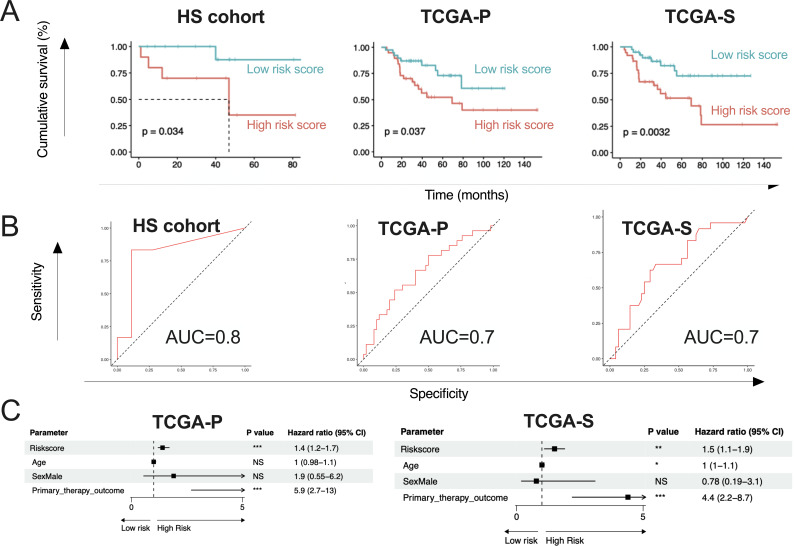
A landmark study by Poore et al. showed intratumor bacteria (ITBs) playing a critical role in most cancers by reproduction of The Cancer Genome Atlas (TCGA) transcriptome data. A recent study by Salzberg et al. argued that ITBs, being overstated as a methodology by Poore et al., were problematic. We previously reported that ITBs were prognostic in adrenocortical carcinoma (ACC), a highly aggressive rare disease using data by Poore et al., and here, we aimed to answer whether ITBs truly existed and were prognostic in ACC. ACC samples from our institutes underwent 16S rRNA sequencing [adrenocortical carcinoma blocks from Huashan Hospital and China Medical University (HS) cohort]. The ITB profile was compared to TCGA data processed by Poore et al. (TCGA-P) and TCGA data processed by Salzberg et al. (TCGA-S), respectively. The primary outcome was overall survival (OS). A total of 26 ACC cases (HS cohort) and 10 paraffin controls were sequenced. The TCGA cohort encompassed 77 cases. Two and four amid the top 10 abundant genera in HS cohort were not detected in TCGA-P and TCGA-S, respectively. Neither was alpha or beta diversity associated with survival nor could ACC be subtyped by ITB signature in the HS cohort. Notably, a five-genera ITB risk score (Corynebacterium, Mycoplasma, Achromobacter, Anaerococcus, and Streptococcus) for OS trained in the HS cohort was validated in both TCGA-P and TCGA-S cohorts and was independently prognostic. Whereas ITB signature on the whole may not be associated with ACC subtypes, certain ITB features are associated with prognosis, and a risk score could be generated and validated externally.
Importance: In this report, we looked at the role of ITBs in ACC in patients with different race and sequencing platforms. We found a five-genera ITB risk score consistently predicted overall survival in all cohorts. We conclude that certain ITB features are universally pathogenic to ACC.
Keywords: adrenocortical carcinoma; intratumor bacteria; prognosis.
Conflict of interest statement
The authors declare no conflict of interest.
Figures
Similar articles
-
Development and Validation of an m6A RNA Methylation Regulators-Based Signature for Predicting the Prognosis of Adrenocortical Carcinoma.Front Endocrinol (Lausanne). 2021 Feb 22;12:568397. doi: 10.3389/fendo.2021.568397. eCollection 2021. Front Endocrinol (Lausanne). 2021. PMID: 33692753 Free PMC article.
-
Bioinformatic analyses and experimental validation of the role of m6A RNA methylation regulators in progression and prognosis of adrenocortical carcinoma.Aging (Albany NY). 2021 Apr 21;13(8):11919-11941. doi: 10.18632/aging.202896. Epub 2021 Apr 21. Aging (Albany NY). 2021. PMID: 33952721 Free PMC article.
-
Prognosis and Therapeutic Efficacy Prediction of Adrenocortical Carcinoma Based on a Necroptosis-Associated Gene Signature.Biomed Res Int. 2022 May 19;2022:8740408. doi: 10.1155/2022/8740408. eCollection 2022. Biomed Res Int. 2022. Retraction in: Biomed Res Int. 2024 Mar 20;2024:9850107. doi: 10.1155/2024/9850107. PMID: 35647181 Free PMC article. Retracted.
-
Genomic and expression profiling of adrenocortical carcinoma: application to diagnosis, prognosis and treatment.Future Oncol. 2009 Jun;5(5):641-55. doi: 10.2217/fon.09.45. Future Oncol. 2009. PMID: 19519204 Review.
-
Adrenocortical carcinoma: the dawn of a new era of genomic and molecular biology analysis.J Endocrinol Invest. 2018 May;41(5):499-507. doi: 10.1007/s40618-017-0775-y. Epub 2017 Oct 28. J Endocrinol Invest. 2018. PMID: 29080966 Review.
References
-
- Poore GD, Kopylova E, Zhu Q, Carpenter C, Fraraccio S, Wandro S, Kosciolek T, Janssen S, Metcalf J, Song SJ, Kanbar J, Miller-Montgomery S, Heaton R, Mckay R, Patel SP, Swafford AD, Knight R. 2020. Microbiome analyses of blood and tissues suggest cancer diagnostic approach. Nature 579:567–574. doi:10.1038/s41586-020-2095-1 - DOI - PMC - PubMed
-
- Oosterlinck B, Ceuleers H, Arras W, De Man JG, Geboes K, De Schepper H, Peeters M, Lebeer S, Skieceviciene J, Hold GL, Kupcinskas J, Link A, De Winter BY, Smet A. 2023. Mucin-microbiome signatures shape the tumor microenvironment in gastric cancer. Microbiome 11:86. doi:10.1186/s40168-023-01534-w - DOI - PMC - PubMed
-
- Mouradov D, Greenfield P, Li S, In E-J, Storey C, Sakthianandeswaren A, Georgeson P, Buchanan DD, Ward RL, Hawkins NJ, Skinner I, Jones IT, Gibbs P, Ma C, Liew YJ, Fung KYC, Sieber OM. 2023. Oncomicrobial community profiling identifies clinicomolecular and prognostic subtypes of colorectal cancer. Gastroenterology 165:104–120. doi:10.1053/j.gastro.2023.03.205 - DOI - PubMed
MeSH terms
Substances
Grants and funding
LinkOut - more resources
Full Text Sources