


Privacy-Preserving Breast Cancer Classification: A Federated Transfer Learning Approach
- PMID: 38424280
- PMCID: PMC11300768
- DOI: 10.1007/s10278-024-01035-8
Privacy-Preserving Breast Cancer Classification: A Federated Transfer Learning Approach
Abstract
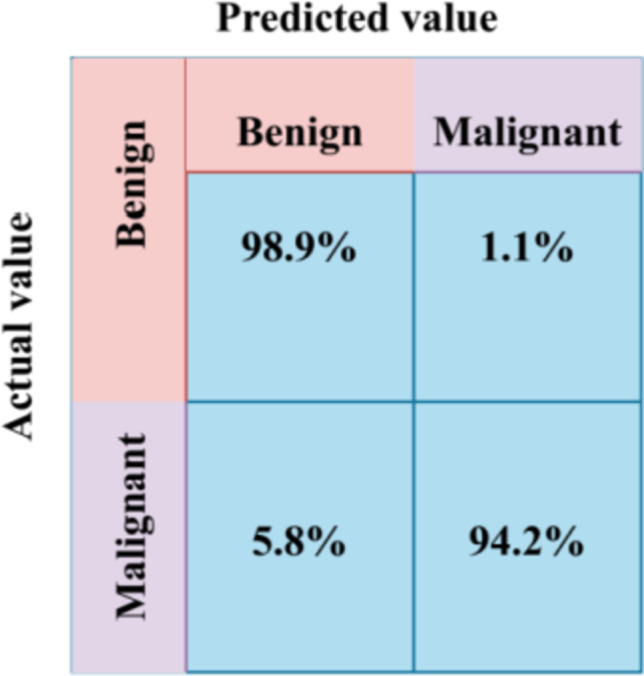
Breast cancer is deadly cancer causing a considerable number of fatalities among women in worldwide. To enhance patient outcomes as well as survival rates, early and accurate detection is crucial. Machine learning techniques, particularly deep learning, have demonstrated impressive success in various image recognition tasks, including breast cancer classification. However, the reliance on large labeled datasets poses challenges in the medical domain due to privacy issues and data silos. This study proposes a novel transfer learning approach integrated into a federated learning framework to solve the limitations of limited labeled data and data privacy in collaborative healthcare settings. For breast cancer classification, the mammography and MRO images were gathered from three different medical centers. Federated learning, an emerging privacy-preserving paradigm, empowers multiple medical institutions to jointly train the global model while maintaining data decentralization. Our proposed methodology capitalizes on the power of pre-trained ResNet, a deep neural network architecture, as a feature extractor. By fine-tuning the higher layers of ResNet using breast cancer datasets from diverse medical centers, we enable the model to learn specialized features relevant to different domains while leveraging the comprehensive image representations acquired from large-scale datasets like ImageNet. To overcome domain shift challenges caused by variations in data distributions across medical centers, we introduce domain adversarial training. The model learns to minimize the domain discrepancy while maximizing classification accuracy, facilitating the acquisition of domain-invariant features. We conducted extensive experiments on diverse breast cancer datasets obtained from multiple medical centers. Comparative analysis was performed to evaluate the proposed approach against traditional standalone training and federated learning without domain adaptation. When compared with traditional models, our proposed model showed a classification accuracy of 98.8% and a computational time of 12.22 s. The results showcase promising enhancements in classification accuracy and model generalization, underscoring the potential of our method in improving breast cancer classification performance while upholding data privacy in a federated healthcare environment.
Keywords: Breast cancer; Classification; Data privacy; Deep learning; Domain adaptation; Federated learning; Medical imaging; Privacy-preserving; ResNet; Transfer learning.
© 2024. The Author(s) under exclusive licence to Society for Imaging Informatics in Medicine.
Conflict of interest statement
The authors declare no competing interests.
Figures




References
-
- Wang X, Ahmad I, Javeed D, Zaidi SA, Alotaibi FM, Ghoneim ME, Daradkeh YI, Asghar J, Eldin ET: Intelligent Hybrid Deep Learning Model for Breast Cancer Detection. Electronics 11(17):27–67, 2022. 10.3390/electronics11172767 - DOI
-
- Saber A, Sakr M, Abo-Seida OM, Keshk A, Chen H: A novel deep-learning model for automatic detection and classification of breast cancer using the transfer–learning technique. IEEE Access 9:71194–71209, 2021. 10.1109/ACCESS.2021.3079204 - DOI
-
- Egwom OJ, Hassan M, Tanimu JJ, Hamada M, Ogar OM: An LDA–SVM machine learning model for breast cancer classification. BioMedInformatics 2(3):345–358, 2022. 10.3390/biomedinformatics2030022 - DOI
-
- Hirra I, Ahmad M, Hussain A, Ashraf MU, Saeed IA, Qadri SF, Alghamdi AM, Alfakeeh AS: Breast cancer classification from histopathological images using patch-based deep learning modeling. IEEE Access 9:24273–24287, 2021. 10.1109/ACCESS.2021.3056516 - DOI
MeSH terms
LinkOut - more resources
Full Text Sources
Medical