


Endovascular coiling versus neurosurgical clipping in the management of aneurysmal subarachnoid haemorrhage in the elderly: a multicenter cohort study
- PMID: 38427140
- PMCID: PMC10907408
- DOI: 10.1007/s10143-024-02325-z
Endovascular coiling versus neurosurgical clipping in the management of aneurysmal subarachnoid haemorrhage in the elderly: a multicenter cohort study
Abstract
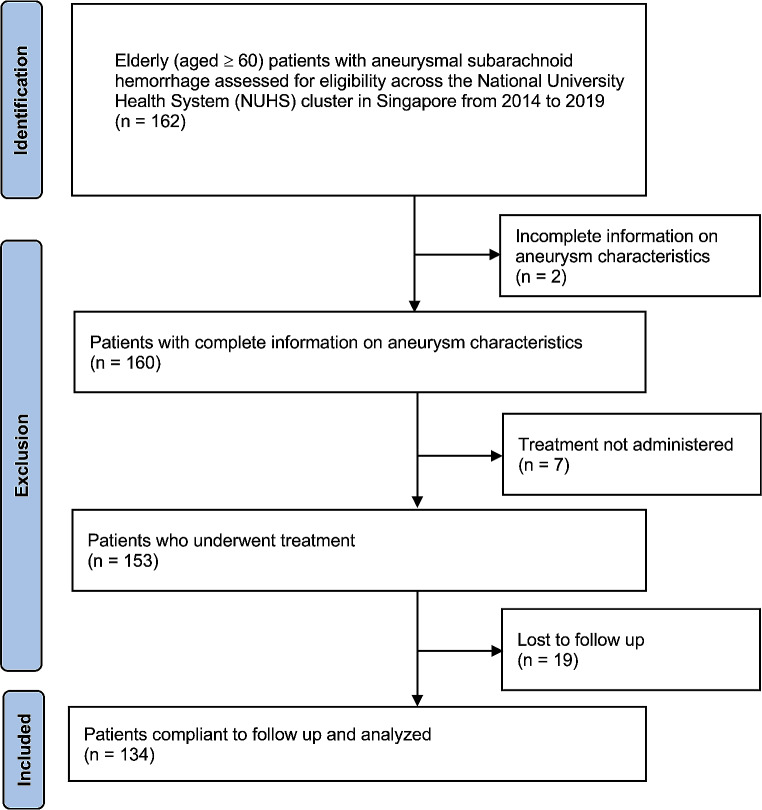
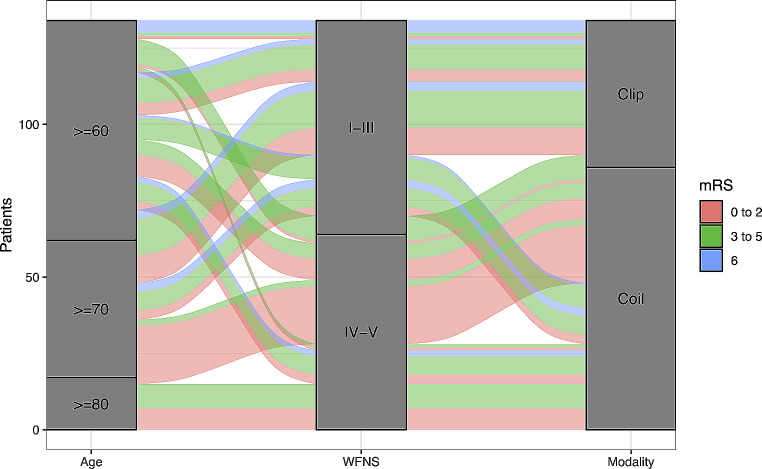
The comparability of endovascular coiling over neurosurgical clipping has not been firmly established in elderly patients with aneurysmal subarachnoid haemorrhage (aSAH). Data were obtained from all patients with aSAH aged ≥60 across three tertiary hospitals in Singapore from 2014 to 2019. Outcome measures included modified Rankin Scale (mRS) score at 3 and at 6 months, and in-hospital mortality. Of the 134 patients analyzed, 84 (62.7%) underwent coiling and 50 (37.3%) underwent clipping. The endovascular group showed a higher incidence of good mRS score 0-2 at 3 months (OR = 2.45 [95%CI:1.16-5.20];p = 0.018), and a lower incidence of in-hospital mortality (OR = 0.31 [95%CI:0.10-0.91];p = 0.026). There were no significant difference between the two treatment groups in terms of good mRS score at 6 months (OR = 1.98 [95%CI:0.97-4.04];p = 0.060). There were no significant differences in the incidence of complications, such as aneurysm rebleed, delayed hydrocephalus, delayed ischemic neurological deficit and venous thromboembolism between the two treatment groups. However, fewer patients in the coiling group developed large infarcts requiring decompressive craniectomy (OR = 0.32 [95%CI:0.12-0.90];p = 0.025). Age, admission WFNS score I-III, and coiling were independent predictors of good functional outcomes at 3 months. Only age and admission WFNS score I-III remained significant predictors of good functional outcomes at 6 months. Endovascular coiling, compared with neurosurgical clipping, is associated with significantly better short term outcomes in carefully selected elderly patients with aSAH. Maximal intervention is recommended for aSAH in the young elderly age group and those with favorable WFNS scores.
Keywords: Aneurysm; Clipping; Cohort study; Elderly; Endovascular; Geriatric; Subarachnoid hemorrhage.
© 2024. The Author(s).
Conflict of interest statement
The authors report no conflict of interest.
Figures
References
-
- Ryttlefors M et al (2010) Neurointensive care is justified in elderly patients with severe subarachnoid hemorrhage–an outcome and secondary insults study. Acta Neurochir (Wien), 152(2): p. 241-9; discussion 249 - PubMed
Publication types
MeSH terms
LinkOut - more resources
Full Text Sources
Medical
