Validation of a sleep staging classification model for healthy adults based on two combinations of a single-channel EEG headband and wrist actigraphy
- PMID: 38427322
- PMCID: PMC11145037
- DOI: 10.5664/jcsm.11082
Validation of a sleep staging classification model for healthy adults based on two combinations of a single-channel EEG headband and wrist actigraphy
Abstract
Study objectives: The aim of this study was to develop a sleep staging classification model capable of accurately performing on different wearable devices.
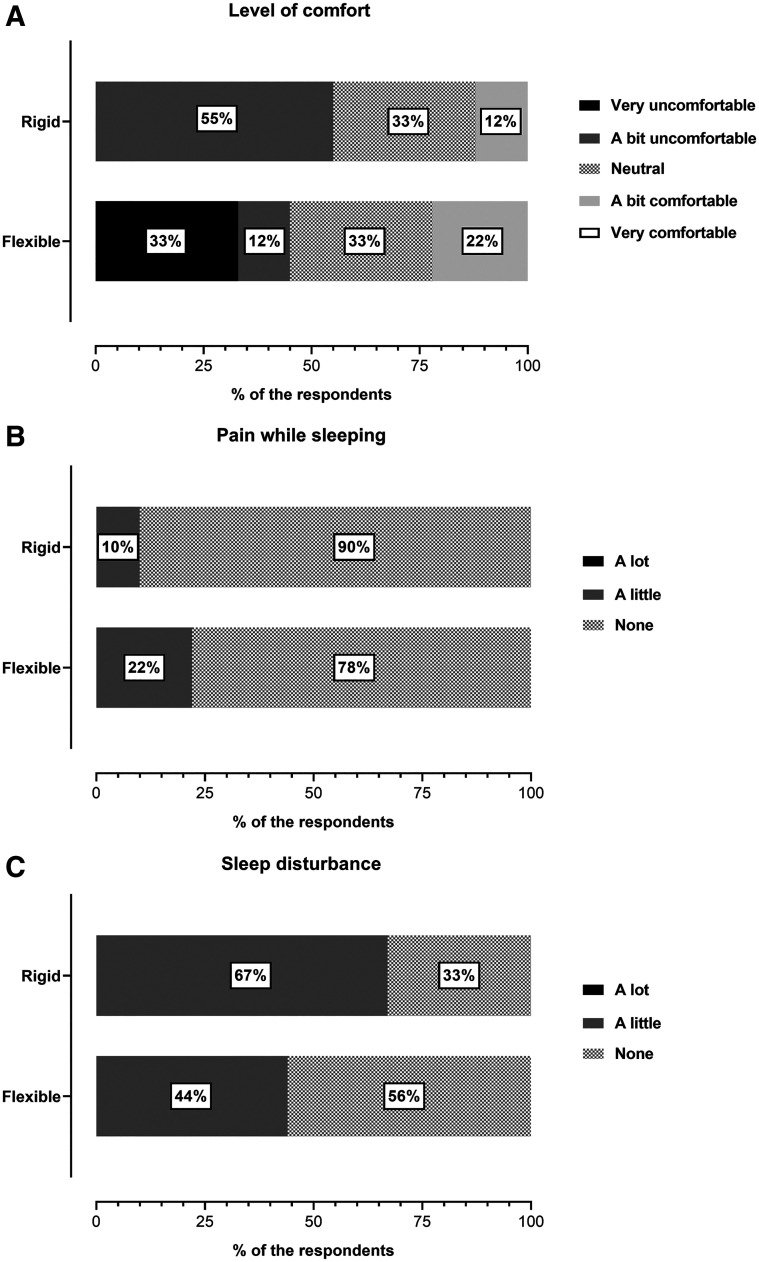
Methods: Twenty-three healthy participants underwent a full-night type I polysomnography and used two device combinations: (A) flexible single-channel electroencephalogram (EEG) headband + actigraphy (n = 12) and (B) rigid single-channel EEG headband + actigraphy (n = 11). The signals were segmented into 30-second epochs according to polysomnographic stages (scored by a board-certified sleep technologist; model ground truth) and 18 frequency and time features were extracted. The model consisted of an ensemble of bagged decision trees. Bagging refers to bootstrap aggregation to reduce overfitting and improve generalization. To evaluate the model, a training dataset under 5-fold cross-validation and an 80-20% dataset split was used. The headbands were also evaluated without the actigraphy feature. Participants also completed a usability evaluation (comfort, pain while sleeping, and sleep disturbance).
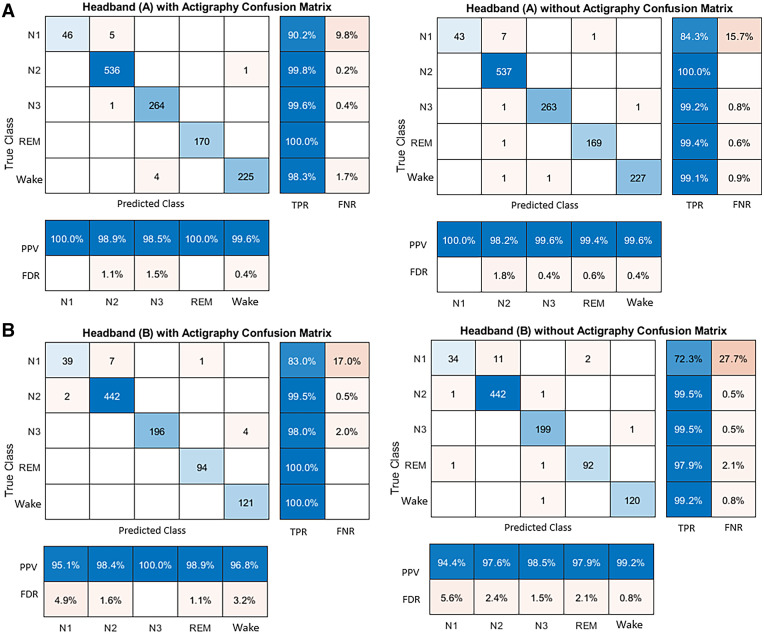
Results: Combination A had an F1-score of 98.4% and the flexible headband alone of 97.7% (error rate for N1: combination A = 9.8%; flexible headband alone = 15.7%). Combination B had an F1-score of 96.9% and the rigid headband alone of 95.3% (error rate for N1: combination B = 17.0%; rigid headband alone = 27.7%); in both, N1 was more confounded with N2.
Conclusions: We developed an accurate sleep classification model based on a single-channel EEG device, and actigraphy was not an important feature of the model. Both headbands were found to be useful, with the rigid one being more disruptive to sleep. Future research can improve our results by applying the developed model in a population with sleep disorders.
Clinical trial registration: Registry: ClinicalTrials.gov; Name: Actigraphy, Wearable EEG Band and Smartphone for Sleep Staging; URL: https://clinicaltrials.gov/study/NCT04943562; Identifier: NCT04943562.
Citation: Melo MC, Vallim JRS, Garbuio S, et al. Validation of a sleep staging classification model for healthy adults based on 2 combinations of a single-channel EEG headband and wrist actigraphy. J Clin Sleep Med. 2024;20(6):983-990.
Keywords: electroencephalogram; polysomnography; sleep tracking; sleep wearables.
© 2024 American Academy of Sleep Medicine.
Conflict of interest statement
All authors have seen and approved the manuscript. Work for this study was performed at SleepUp Tecnologia em Saúde Ltda. This study was funded by Fundação de Amparo à Pesquisa do Estado de São Paulo (FAPESP) no. 2020/00666-2. G.N.P., R.R.B., and K.M.M.S. are shareholders; M.C.M. and J.R.d.S.V. are researchers; and L.A.S. and S.G. are advisors at SleepUp.
Figures
References
-
- Troester MM , Quan SF , Berry RB , et al; for the American Academy of Sleep Medicine. The AASM Manual for the Scoring of Sleep and Associated Events: Rules, Terminology and Technical Specifications. Version 3. Darien, IL: : American Academy of Sleep Medicine; ; 2023. .
-
- Pires GN , Arnardóttir ES , Islind AS , Leppänen T , McNicholas WT . Consumer sleep technology for the screening of obstructive sleep apnea and snoring: current status and a protocol for a systematic review and meta-analysis of diagnostic test accuracy . J Sleep Res. 2023. ; 32 ( 4 ): e13819 . - PubMed
-
- Vaughn BV , Giallanza P . Technical review of polysomnography . Chest. 2008. ; 134 ( 6 ): 1310 – 1319 . - PubMed
Publication types
MeSH terms
Associated data
LinkOut - more resources
Full Text Sources
Medical