


12-week Dolutegravir treatment marginally reduces energy expenditure but does not increase body weight or alter vascular function in a murine model of Human Immunodeficiency Virus infection
- PMID: 38428626
- PMCID: PMC11189738
- DOI: 10.1016/j.vph.2024.107288
12-week Dolutegravir treatment marginally reduces energy expenditure but does not increase body weight or alter vascular function in a murine model of Human Immunodeficiency Virus infection
Abstract
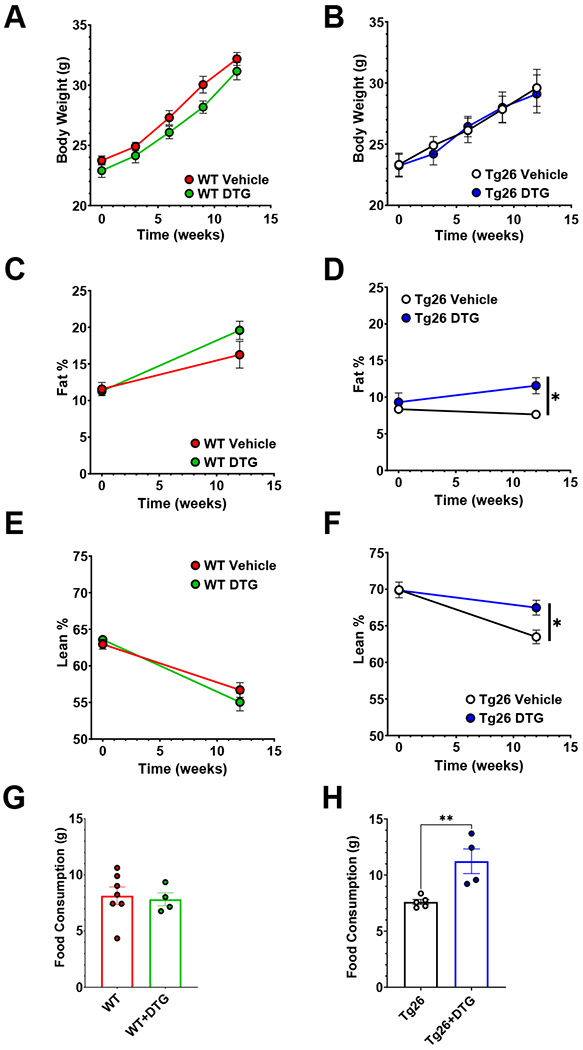
Combination antiretroviral therapy (cART) has markedly increased life expectancy in people with HIV (PWH) but has also resulted in an increased prevalence of cardiometabolic disorders, whose etiopathology remains ill-defined. Notably, the respective contribution of cART and HIV-derived proteins to obesity and vascular alterations remain poorly understood. Therefore, we investigated the individual and combined effects of HIV-proteins and of the integrase strand transfer inhibitor Dolutegravir (DTG) on body composition and vascular reactivity. Male wildtype (WT) and HIV transgenic (Tg26) mice, received DTG or vehicle for 12 weeks. Viral proteins expression in Tg26 mice lowered fat mass, increased heat production, and induced a 2-fold increase in brown adipose tissue (BAT) uncoupling protein 1 (UCP1) expression. DTG increased the expression of markers of adipogenesis in adipocytes in culture, but also reduced heat production and BAT UCP1 and UCP3 expression in Tg26 mice. DTG increased food intake, fat percentage and protected from lean mass reduction in Tg26 mice only. However, DTG did not increase body weight in either WT or Tg26 mice. Viral protein expression reduced acetylcholine (endothelium)-mediated relaxation by 14% in mesenteric arteries preconstricted with phenylephrine. However, DTG did not impair nor improve endothelium-dependent relaxation. Together, these data indicate that DTG's effects on food intake, adipogenesis and energy expenditure are insufficient to increase body weight, even in the presence of HIV-proteins, suggesting that body weight gain in PWH involves additional factors likely including other cART components and pre-existing comorbidities. Moreover, these data rule out DTG as a source of vascular disorders in PWH.
Keywords: Combination antiretroviral therapy; Endothelial function; HIV; Integrase inhibitor; Obesity.
Copyright © 2023. Published by Elsevier Inc.
Conflict of interest statement
Declaration of competing interest The authors declare the following financial interests/personal relationships which may be considered as potential competing interests: Eric Belin de Chantemele reports financial support was provided by National Heart Lung and Blood Institute. Eric Belin de Chantemele reports financial support was provided by American Heart Association Inc. Taylor Kress reports financial support was provided by American Heart Association Inc. If there are other authors, they declare that they have no known competing financial interests or personal relationships that could have appeared to influence the work reported in this paper.
Figures


References
-
- Trickey A, Sabin CA, Burkholder G, Crane H, d’Arminio Monforte A, Egger M, Gill MJ, Grabar S, Guest JL, Jarrin I, Lampe FC, Obel N, Reyes JM, Stephan C, Sterling TR, Teira R, Touloumi G, Wasmuth JC, Wit F, Wittkop L, Zangerle R, Silverberg MJ, Justice A, Sterne JAC, Life expectancy after 2015 of adults with HIV on long-term antiretroviral therapy in Europe and North America: a collaborative analysis of cohort studies, Lancet HIV 10(5) (2023) e295–e307. - PMC - PubMed
-
- Vachiat A, McCutcheon K, Tsabedze N, Zachariah D, Manga P, HIV and Ischemic Heart Disease, Journal of the American College of Cardiology 69(1) (2017) 73–82. - PubMed
Publication types
MeSH terms
Substances
Grants and funding
LinkOut - more resources
Full Text Sources
Medical
Research Materials
