


Soleus arthrogenic muscle inhibition following acute lateral ankle sprain correlates with symptoms and ankle disability but not with postural control
- PMID: 38428732
- PMCID: PMC11184308
- DOI: 10.1016/j.jshs.2024.02.005
Soleus arthrogenic muscle inhibition following acute lateral ankle sprain correlates with symptoms and ankle disability but not with postural control
Abstract
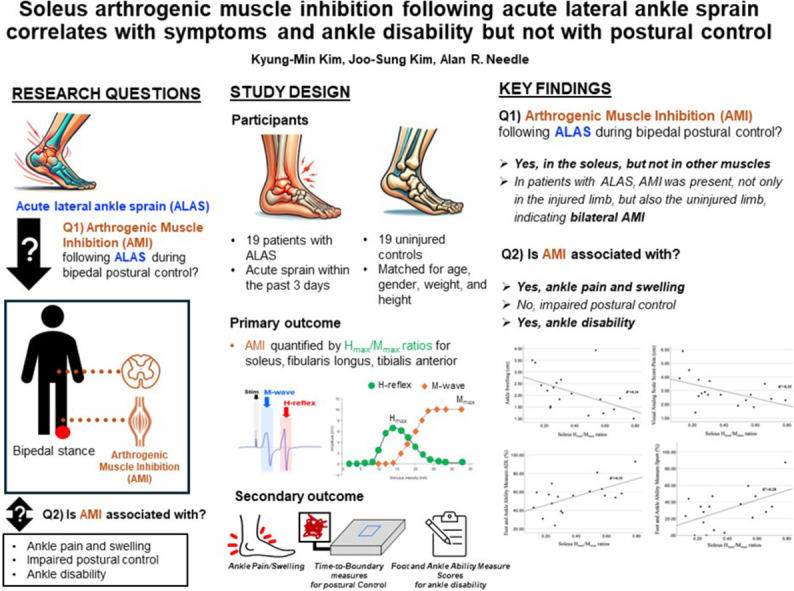
Background: Acute lateral ankle sprains (ALAS) are associated with long-term impairments and instability tied to altered neural excitability. Arthrogenic muscle inhibition (AMI) has been observed in this population; however, relationships with injury-related impairments are unclear, potentially due to the resting, prone position in which AMI is typically measured. Assessing AMI during bipedal stance may provide a better understanding of this relationship.
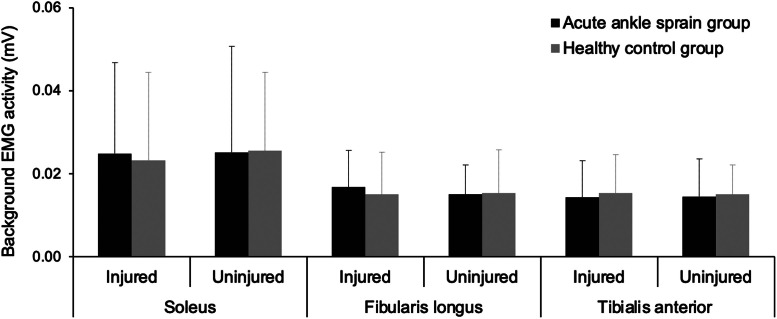
Methods: AMI was assessed in 38 young adults (19 ALAS within 72 h of injury: 10 males, 21.4 ± 2.7 years; 19 healthy controls: 10 males, 21.9 ± 2.2 years; mean ± SD) using the Hoffmann reflex (H-reflex) during bipedal stance. Electrical stimulation was administered to identify the maximal H-reflex (Hmax) and maximal motor response (Mmax) from the soleus, fibularis longus, and tibialis anterior muscles. The primary outcome measure was the Hmax/Mmax ratio. Secondary outcomes included acute symptoms (pain and swelling), postural control during bipedal stance, and self-reported function.
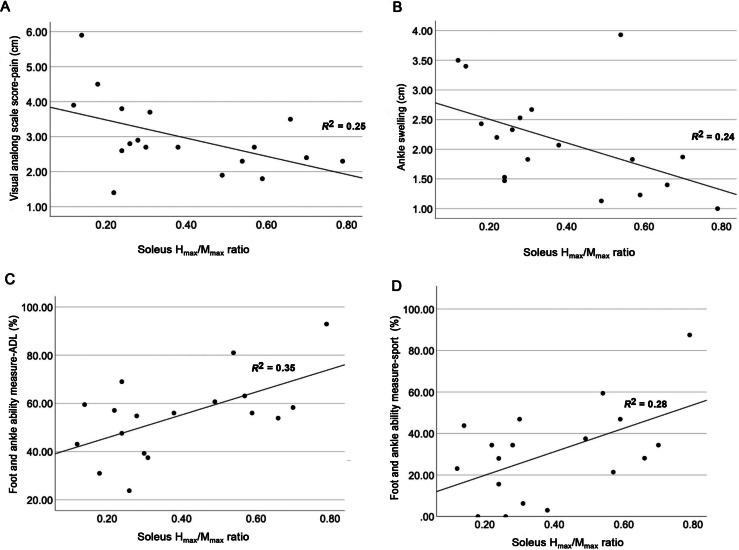
Results: No significant group-by-limb interactions were observed for any muscle. However, a significant group main effect was observed in the soleus muscle (F(1,35) = 6.82, p = 0.013), indicating significantly lower Hmax/Mmax ratios following ALAS (0.38 ± 0.20) compared to healthy controls (0.53 ± 0.16). Furthermore, lower Hmax/Mmax ratios in the soleus significantly correlated with acute symptoms and self-reported function but not with postural control.
Conclusion: This study supports previous evidence of AMI in patients with ALAS, providing insight into neurophysiologic impacts of musculoskeletal injury. Our results suggest that assessing AMI in a standing position following acute injury may provide valuable insight into how AMI develops and guide potential therapeutic options to curb and offset the formation of joint instability.
Keywords: Acute injuries; Balance; Hoffmann reflex; Neural excitability; Patient-reported outcomes.
Copyright © 2024. Production and hosting by Elsevier B.V.
Conflict of interest statement
The authors declare that they have no competing interests.
Figures
References
-
- Gribble PA, Bleakley CM, Caulfield BM, et al. 2016 consensus statement of the international ankle consortium: Prevalence, impact and long-term consequences of lateral ankle sprains. Br J Sports Med. 2016;50:1493–1495. - PubMed
-
- Wikstrom EA, Song K, Tennant JN, Dederer KM, Paranjape C, Pietrosimone B. T1rho MRI of the talar articular cartilage is increased in those with chronic ankle instability. Osteoarthritis Cartilage. 2019;27:646–649. - PubMed
MeSH terms
LinkOut - more resources
Full Text Sources
Medical
