


The prospect of artificial intelligence to personalize assisted reproductive technology
- PMID: 38429464
- PMCID: PMC10907618
- DOI: 10.1038/s41746-024-01006-x
The prospect of artificial intelligence to personalize assisted reproductive technology
Abstract
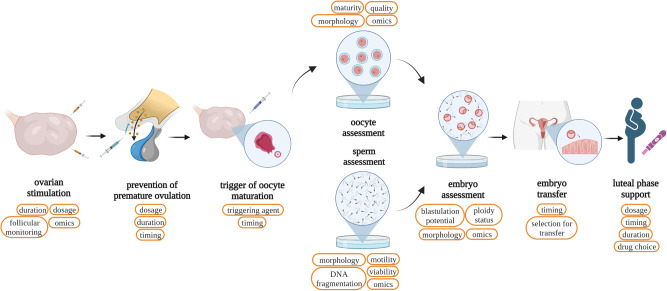
Infertility affects 1-in-6 couples, with repeated intensive cycles of assisted reproductive technology (ART) required by many to achieve a desired live birth. In ART, typically, clinicians and laboratory staff consider patient characteristics, previous treatment responses, and ongoing monitoring to determine treatment decisions. However, the reproducibility, weighting, and interpretation of these characteristics are contentious, and highly operator-dependent, resulting in considerable reliance on clinical experience. Artificial intelligence (AI) is ideally suited to handle, process, and analyze large, dynamic, temporal datasets with multiple intermediary outcomes that are generated during an ART cycle. Here, we review how AI has demonstrated potential for optimization and personalization of key steps in a reproducible manner, including: drug selection and dosing, cycle monitoring, induction of oocyte maturation, and selection of the most competent gametes and embryos, to improve the overall efficacy and safety of ART.
© 2024. The Author(s).
Conflict of interest statement
A.A. has received grants from the BRC; and has provided consulting services for Myovant Sciences Ltd. G.H.T. has stock in TFP; has received honoraria and travel support from Ferring Pharmaceuticals; and has provided consultancy services to ARC Medical Inc. S.M.N. received grants from NIHR, CSO, and BRC; provided consultancy services for Access Fertility, Modern Fertility, TFP, and Ferring Pharmaceuticals; received honoraria from Ferring Pharmaceuticals and Merck; received support for attending meetings and/or travel from Ferring Pharmaceuticals and Merck; participated in a data safety monitoring board or advisory board for NIHR; owns stock or stock options in TFP. W.S.D. received grants from NIHR, MRC, and Imperial Health Charity, and is a Consultant for Myovant Sciences Ltd. The remaining authors declare no competing interests.
Figures
References
-
- Gu, S. et al. Vector quantized diffusion model for text-to-image synthesis. In Proceedings of the IEEE/CVF Conference on Computer Vision and Pattern Recognition 10696–10706 (IEEE, 2022).
-
- McLernon, D. J. & Bhattacharya, S. Quality of clinical prediction models in in vitro fertilisation: which covariates are really important to predict cumulative live birth and which models are best? Pract. Res. Clin. Obstetr. Gynaecol.135, 102309–102329 (2022). - PubMed
Publication types
LinkOut - more resources
Full Text Sources
