


Inflammation, the kynurenines, and mucosal injury during human experimental enterotoxigenic Escherichia coli infection
- PMID: 38430452
- PMCID: PMC10908629
- DOI: 10.1007/s00430-024-00786-z
Inflammation, the kynurenines, and mucosal injury during human experimental enterotoxigenic Escherichia coli infection
Abstract
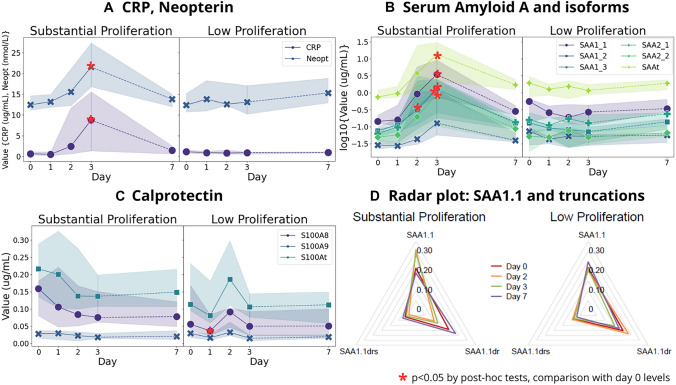
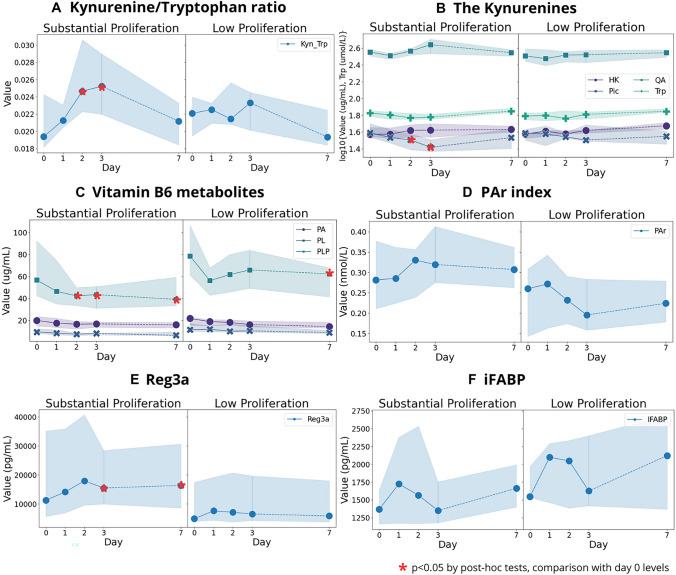
Enterotoxigenic Escherichia coli (ETEC) is an important cause of diarrhea in children and travelers, especially in low- and middle-income countries. ETEC is a non-invasive gut pathogen colonizing the small intestinal wall before secreting diarrhea-inducing enterotoxins. We sought to investigate the impact of ETEC infection on local and systemic host defenses by examining plasma markers of inflammation and mucosal injury as well as kynurenine pathway metabolites. Plasma samples from 21 volunteers experimentally infected with ETEC were collected before and 1, 2, 3, and 7 days after ingesting the ETEC dose, and grouped based on the level of intestinal ETEC proliferation: 14 volunteers experienced substantial proliferation (SP) and 7 had low proliferation (LP). Plasma markers of inflammation, kynurenine pathway metabolites, and related cofactors (vitamins B2 and B6) were quantified using targeted mass spectrometry, whereas ELISA was used to quantify the mucosal injury markers, regenerating islet-derived protein 3A (Reg3a), and intestinal fatty acid-binding protein 2 (iFABP). We observed increased concentrations of plasma C-reactive protein (CRP), serum amyloid A (SAA), neopterin, kynurenine/tryptophan ratio (KTR), and Reg3a in the SP group following dose ingestion. Vitamin B6 forms, pyridoxal 5'-phosphate and pyridoxal, decreased over time in the SP group. CRP, SAA, and pyridoxic acid ratio correlated with ETEC proliferation levels. The changes following experimental ETEC infection indicate that ETEC, despite causing a non-invasive infection, induces systemic inflammation and mucosal injury when proliferating substantially, even in cases without diarrhea. It is conceivable that ETEC infections, especially when repeated, contribute to negative health impacts on children in ETEC endemic areas.
Keywords: Calprotectin; Experimental infection; Indoleamine 2,3-dioxygenase; Longitudinal; Truncation; Tryptophan.
© 2024. The Author(s).
Conflict of interest statement
KM and AMc are employees at Bevital AS, which is owned by a not-for-profit foundation established to promote research on functional B vitamin deficiency. The authors declare no conflicts of interest.
Figures
References
-
- Brubaker J, Zhang X, Bourgeois AL, Harro C, Sack DA, Chakraborty S (2021) Intestinal and systemic inflammation induced by symptomatic and asymptomatic enterotoxigenic E. coli infection and impact on intestinal colonization and ETEC specific immune responses in an experimental human challenge model. Gut Microbes. 13(1):1–13. 10.1080/19490976.2021.1891852 - PMC - PubMed
-
- Walker RI (2015) An assessment of enterotoxigenic Escherichia coli and Shigella vaccine candidates for infants and children. Vaccine 33(8):954–965. 10.1016/j.vaccine.2014.11.049 - PubMed
MeSH terms
Substances
Grants and funding
LinkOut - more resources
Full Text Sources
Medical
Research Materials
Miscellaneous
