. 2024 Jan 8;18(1):wrae032.
doi: 10.1093/ismejo/wrae032.

Coordinated transcriptional response to environmental stress by a Synechococcus virus

Affiliations

Coordinated transcriptional response to environmental stress by a Synechococcus virus

Branko Rihtman et al. ISME J. .

Erratum in

Abstract

Viruses are a major control on populations of microbes. Often, their virulence is examined in controlled laboratory conditions. Yet, in nature, environmental conditions lead to changes in host physiology and fitness that may impart both costs and benefits on viral success. Phosphorus (P) is a major abiotic control on the marine cyanobacterium Synechococcus. Some viruses infecting Synechococcus have acquired, from their host, a gene encoding a P substrate binding protein (PstS), thought to improve virus replication under phosphate starvation. Yet, pstS is uncommon among cyanobacterial viruses. Thus, we asked how infections with viruses lacking PstS are affected by P scarcity. We show that the production of infectious virus particles of such viruses is reduced in low P conditions. However, this reduction in progeny is not caused by impaired phage genome replication, thought to be a major sink for cellular phosphate. Instead, transcriptomic analysis showed that under low P conditions, a PstS-lacking cyanophage increased the expression of a specific gene set that included mazG, hli2, and gp43 encoding a pyrophosphatase, a high-light inducible protein and DNA polymerase, respectively. Moreover, several of the upregulated genes were controlled by the host's phoBR two-component system. We hypothesize that recycling and polymerization of nucleotides liberates free phosphate and thus allows viral morphogenesis, albeit at lower rates than when phosphate is replete or when phages encode pstS. Altogether, our data show how phage genomes, lacking obvious P-stress-related genes, have evolved to exploit their host's environmental sensing mechanisms to coordinate their own gene expression in response to resource limitation.

Keywords: Synechococcus; bacteriophage; cyanobacteria; nutrient limitation; phosphorus.


Conflict of interest statement

The authors declare that they have no conflict of interest.

Figures
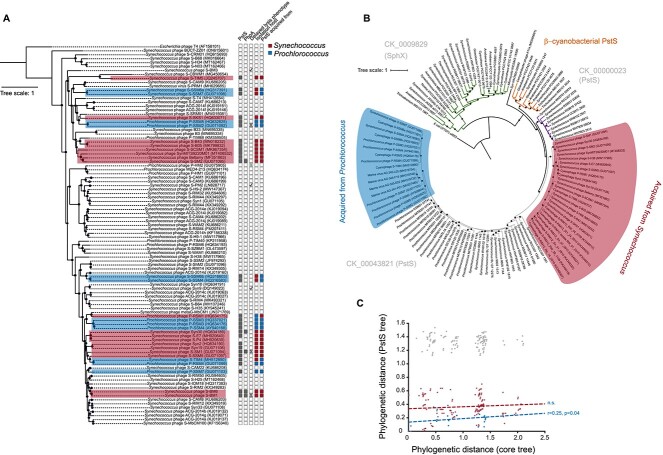
Figure 1
Figure 1
The distribution and evolution of phosphate acquisition AMGs in Kyanoviridae cyanophages. (A) Core phylogenetic tree of Kyanoviridae cyanophages constructed from 57 gene markers. The tree is rooted on E. coli phage T4. The host genus, the presence/absence of pstS, phoA, and the delayed lysis phenotype is shown for each taxon. Circles on branch junctions indicate bootstrap values >80% (B). Phylogeny of PstS proteins from cyanophages and cyanobacteria. The tree is rooted with E. coli PstS. Black circles on branch junctions indicate bootstrap values >80%. (C) Comparison of the phylogenetic distance of cyanophage PstS proteins and their phylogenetic distance in the core tree. Grey dots indicate correlation between all cyanophage PstS proteins, while red and blue signify correlations within the red and blue groups highlighted in (B). Output linear regression statistical tests (Pearson’s correlation) are shown next to the line.
Figure 2
Figure 2
Plaque assay results (A) and (B) and OD750 values (C) and (D) of cyanophage infection of Synechococcus sp. WH7803 grown under P-replete and P-deplete conditions. Cyanophage used: (A) and (C) S-PM2d; (B) and (D) S-BM1. Error bars represent the standard error of the average of three replicates. T-tests between the number of plaques at the last time point show statistically significant differences between +P and −P-infected samples, both for S-PM2 (t-value: 3.511, P-value: .025) and S-BM1 (t-value: −3.024, P-value: .039).
Figure 3
Figure 3
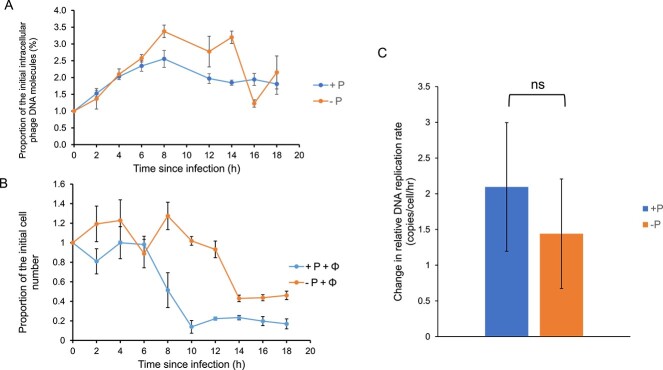
DNA replication rate of cyanophage S-PM2d during infection of Synechococcus sp. WH7803 under P-replete and P-deplete conditions. (A) Percentage of the initial amount of intracellular S-PM2d phage DNA over the course of infection under P-replete and P-deplete conditions. (B) The percentage of initial Synechococcus sp. WH7803 cell abundance following infection with cyanophage S-PM2d under P-replete and P-deplete conditions. (C) The relative cyanophage DNA replication rate under P-replete and P-deplete conditions. The rate was estimated by calculating the slope of a curve representing the change in the amount of DNA per hour for each of the three replicates, between 2- and 6-hour time points post infection. Error bars represent the standard deviation of three replicates.
Figure 4
Figure 4
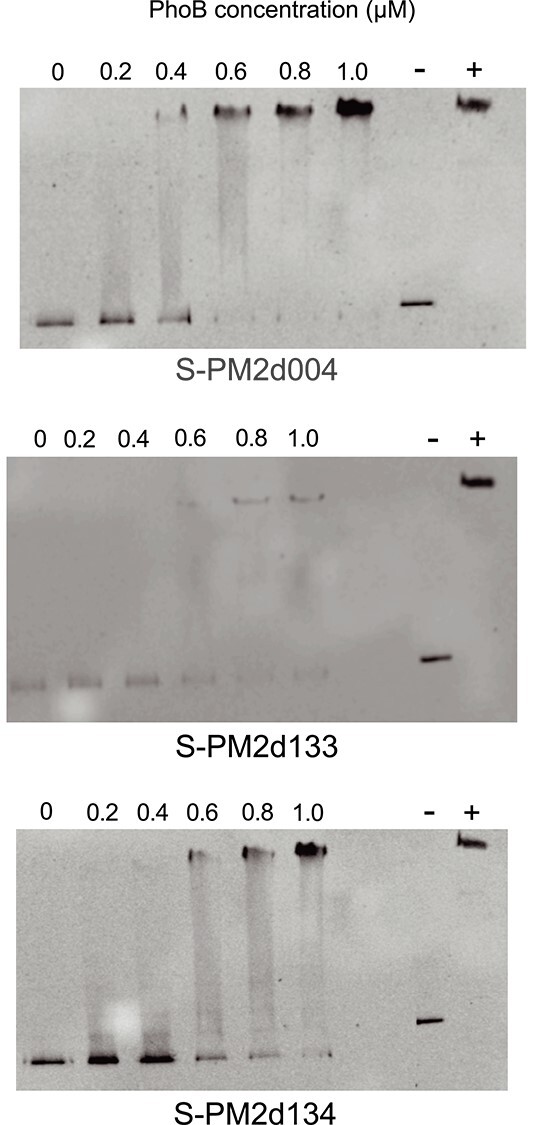
EMSA of purified MBP-PhoB from Synechococcus sp. WH7803 with specific cyanophage S-PM2d gene promoters. The concentration of MBP-PhoB protein used ranged from 0 to 1 μM, while 25-ng DNA fragment was used in each case. (−): Negative control, PhoB with an internal fragment of the Synechococcus sp. WH7803 phoB gene. (+): Positive control, PhoB with the promoter region of the Synechococcus sp. WH7803 phoB gene.

References

    1. Weinbauer MG. Ecology of prokaryotic viruses. FEMS Microbiol Rev 2004;28:127–81. 10.1016/j.femsre.2003.08.001 - DOI - PubMed
    1. Wahl LM, Betti MI, Dick DW et al. Evolutionary stability of the lysis-lysogeny decision: why be virulent? Evolution 2019;73:92–8. 10.1111/evo.13648 - DOI - PubMed
    1. Knowles B, Silveira CB, Bailey BA et al. Lytic to temperate switching of viral communities. Nature 2016;531:466–70. 10.1038/nature17193 - DOI - PubMed
    1. Wu J, Sunda W, Boyle EA et al. Phosphate depletion in the western North Atlantic Ocean. Science 2000;289:759–62. 10.1126/science.289.5480.759 - DOI - PubMed
    1. Scanlan DJ, Ostrowski M, Mazard S et al. Ecological genomics of marine picocyanobacteria. Microbiol Mol Biol Rev 2009;73:249–99. 10.1128/MMBR.00035-08 - DOI - PMC - PubMed