. 2024 Dec;13(1):2322649.
doi: 10.1080/22221751.2024.2322649. Epub 2024 Mar 3.

Lansoprazole interferes with fungal respiration and acts synergistically with amphotericin B against multidrug-resistant Candida auris

Affiliations

Lansoprazole interferes with fungal respiration and acts synergistically with amphotericin B against multidrug-resistant Candida auris

Ehab A Salama et al. Emerg Microbes Infect. 2024 Dec.

Abstract

Candida auris has emerged as a problematic fungal pathogen associated with high morbidity and mortality. Amphotericin B (AmB) is the most effective antifungal used to treat invasive fungal candidiasis, with resistance rarely observed among clinical isolates. However, C. auris possesses extraordinary resistant profiles against all available antifungal drugs, including AmB. In our pursuit of potential solutions, we screened a panel of 727 FDA-approved drugs. We identified the proton pump inhibitor lansoprazole (LNP) as a potent enhancer of AmB's activity against C. auris. LNP also potentiates the antifungal activity of AmB against other medically important species of Candida and Cryptococcus. Our investigations into the mechanism of action unveiled that LNP metabolite(s) interact with a crucial target in the mitochondrial respiratory chain (complex III, known as cytochrome bc1). This interaction increases oxidative stress within fungal cells. Our results demonstrated the critical role of an active respiratory function in the antifungal activity of LNP. Most importantly, LNP restored the efficacy of AmB in an immunocompromised mouse model, resulting in a 1.7-log (∼98%) CFU reduction in the burden of C. auris in the kidneys. Our findings strongly advocate for a comprehensive evaluation of LNP as a cytochrome bc1 inhibitor for combating drug-resistant C. auris infections.

Keywords: C. auris; In vivo mouse model; Lansoprazole; PISA analysis; cytochrome bc1; fungal respiration; metabolites.


Conflict of interest statement

No potential conflict of interest was reported by the author(s).

Figures

Figure 1.
Figure 1.
A screen of 727 FDA-approved drugs identified lansoprazole (LNP) as a potent potentiator of the antifungal activity of amphotericin B (AmB) against C. auris. a) An NIH drug collection library containing 727 drugs was screened at 16 µM in RPMI medium at 35 °C for 24 hr in the presence of 0.125×MIC of AmB (0.25 µg/mL). Growth of C. auris AR0390 was detected by measuring the optical density (OD600). The dotted line indicates 80% growth inhibition of C. auris. b) A time-kill assay of AmB at 2 µg/mL (1×MIC), LNP at 40 µg/mL, or a combination of the two drugs in RPMI media against C. auris AR0390 at 35°C for 24 hr. Time-kill assay results are shown as the mean values of CFU ± SD obtained from two independent experiments.
Figure 2.
Figure 2.
Volcano plots indicating “stabilized” (from PISA) and “up” regulated proteins (global proteomics) by LNP treatment compared to DMSO treatment. a) Corresponding volcano plot (ΔSm, p) of the PISA experiments for LNP-treated (64 µg/mL) vs. DMSO-treated C. auris AR0390 cells demonstrating the strong positive outliers (potential protein targets). b) Corresponding volcano plot (ΔSm, p) of the Global experiments for LNP-treated (64 µg/mL) vs. DMSO-treated C. auris AR0390 cells showing proteins increased in abundance in the Global experiment (Up in Global). Results are presented from triplicate experiments; black dots represent the proteins stabilized in the PISA Experiment, and the dotted line identifies the statistical significance (p < 0.05). c) Summary of the total number of proteins stabilized in PISA or up in the Global proteomic analysis. (All the protein IDs and relevant details can be visualized in the supplementary spreadsheet (Excel spreadsheet_S1).
Figure 3.
Figure 3.
RNA-Seq analysis and oxidative stress response upon AmB/LNP treatment. a) Volcano plot highlights differentially expressed genes (DEGs) from C. auris AR0390 cells treated with AmB (0.5 µg/mL), LNP (30 µg/mL) or the AmB/LNP combination. The LNP-treated group (in the middle) showed three upregulated and 7 downregulated genes. Superoxide dismutase and oxidoreductase orthologs appeared among the up and downregulated genes. Genes with FDR < 0.05 were considered differentially expressed (4010, 10, and 4160 DEGs for samples receiving AmB, LNP, and AmB/LNP, respectively). Results are presented from three independent experiments. b) ROS level measurement. 1 × 107 C. auris AR0390 cells/mL were treated with AmB (0.5 µg/mL), LNP (32 µg/mL), or a combination of both drugs for 3 hr. ROS levels were measured by incubating fungal cells with a cell-permeant H2DCFDA kit, and the fluorescence intensity was adjusted to the untreated and presented from two independent experiments. c) Comparison of LNP sensitivity between S. cerevisiae AD1-9 and two derived mutants (Δsod1 and Δsod2). The cells were grown in YPEtOH media with or without 300 μM LNP. The OD600nm were recorded after 72 hr incubation. d) LNP dose-dependent sensitivity of the Δsod1 and Δsod2 mutants. The cells were cultured as in c).
Figure 4.
Figure 4.
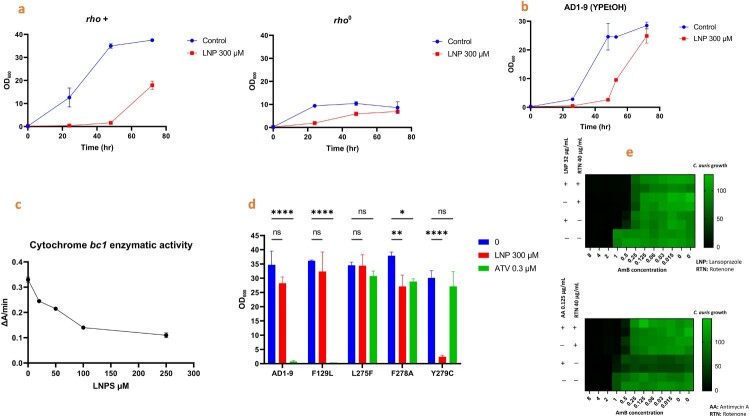
Lansoprazole (or its metabolites) interferes with the fungal mitochondrial respiration and cytochrome bc1 activity. a) Comparison of LNP sensitivity between AD1-9 (rho+) and its derivative lacking mtDNA, and thus a respiratory function (rho°). The cells were grown in YPD medium with or without 300 μM LNP. The OD600nm were recorded at 24, 48 and 72 hr. b) Effect of LNP on the growth of S. cerevisiae AD1-9 on medium containing ethanol as a sole carbon source (YPEtOH) over 72 hr. c) Effect of LNP metabolite (LNPS) on cytochrome bc1 activity. Mitochondria were prepared from S. cerevisiae AD1-9 strain. The enzyme activity was measured by monitoring the rate of cytochrome c reduction spectrophotometrically at 550-540 nm using NADH as an electron donor in the presence of increasing concentration of LNPS. d) Effect of cytochrome b amino acid replacement on the susceptibility of S. cerevisiae to LNP. The cytochrome b mutants and their parent strain AD1-9 were grown 4 days in YPEtOH medium with or without 300 μM LNP or 0.3 μM atovaquone (ATV). Asterisks indicate a statistical significance * (P < 0.1), ** (P < 0.01), **** (P < 0.0001). e) Effect of the respiratory chain inhibitor, rotenone (targeting complex I), on the synergistic effect between AmB and both LNP and antimycin A (targeting complex III). The heat-maps represent C. auris AR0390 growth after 24 hr relative to the untreated control. Top panel, the effect of rotenone on the synergistic relationship between AmB and LNP; lower panel, the effect of rotenone on the synergistic relationship observed between AmB and AA.
Figure 5.
Figure 5.
Docking analysis of C. albicans (PDB ID: 7RJA) and crystal structure analysis of Bovine bc1 with UHDBT (PDB ID: 1SQV). a) Predicted binding mode of LNP and lansoprazole sulfide to the binding site of 7RJA. Green dashed line, pi-pi interaction, yellow dashed line, hydrogen bond. b) Predicted binding mode of lansoprazole to the binding site of 1SQV. Green dashed line, pi-pi interaction.
Figure 6.
Figure 6.
Lansoprazole (LNP) potentiates the antifungal activity of amphotericin B (AmB) in a murine model of C. auris infection. a) Groups of female CD-1 mice (10 mice per group) were infected with AmB–resistant C. auris AR0390 (2.6 × 107 CFU/mouse) and treated with vehicle control (untreated), AmB (0.5 mg/kg), LNP 300 mg/kg, or a combination of both drugs. The burden of C. auris in murine kidneys (log CFU) was determined from a single experiment. A dot on the graph represents each mouse. The data were analyzed via a one-way analysis of variance (ANOVA) using post-hoc Dunnett’s test for multiple comparisons. The asterisks (***) indicate a statistically significant difference (P < 0.05) compared to the untreated control. b) Monitoring the weight of CD-1 mice in the murine model of C. auris infection. Percent changes in weight were calculated for 48 hr. Data are presented as mean +/- SE. The asterisk (*) and pound (#) signs indicate a statistically significant difference compared to the untreated and the AmB-treated cells, respectively, as determined via a two-way ANOVA using Dunnett’s test for multiple comparisons.
Figure 7.
Figure 7.
Diagram of the synergistic mechanism of the amphotericin B (AmB)/lansoprazole (LNP) combination. LNP/its metabolites inhibit fungal mitochondrial cytochrome bc1 (complex III), leading to the generation of oxidative stress (reactive oxygen species [ROS]), and work synergistically with the antifungal activity of AmB.

References

    1. Iyer KR, Camara K, Daniel-Ivad M, et al. An oxindole efflux inhibitor potentiates azoles and impairs virulence in the fungal pathogen Candida auris. Nat Commun. 2020 Dec 22;11(1):6429. doi: 10.1038/s41467-020-20183-3 - DOI - PMC - PubMed
    1. Eldesouky HE, Salama EA, Lanman NA, et al. Potent synergistic interactions between Lopinavir and Azole antifungal drugs against emerging multidrug-resistant Candida auris. Antimicrob Agents Ch. 2021 Jan;65(1). doi: 10.1128/AAC.00684-20 - DOI - PMC - PubMed
    1. Eldesouky HE, Li X, Abutaleb NS, et al. Synergistic interactions of sulfamethoxazole and azole antifungal drugs against emerging multidrug-resistant Candida auris. Int J Antimicrob Agents. 2018 Dec;52(6):754–761. doi: 10.1016/j.ijantimicag.2018.08.016 - DOI - PubMed
    1. Egger NB, Kainz K, Schulze A, et al. The rise of Candida auris: from unique traits to co-infection potential. Microb Cell. 2022 Aug 1;9(8):141–144. doi: 10.15698/mic2022.08.782 - DOI - PMC - PubMed
    1. Rossato L, Colombo AL.. Candida auris: what have we learned about its mechanisms of pathogenicity? Front Microbiol. 2018;9:3081. doi: 10.3389/fmicb.2018.03081 - DOI - PMC - PubMed

Supplementary concepts