


Involvement of CX3CR1+ cells appearing in the abdominal cavity in the immunosuppressive environment immediately after gastric cancer surgery
- PMID: 38433196
- PMCID: PMC10910822
- DOI: 10.1186/s12957-024-03353-1
Involvement of CX3CR1+ cells appearing in the abdominal cavity in the immunosuppressive environment immediately after gastric cancer surgery
Abstract
Background: Gastric cancer is primarily treated by surgery; however, little is known about the changes in the intraperitoneal immune environment and the prognostic impact of surgery. Surgical stress and cancer-associated inflammation cause immune cells to mobilize into the abdominal cavity via numerous cytokines. One such cytokine, CX3CR1, has various immune-related functions that remain to be fully explained. We characterized the intraperitoneal immune environment by investigating CX3CR1+ cells in intraperitoneal lavage fluid during gastric cancer surgery.
Methods: Lavage fluid samples were obtained from a total of 41 patients who underwent gastrectomy. The relative expression of various genes was analyzed using quantitative real-time PCR. The association of each gene expression with clinicopathological features and surgical outcomes was examined. The fraction of CX3CR1+ cells was analyzed by flow cytometry. Cytokine profiles in lavage fluid samples were investigated using a cytometric beads array.
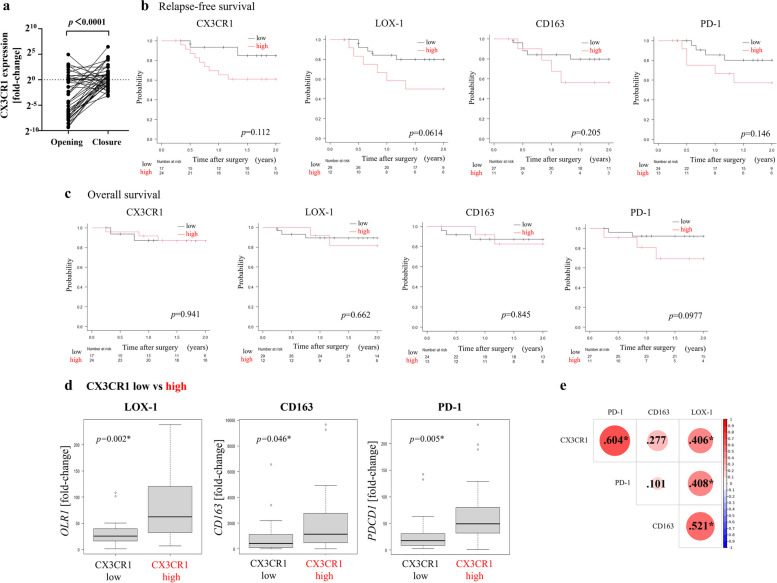
Results: CX3CR1high patients exhibited higher levels of perioperative inflammation in blood tests and more recurrences than CX3CR1low patients. CX3CR1high patients tended to exhibit higher pathological T and N stage than CX3CR1low patients. CX3CR1 was primarily expressed on myeloid-derived suppressor cells and tumor-associated macrophages. In particular, polymorphonuclear myeloid-derived suppressor cells were associated with perioperative inflammation, pathological N, and recurrences. These immunosuppressive cells were associated with a trend toward unfavorable prognosis. Moreover, CX3CR1 expression was correlated with programmed death-1 expression.
Conclusions: Our results suggest that CX3CR1+ cells are associated with an acute inflammatory response, tumor-promotion, and recurrence. CX3CR1 expression could be taken advantage of as a beneficial therapeutic target for improving immunosuppressive state in the future. In addition, analysis of intra-abdominal CX3CR1+ cells could be useful for characterizing the immune environment after gastric cancer surgery.
Keywords: CX3CR1; Fractalkine receptor; Gastric cancer; Intraperitoneal lavage fluid; Myeloid-derived suppressor cell; Programmed death 1; Tumor-associated macrophage.
© 2024. The Author(s).
Conflict of interest statement
The authors declare no competing interests.
Figures


References
-
- Yoshii M, Tanaka H, Ohira M, Muguruma K, Lee T, Sakurai K, Kubo N, Maeda K, Hirakawa K. Regulation of neutrophil infiltration into peritoneal cavity by laparoscopic gastrectomy. Hepatogastroenterology. 2015;62:546–550. - PubMed
-
- Imai T, Hieshima K, Haskell C, Baba M, Nagira M, Nishimura M, Kakizaki M, Takagi S, Nomiyama H, Schall TJ, Yoshie O. Identification and Molecular Characterization of Fractalkine Receptor CX<sub>3</sub>CR1, which Mediates Both Leukocyte Migration and Adhesion. Cell. 1997;91:521–530. doi: 10.1016/S0092-8674(00)80438-9. - DOI - PubMed
-
- Schmall A, Al-tamari HM, Herold S, Kampschulte M, Weigert A, Wietelmann A, Vipotnik N, Grimminger F, Seeger W, Pullamsetti SS, Savai R. Macrophage and Cancer Cell Cross-talk via CCR2 and CX3CR1 Is a Fundamental Mechanism Driving Lung Cancer. American Journal of Respiratory and Critical Care Medicine. 2014;191:437–447. doi: 10.1164/rccm.201406-1137OC. - DOI - PubMed
MeSH terms
Substances
LinkOut - more resources
Full Text Sources
Medical
Research Materials
