


Incidence of mental health diagnoses during the COVID-19 pandemic: a multinational network study
- PMID: 38433286
- PMCID: PMC10940053
- DOI: 10.1017/S2045796024000088
Incidence of mental health diagnoses during the COVID-19 pandemic: a multinational network study
Abstract
Aims: Population-wide restrictions during the COVID-19 pandemic may create barriers to mental health diagnosis. This study aims to examine changes in the number of incident cases and the incidence rates of mental health diagnoses during the COVID-19 pandemic.
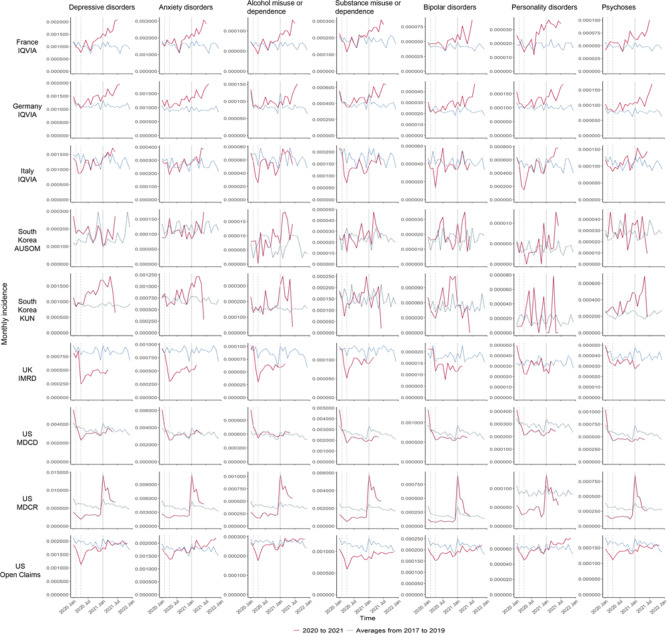
Methods: By using electronic health records from France, Germany, Italy, South Korea and the UK and claims data from the US, this study conducted interrupted time-series analyses to compare the monthly incident cases and the incidence of depressive disorders, anxiety disorders, alcohol misuse or dependence, substance misuse or dependence, bipolar disorders, personality disorders and psychoses diagnoses before (January 2017 to February 2020) and after (April 2020 to the latest available date of each database [up to November 2021]) the introduction of COVID-related restrictions.
Results: A total of 629,712,954 individuals were enrolled across nine databases. Following the introduction of restrictions, an immediate decline was observed in the number of incident cases of all mental health diagnoses in the US (rate ratios (RRs) ranged from 0.005 to 0.677) and in the incidence of all conditions in France, Germany, Italy and the US (RRs ranged from 0.002 to 0.422). In the UK, significant reductions were only observed in common mental illnesses. The number of incident cases and the incidence began to return to or exceed pre-pandemic levels in most countries from mid-2020 through 2021.
Conclusions: Healthcare providers should be prepared to deliver service adaptations to mitigate burdens directly or indirectly caused by delays in the diagnosis and treatment of mental health conditions.
Keywords: COVID-19; OHDSI; OMOP; SARS-CoV-2; mental health; psychiatric disorder.
Conflict of interest statement
K. Man reports grants from the CW Maplethorpe Fellowship, National Institute of Health Research, UK, Hong Kong Research Grant Council and the European Commission Horizon 2020 Framework, personal fees from IQVIA and grants from Amgen and GlaxoSmithKline, outside the submitted work; H. Luo reports grants from Research Grants Council of Hong Kong, outside the submitted work; J. Hayes reports grants from UKRI, NIHR UCLH Biomedical Research Centre, and Wellcome Trust and Consultancy Fees from Wellcome Trust and juli Health, outside the submitted work; E. Chan reports grants from Research Grants Council of Hong Kong, Research Fund Secretariat of the Food and Health Bureau of Hong Kong, National Natural Science Fund of China, Wellcome Trust, Bayer, Bristol-Myers Squibb, Pfizer, Janssen, Amgen, Takeda and Narcotics Division of the Security Bureau of Hong Kong; honorarium from Hospital Authority; outside the submitted work; S. Fortin is an employee of Johnson and Johnson and owns stock in Johnson and Johnson; D. Kern is an employee of Janssen R&D, a subsidiary of Johnson and Johnson, and owns stock in Johnson and Johnson; W. Lau reports receiving grants from AIR@InnoHK administered by the Innovation and Technology Commission of Hong Kong outside the submitted work; I. Wong reports grants from Amgen, Bristol-Myers Squibb, Pfizer, Janssen, Bayer, GSK and Novartis, the Hong Kong RGC, and the Hong Kong Health and Medical Research Fund in Hong Kong, National Institute for Health Research in England, European Commission, National Health and Medical Research Council in Australia, consulting fees from IQVIA, payment for expert testimony and is an independent non-executive director of Jacobson Medical in Hong Kong, outside of the submitted work; no other relationships or activities that could appear to have influenced the submitted work.
Figures



References
-
- Ahmed N, Barnett P, Greenburgh A, Pemovska T, Stefanidou T, Lyons N, Ikhtabi S, Talwar S, Francis ER, Harris SM, Shah P, Machin K, Jeffreys S, Mitchell L, Lynch C, Foye U, Schlief M, Appleton R, Saunders KRK, Baldwin H, Allan SM, Sheridan-Rains L, Kharboutly O, Kular A, Goldblatt P, Stewart R, Kirkbride JB, Lloyd-Evans B and Johnson S (2023) Mental health in Europe during the COVID-19 pandemic: A systematic review. The Lancet Psychiatry 10(7), 537–556. - PMC - PubMed
-
- Aknin LB, De Neve JE, Dunn EW, Fancourt DE, Goldberg E, Helliwell JF, Jones SP, Karam E, Layard R, Lyubomirsky S, Rzepa A, Saxena S, Thornton EM, VanderWeele TJ, Whillans AV, Zaki J, Karadag O and Ben Amor Y (2022) Mental health during the first year of the COVID-19 pandemic: A review and recommendations for moving forward. Perspectives on Psychological Science 17(4), 915–936. - PMC - PubMed
-
- Anderson KN, Radhakrishnan L, Lane RI, Sheppard M, DeVies J, Azondekon R, Smith AR, Bitsko RH, Hartnett KP, Lopes-Cardozo B, Leeb RT, van Santen KL, Carey K, Crossen S, Dias TP, Wotiz S, Adjemian J, Rodgers L, Njai R and Thomas C (2022) Changes and inequities in adult mental health–related emergency department visits during the COVID-19 pandemic in the US. JAMA Psychiatry 79(5), 475–485. - PMC - PubMed
MeSH terms
LinkOut - more resources
Full Text Sources
Medical
Miscellaneous
