


Coping with light pollution in urban environments: Patterns and challenges
- PMID: 38433890
- PMCID: PMC10904992
- DOI: 10.1016/j.isci.2024.109244
Coping with light pollution in urban environments: Patterns and challenges
Abstract
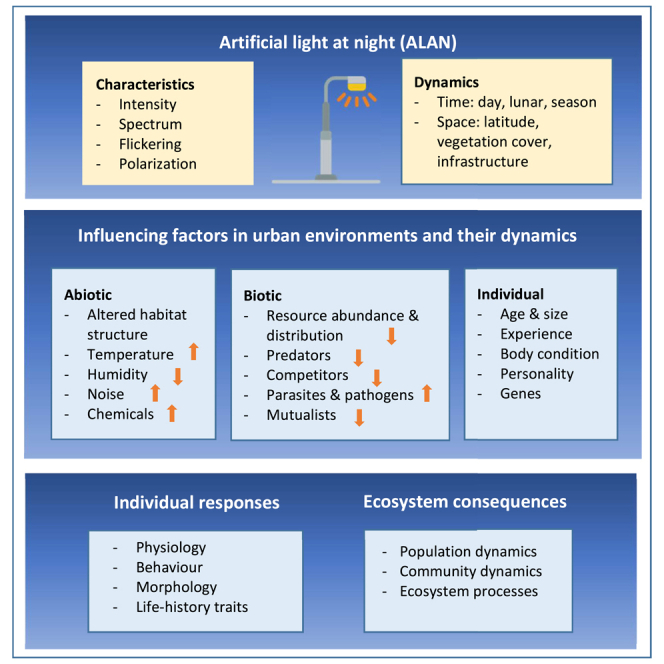
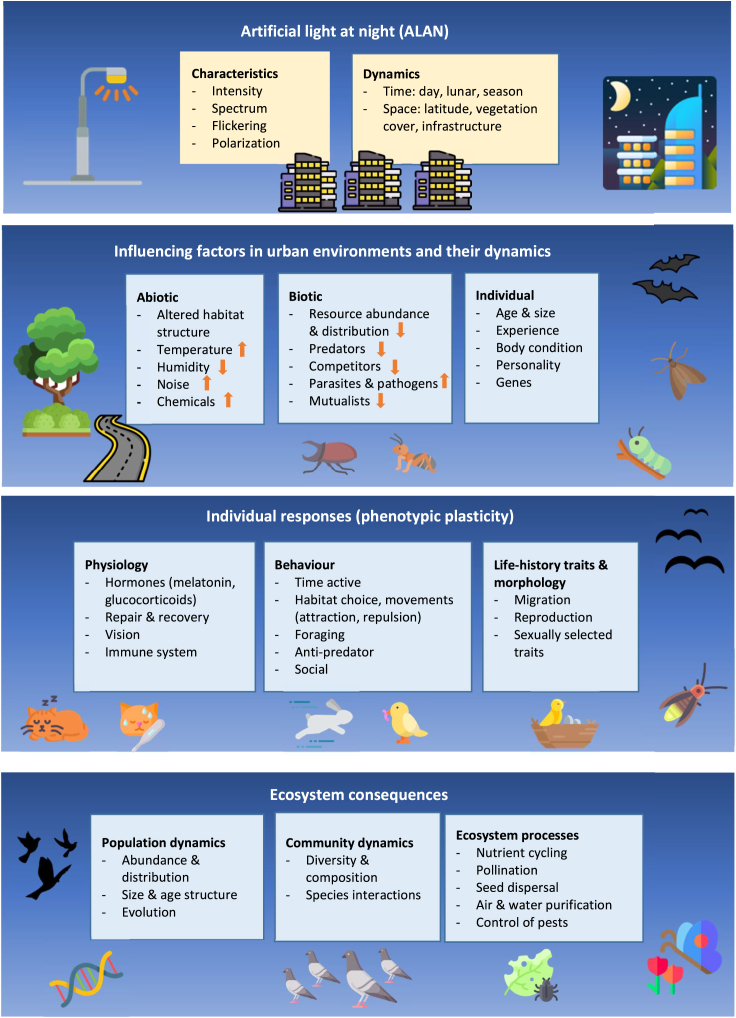
Artificial light at night is a growing environmental problem that is especially pronounced in urban environments. Yet, impacts on urban wildlife have received scant attention and patterns and consequences are largely unknown. Here, I present a conceptual framework outlining the challenges species encounter when exposed to urban light pollution and how they may respond through plastic adjustments and genetic adaptation. Light pollution interferes with biological rhythms, influences behaviors, fragments habitats, and alters predation risk and resource abundance, which changes the diversity and spatiotemporal distribution of species and, hence, the structure and function of urban ecosystems. Furthermore, light pollution interacts with other urban disturbances, which can exacerbate negative effects on species. Given the rapid growth of urban areas and light pollution and the importance of healthy urban ecosystems for human wellbeing, more research is needed on the impacts of light pollution on species and the consequences for urban ecosystems.
Keywords: Classification Description; Ecology; Evolutionary biology; Nature conservation.
© 2024 The Author(s).
Conflict of interest statement
The authors declare no competing interests.
Figures
References
-
- Gaston K.J., Davies T.W., Nedelec S.L., Holt L.A. Impacts of artificial light at night on biological timings. Annu. Rev. Ecol. Evol. Syst. 2017;48:49–68. doi: 10.1146/annurev-ecolsys-110316-022745. - DOI
-
- Gaston K.J., Sánchez de Miguel A. Environmental impacts of artificial light at night. Annu. Rev. Environ. Resour. 2022;47:373–398. doi: 10.1146/annurev-environ-112420-014438. - DOI
-
- Coetzee B.W.T., Gaston K.J., Koekemoer L.L., Kruger T., Riddin M.A., Smit I.P.J. Artificial light as a modulator of mosquito-borne disease risk. Front. Ecol. Evol. 2022;9 doi: 10.3389/fevo.2021.768090. - DOI
-
- Sánchez de Miguel A., Bennie J., Rosenfeld E., Dzurjak S., Gaston K.J. First estimation of global trends in nocturnal power emissions reveals acceleration of light pollution. Rem. Sens. 2021;13:3311. doi: 10.3390/rs13163311. - DOI
Publication types
LinkOut - more resources
Full Text Sources
