. 2024 Feb;7(2):120-131.
doi: 10.1038/s41929-023-01073-5. Epub 2024 Jan 2.

Interfacial Tuning of Electrocatalytic Ag Surfaces for Fragment-Based Electrophile Coupling

Affiliations

Interfacial Tuning of Electrocatalytic Ag Surfaces for Fragment-Based Electrophile Coupling

Qiu-Cheng Chen et al. Nat Catal. 2024 Feb.

Abstract

Construction of C‒C bonds in medicinal chemistry frequently draws on the reductive coupling of organic halides with ketones or aldehydes. Catalytic C(sp3)‒C(sp3) bond formation, however, is constrained by the competitive side reactivity of radical intermediates following sp3 organic halide activation. Here, an alternative paradigm deploys catalytic Ag surfaces for reductive fragment-based electrophile coupling compatible with sp3 organic halides. We use in-situ spectroscopy, electrochemical analyses, and simulation to uncover the catalytic interfacial structure and guide reaction development. Specifically, Mg(OAc)2 outcompetes the interaction between Ag and the aldehyde, thereby tuning the Ag surface for selective product formation. Data are consistent with an increased population of Mg-bound aldehyde facilitating the addition of a carbon-centered radical (product of Ag-electrocatalyzed organic halide reduction) to the carbonyl. Electron transfer from Ag to the resultant alkoxy radical yields the desired alcohol. Molecular interfacial tuning at reusable catalytic electrodes will accelerate development of sustainable organic synthetic methods.


Conflict of interest statement

Competing interests The authors declare no competing interests.

Figures
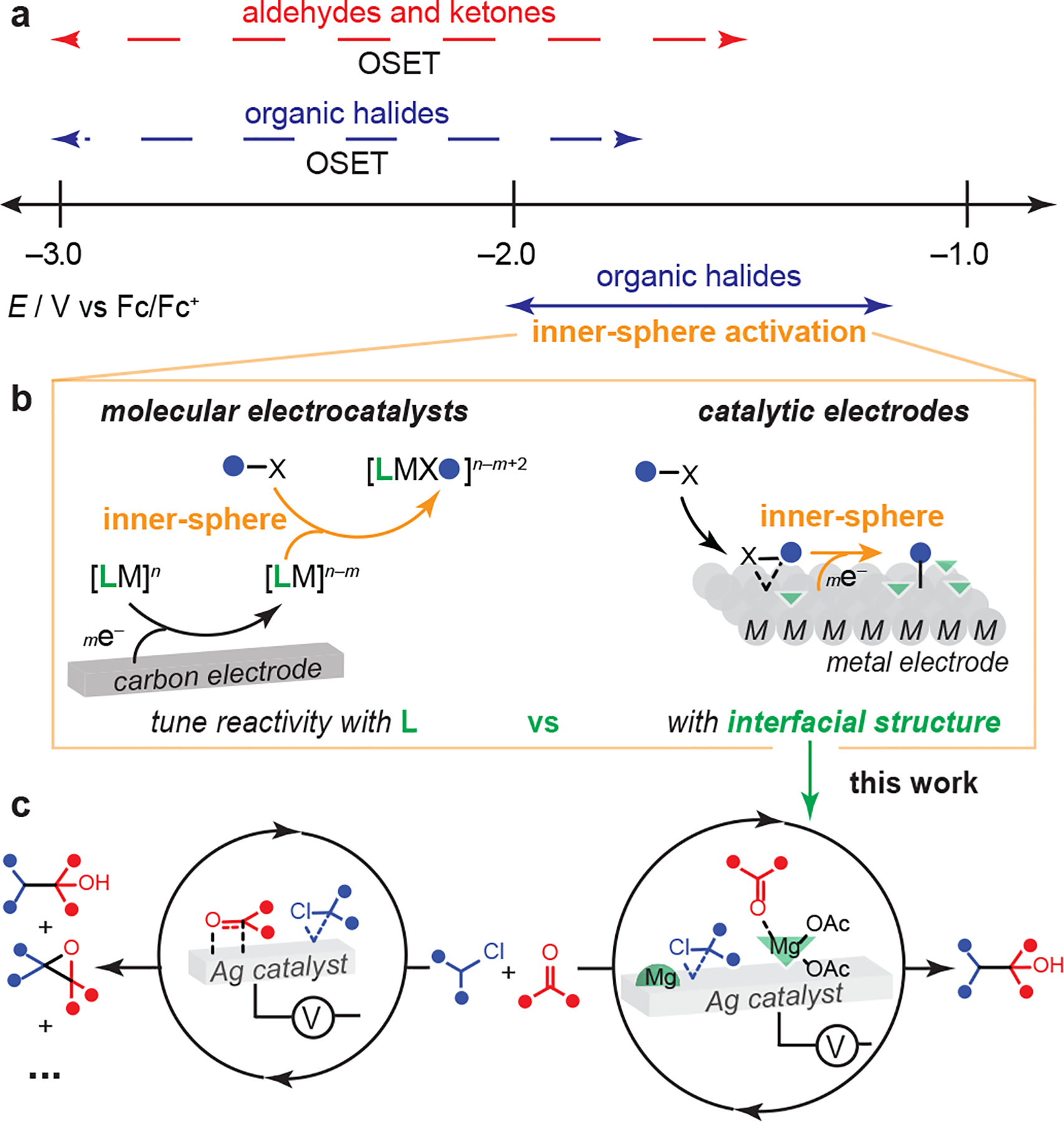
Figure 1.
Figure 1.. Electrocatalysis enables facile organic halide activation.
(a) Selective reductive activation of organic halides over aldehydes and ketones is limited due to the similar reduction potentials accessed via outer-sphere electron transfer (OSET). (b) Inner-sphere reductive activation of organic halides via molecular electrocatalysis or catalytic electrodes drives the reduction potential of organic halides to more positive potentials. (c) This work uncovers the interfacial structure at catalytic Ag electrodes that enables selective electrophile coupling.
Figure 2.
Figure 2.. Electrochemical and reactivity data for Ag-catalyzed electrophile coupling.
(a) Observed reactivity between 40 mM mCNBzCl and 120 mM pAN at −2.23 V vs Fc/Fc+ with and without 44 mM Mg(OAc)2. m-cyanotoluene yield was determined by GCMS of the crude reaction mixture. All other product yields are isolated yields after chromatography on silica gel. (b) Cyclic voltammetry (CV) of 40 mM mCNBzCl on glassy carbon (grey), Ag (black) and Ag in the presence of 44 mM Mg(OAc)2 (green) at 100 mVs−1. (c) CV of 40 mM pAN on glassy carbon (grey), Ag (black) and Ag in the presence of 44 mM Mg(OAc)2 (green) at 100 mVs−1. (d) CV of 40 mM mCNBzCl and 40 mM pAN on Ag at 100 mVs−1 on Ag in the absence (black) and presence (green) of 44 mM Mg(OAc)2 at 100 mVs−1. All CVs are conducted with a negative direction of scan. (e) Chronoamperometry trace of 40 mM mCNBzCl and 120 mM pAN at −2.23 V vs Fc/Fc+ in the absence (black) and presence (green) of 44 mM Mg(OAc)2. All experiments are conducted in DMF containing 0.05 M TBAClO4.
Figure 3.
Figure 3.. Spectroscopic data collected during Ag-electrocatalyzed electrophile coupling reactions.
Chronoamperometry traces (a, c) recorded on SEIRAS-active Ag film, where substrates and reagents were sequentially added at −1.03 V vs Fc/Fc+, indicated by blue (mCNBzCl), red (pAN), and (only for c) yellow (Mg(OAc)2) arrows. SEIRA spectra (b, d) collected simultaneously at −1.03 V before (grey) and after the sequential addition of Mg(OAc)2 (44 mM, orange, only in d), mCNBzCl (40 mM, blue), and pAN (40 mM, red), followed by spectra collected during electrolysis at −2.23 V at given times. Background spectra (grey, in b and d) collected in DMF containing 50 mM TBAClO4 on the same SEIRAS-active Ag film at −1.03 V before the addition of substrates or Mg(OAc)2. Red shaded region in b and d highlight major changes to the spectra associated with pAN normal modes for data collected in the absence and presence of Mg(OAc)2.
Figure 4.
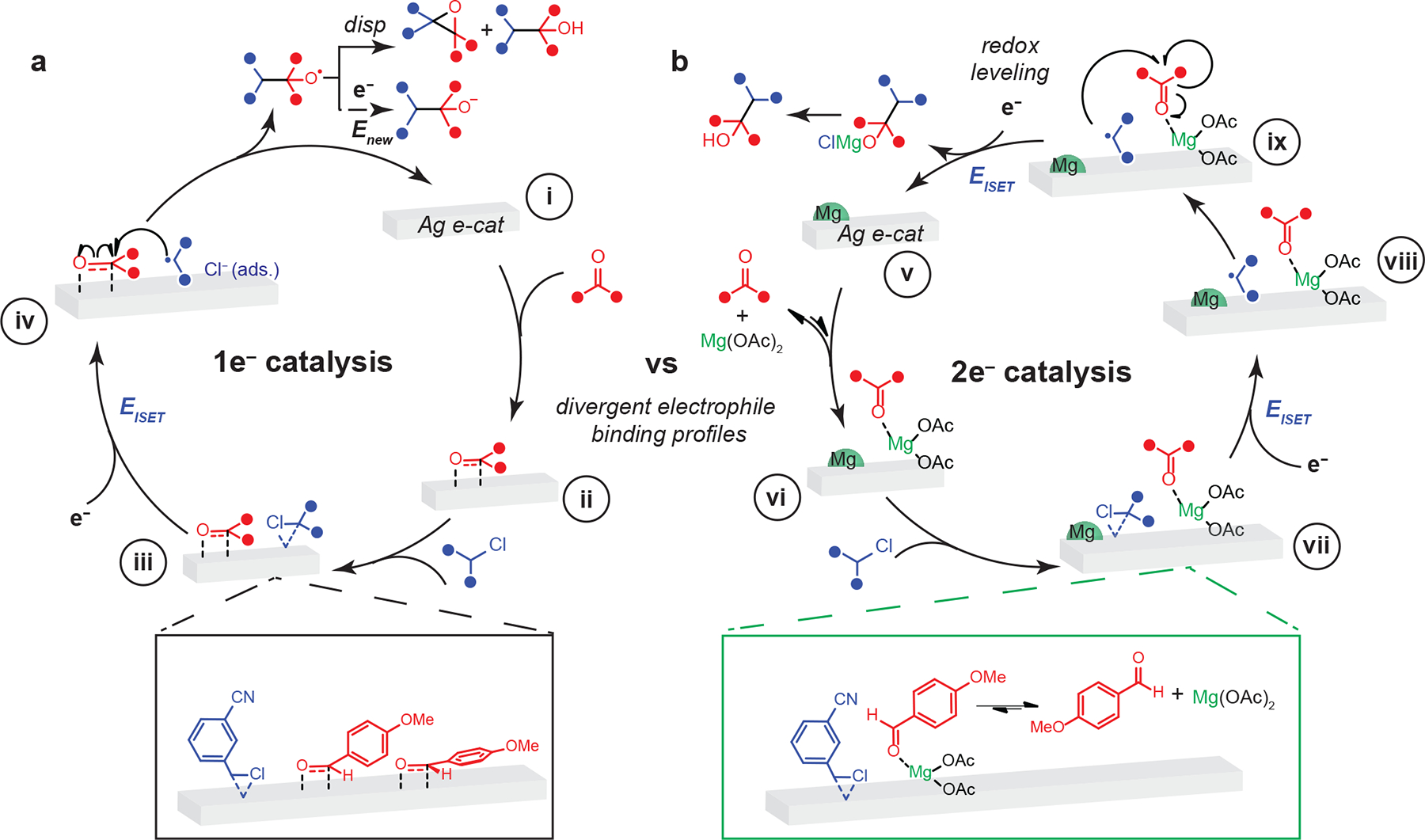
Figure 4.. Summary of proposed mechanisms in the absence and presence of Mg(OAc)2.
Key mechanistic steps in the absence (a) and presence (b) of Mg(OAc)2 postulated via a combination of electroanalytical studies, simulation, reactivity observations, as well as in-situ spectroscopy are indicated with lower-case letter labels. Disp indicates disproportionation step. Black or green box indicates a zoom-in of the interfacial structure proposed in step iii or step vii. The Mg alkoxide salt is converted to the alcohol upon workup.
Figure 5.
Figure 5.. Investigated scope of the transformation.
All reactions were performed at room temperature in 3.5 mL DMF containing 40 mM chloride, 120 mM ketone/aldehyde, 44 mM Mg(OAc)2, and 50 mM TBAClO4 at a constant applied potential 200 mV more negative than the of the chloride substrate (values ranged from −2.0 to −2.8 V vs. Ag/Ag+). Reaction times ranged from 3 to 5 hours, until the current reached a value of −0.05 mA cm−2. All reported yields are isolated yields after chromatography on silica gel. Scale up details for 8 are provided in Methods.

References

    1. Lovering F, Bikker J & Humblet C Escape from flatland: increasing saturation as an approach to improving clinical success. J. Med. Chem 52, 6752–6756 (2009). - PubMed
    1. Huffman BJ et al. Electronic complementarity permits hindered butenolide heterodimerization and discovery of novel cGAS/STING pathway antagonists. Nat. Chem 12, 310–317 (2020). - PubMed
    1. Wei W, Cherukupalli S, Jing L, Liu X & Zhan P Fsp3: a new parameter for drug-likeness. Drug Discov. Today 25, 1839–1845 (2020). - PubMed
    1. Rappoport Z & Marek I The Chemistry of Organomagnesium Compounds. (John Wiley & Sons, Ltd, 2008).
    1. Wu G & Huang M Organolithium reagents in pharmaceutical asymmetric processes. Chem. Rev 106, 2596–2616 (2006). - PubMed

LinkOut - more resources