This is a preprint.
A Stacking Framework for Polygenic Risk Prediction in Admixed Individuals
- PMID: 38434717
- PMCID: PMC10907988
- DOI: 10.1101/2024.01.31.24302103
A Stacking Framework for Polygenic Risk Prediction in Admixed Individuals
Abstract
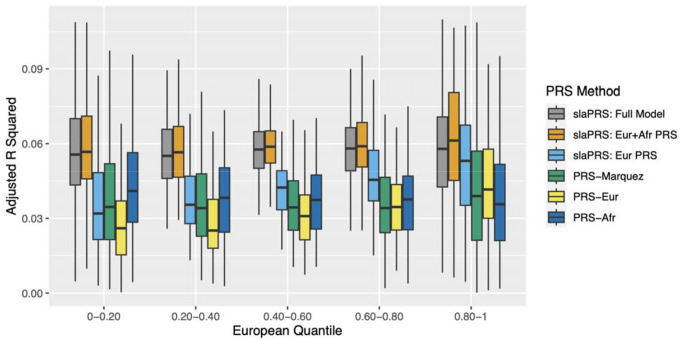
Polygenic risk scores (PRS) are summaries of an individual's personalized genetic risk for a trait or disease. However, PRS often perform poorly for phenotype prediction when the ancestry of the target population does not match the population in which GWAS effect sizes were estimated. For many populations this can be addressed by performing GWAS in the target population. However, admixed individuals (whose genomes can be traced to multiple ancestral populations) lie on an ancestry continuum and are not easily represented as a discrete population. Here, we propose slaPRS (stacking local ancestry PRS), which incorporates multiple ancestry GWAS to alleviate the ancestry dependence of PRS in admixed samples. slaPRS uses ensemble learning (stacking) to combine local population specific PRS in regions across the genome. We compare slaPRS to single population PRS and a method that combines single population PRS globally. In simulations, slaPRS outperformed existing approaches and reduced the ancestry dependence of PRS in African Americans. In lipid traits from African British individuals (UK Biobank), slaPRS again improved on single population PRS while performing comparably to the globally combined PRS. slaPRS provides a data-driven and flexible framework to incorporate multiple population-specific GWAS and local ancestry in samples of admixed ancestry.
Conflict of interest statement
Conflict of interest disclosure The authors report no conflicts of interest regarding commercial or financial interests involved with the study.
Figures



References
-
- Polygenic Risk Score Task Force of the International Common Disease Alliance. Responsible use of polygenic risk scores in the clinic: potential benefits, risks and gaps. Nat. Med. 27, 1876–1884 (2021). - PubMed
Publication types
Grants and funding
LinkOut - more resources
Full Text Sources