


Biophysical Analysis of Potential Inhibitors of SARS-CoV-2 Cell Recognition and Their Effect on Viral Dynamics in Different Cell Types: A Computational Prediction from In Vitro Experimental Data
- PMID: 38434903
- PMCID: PMC10905729
- DOI: 10.1021/acsomega.3c06968
Biophysical Analysis of Potential Inhibitors of SARS-CoV-2 Cell Recognition and Their Effect on Viral Dynamics in Different Cell Types: A Computational Prediction from In Vitro Experimental Data
Abstract
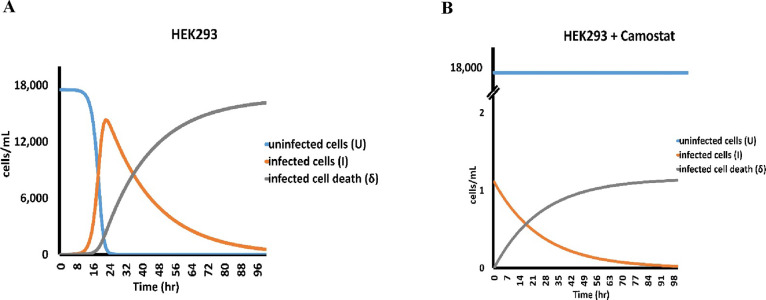
Recent reports have suggested that the susceptibility of cells to SARS-CoV-2 infection can be influenced by various proteins that potentially act as receptors for the virus. To investigate this further, we conducted simulations of viral dynamics using different cellular systems (Vero E6, HeLa, HEK293, and CaLu3) in the presence and absence of drugs (anthelmintic, ARBs, anticoagulant, serine protease inhibitor, antimalarials, and NSAID) that have been shown to impact cellular recognition by the spike protein based on experimental data. Our simulations revealed that the susceptibility of the simulated cell systems to SARS-CoV-2 infection was similar across all tested systems. Notably, CaLu3 cells exhibited the highest susceptibility to SARS-CoV-2 infection, potentially due to the presence of receptors other than ACE2, which may account for a significant portion of the observed susceptibility. Throughout the study, all tested compounds showed thermodynamically favorable and stable binding to the spike protein. Among the tested compounds, the anticoagulant nafamostat demonstrated the most favorable characteristics in terms of thermodynamics, kinetics, theoretical antiviral activity, and potential safety (toxicity) in relation to SARS-CoV-2 spike protein-mediated infections in the tested cell lines. This study provides mathematical and bioinformatic models that can aid in the identification of optimal cell lines for compound evaluation and detection, particularly in studies focused on repurposed drugs and their mechanisms of action. It is important to note that these observations should be experimentally validated, and this research is expected to inspire future quantitative experiments.
© 2024 The Authors. Published by American Chemical Society.
Conflict of interest statement
The authors declare no competing financial interest.
Figures
References
-
- Kyrou I.; Randeva H. S.; Spandidos D. A.; Karteris E. Not only ACE2—the quest for additional host cell mediators of SARS-CoV-2 infection: Neuropilin-1 (NRP1) as a novel SARS-CoV-2 host cell entry mediator implicated in COVID-19. Signal transduction and targeted therapy 2021, 6 (1), 1–3. 10.1038/s41392-020-00460-9. - DOI - PMC - PubMed
-
- Dobrindt K.; Hoagland D. A.; Seah C.; Kassim B.; O'Shea C. P.; Murphy A.; Iskhakova M.; Fernando M. B.; Powell S. K.; Deans P. J. M.; Javidfar B.; Peter C.; Møller R.; Uhl S. A.; Garcia M. F.; Kimura M.; Iwasawa K.; Crary J. F.; Kotton D. N.; Takebe T.; Huckins L. M.; tenOever B. R.; Akbarian S.; Brennand K. J. Common genetic variation in humans impacts in vitro susceptibility to SARS-CoV-2 infection. Stem Cell Rep. 2021, 16 (3), 505–518. 10.1016/j.stemcr.2021.02.010. - DOI - PMC - PubMed
LinkOut - more resources
Full Text Sources
Miscellaneous