


The past, present, and future of predator-prey interactions in a warming world: Using species distribution modeling to forecast ectotherm-endotherm niche overlap
- PMID: 38435021
- PMCID: PMC10905248
- DOI: 10.1002/ece3.11067
The past, present, and future of predator-prey interactions in a warming world: Using species distribution modeling to forecast ectotherm-endotherm niche overlap
Abstract
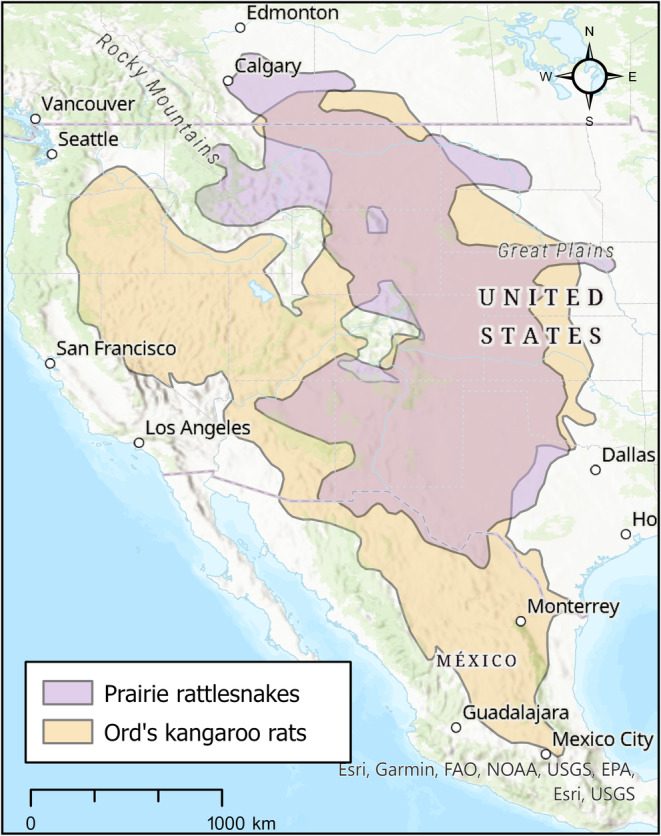
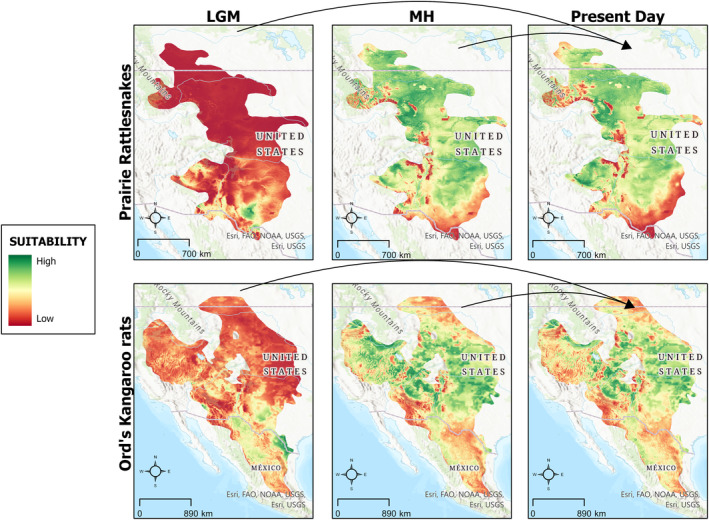
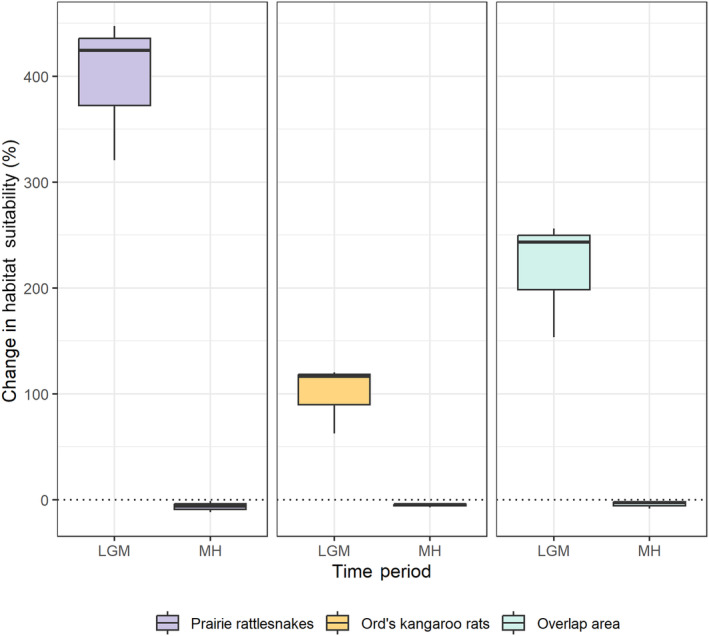
Climate change has the potential to disrupt species interactions across global ecosystems. Ectotherm-endotherm interactions may be especially prone to this risk due to the possible mismatch between the species in physiological response and performance. However, few studies have examined how changing temperatures might differentially impact species' niches or available suitable habitat when they have very different modes of thermoregulation. An ideal system for studying this interaction is the predator-prey system. In this study, we used ecological niche modeling to characterize the niche overlap and examine biogeography in past and future climate conditions of prairie rattlesnakes (Crotalus viridis) and Ord's kangaroo rats (Dipodomys ordii), an endotherm-ectotherm pair typifying a predator-prey species interaction. Our models show a high niche overlap between these two species (D = 0.863 and I = 0.979) and further affirm similar paleoecological distributions during the last glacial maximum (LGM) and mid-Holocene (MH). Under future climate change scenarios, we found that prairie rattlesnakes may experience a reduction in overall suitable habitat (RCP 2.6 = -1.82%, 4.5 = -4.62%, 8.5 = -7.34%), whereas Ord's kangaroo rats may experience an increase (RCP 2.6 = 9.8%, 4.5 = 11.71%, 8.5 = 8.37%). We found a shared trend of stable suitable habitat at northern latitudes but reduced suitability in southern portions of the range, and we propose future monitoring and conservation be focused on those areas. Overall, we demonstrate a biogeographic example of how interacting ectotherm-endotherm species may have mismatched responses under climate change scenarios and the models presented here can serve as a starting point for further investigation into the biogeography of these systems.
Keywords: climate change; ecological niche modeling; predator–prey interactions; rattlesnake; small mammal.
© 2024 The Authors. Ecology and Evolution published by John Wiley & Sons Ltd.
Conflict of interest statement
The authors declare they have no competing interests.
Figures



References
-
- Allouche, O. , Tsoar, A. , & Kadmon, R. (2006). Assessing the accuracy of species distribution models: Prevalence, kappa and the true skill statistic (TSS). Journal of Applied Ecology, 43(6), 1223–1232. 10.1111/j.1365-2664.2006.01214.x - DOI
-
- Almeida, A. M. , Martins, M. J. , Campagnolo, M. L. , Fernandez, P. , Albuquerque, T. , Gerassis, S. , Gonçalves, J. C. , & Ribeiro, M. M. (2022). Prediction scenarios of past, present, and future environmental suitability for the Mediterranean species Arbutus unedo L. Scientific Reports, 12(1), 1. 10.1038/s41598-021-03996-0 - DOI - PMC - PubMed
-
- Balint, M. , Domisch, S. , Engelhardt, C. H. , Haase, P. , Lehrian, S. , Sauer, J. , Theissinger, K. , Pauls, S. U. , & Nowak, C. (2011). Cryptic biodiversity loss linked to global climate change. Nature Climate Change, 1, 313–318. 10.1038/nclimate1191 - DOI
-
- Barbet‐Massin, M. , Jiguet, F. , Albert, C. H. , & Thuiller, W. (2012). Selecting psuedo‐absences for species distribution models: How, where, and how many? Methods in Ecology and Evolution, 3, 327–338. 10.1111/j.2041-210X.2011.00172 - DOI
Associated data
LinkOut - more resources
Full Text Sources
Other Literature Sources
Miscellaneous
