


Microfluidic chip as a promising evaluation method in assisted reproduction: A systematic review
- PMID: 38435817
- PMCID: PMC10905557
- DOI: 10.1002/btm2.10625
Microfluidic chip as a promising evaluation method in assisted reproduction: A systematic review
Abstract
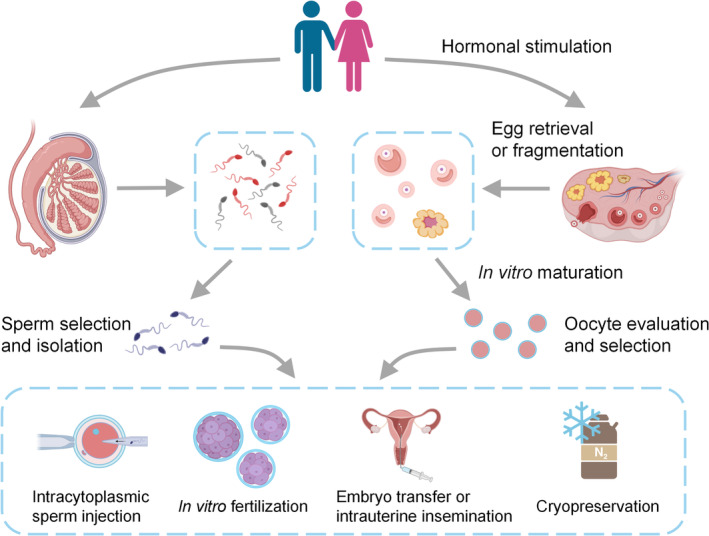
The aim of assisted reproductive technology (ART) is to select the high-quality sperm, oocytes, and embryos, and finally achieve a successful pregnancy. However, functional evaluation is hindered by intra- and inter-operator variability. Microfluidic chips emerge as the one of the most powerful tools to analyze biological samples for reduced size, precise control, and flexible extension. Herein, a systematic search was conducted in PubMed, Scopus, Web of Science, ScienceDirect, and IEEE Xplore databases until March 2023. We displayed and prospected all detection strategies based on microfluidics in the ART field. After full-text screening, 71 studies were identified as eligible for inclusion. The percentages of human and mouse studies equaled with 31.5%. The prominent country in terms of publication number was the USA (n = 13). Polydimethylsiloxane (n = 49) and soft lithography (n = 28) were the most commonly used material and fabrication method, respectively. All articles were classified into three types: sperm (n = 38), oocytes (n = 20), and embryos (n = 13). The assessment contents included motility, counting, mechanics, permeability, impedance, secretion, oxygen consumption, and metabolism. Collectively, the microfluidic chip technology facilitates more efficient, accurate, and objective evaluation in ART. It can even be combined with artificial intelligence to assist the daily activities of embryologists. More well-designed clinical studies and affordable integrated microfluidic chips are needed to validate the safety, efficacy, and reproducibility. Trial registration: The protocol was registered in the Open Science Frame REGISTRIES (identification: osf.io/6rv4a).
Keywords: assisted reproductive technology; evaluation; female reproduction; microfluidic chip; microfluidics.
© 2023 The Authors. Bioengineering & Translational Medicine published by Wiley Periodicals LLC on behalf of American Institute of Chemical Engineers.
Conflict of interest statement
The authors declare that they have no known competing financial interests or personal relationships that could have appeared to influence the work reported in this paper.
Figures


References
-
- Balasch J, Gratacós E. Delayed childbearing: effects on fertility and the outcome of pregnancy. Curr Opin Obstet Gynecol. 2012;24(3):187‐193. - PubMed
-
- Inhorn MC, Patrizio P. Infertility around the globe: new thinking on gender, reproductive technologies and global movements in the 21st century. Hum Reprod Update. 2015;21(4):411‐426. - PubMed
-
- Lutz W. Fertility rates and future population trends: will Europe's birth rate recover or continue to decline? Int J Androl. 2006;29(1):25‐33. - PubMed
Publication types
LinkOut - more resources
Full Text Sources
