


Exome and genome sequencing in a heterogeneous population of patients with rare disease: Identifying predictors of a diagnosis
- PMID: 38436216
- PMCID: PMC11161308
- DOI: 10.1016/j.gim.2024.101115
Exome and genome sequencing in a heterogeneous population of patients with rare disease: Identifying predictors of a diagnosis
Abstract
Purpose: Exome (ES) and genome sequencing (GS) are increasingly being utilized for individuals with rare and undiagnosed diseases; however, guidelines on their use remain limited. This study aimed to identify factors associated with diagnosis by ES and/or GS in a heterogeneous population of patients with rare and undiagnosed diseases.
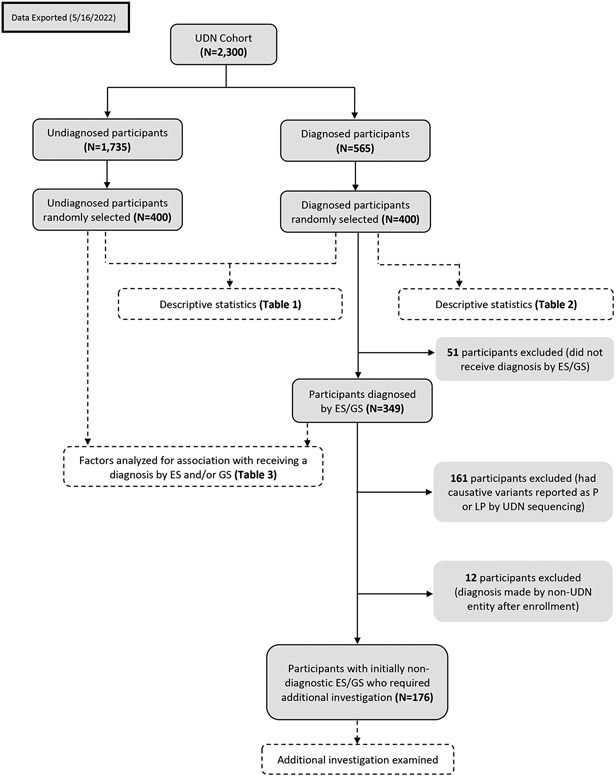
Methods: In this case control study, we reviewed data from 400 diagnosed and 400 undiagnosed randomly selected participants in the Undiagnosed Diseases Network, all of whom had undergone ES and/or GS. We analyzed factors associated with receiving a diagnosis by ES and/or GS.
Results: Factors associated with a decreased odds of being diagnosed included adult symptom onset, singleton sequencing, and having undergone ES and/or GS before acceptance to the Undiagnosed Diseases Network (48%, 51%, and 32% lower odds, respectively). Factors that increased the odds of being diagnosed by ES and/or GS included having primarily neurological symptoms and having undergone prior chromosomal microarray testing (44% and 59% higher odds, respectively).
Conclusion: We identified several factors that were associated with receiving a diagnosis by ES and/or GS. This will ideally inform the utilization of ES and/or GS and help manage expectations of individuals and families undergoing these tests.
Keywords: Exome sequencing; Genome sequencing; Predictors of a diagnosis; Rare disease; Undiagnosed disease.
Copyright © 2024 American College of Medical Genetics and Genomics. Published by Elsevier Inc. All rights reserved.
Conflict of interest statement
Conflict of Interest The authors declare no conflicts of interest.
Figures
References
-
- Haendel M, Vasilevsky N, Unni D, Bologa C, Harris N, Rehm H, Hamosh A, Baynam G, Groza T, McMurry J, Dawkins H, Rath A, Thaxon C, Bocci G, Joachimiak MP, Köhler S, Robinson PN, Mungall C, & Oprea TI (2020). How many rare diseases are there? Nature Reviews Drug Discovery, 19(2), 77–78. 10.1038/d41573-019-00180-y - DOI - PMC - PubMed
-
- Spillmann RC, McConkie-Rosell A, Pena L, Jiang Y-H, Adams CJ, Adams DR, Alejandro ME, Allard P, Ashley EA, Azamian MS, Bacino CA, Balasubramanyam A, Barseghyan H, Beggs AH, Bellen HJ, Bernstein JA, Bican A, Bick DP, Birch CL, … Undiagnosed Diseases Network. (2017). A window into living with an undiagnosed disease: Illness narratives from the Undiagnosed Diseases Network. Orphanet Journal of Rare Diseases, 12(1), 71. 10.1186/s13023-017-0623-3 - DOI - PMC - PubMed
Publication types
MeSH terms
Grants and funding
LinkOut - more resources
Full Text Sources
Medical
Molecular Biology Databases
