


Examining interrater agreement between self-report and proxy-report responses for the quality of life-aged care consumers (QOL-ACC) instrument
- PMID: 38436803
- PMCID: PMC10912388
- DOI: 10.1186/s41687-024-00705-z
Examining interrater agreement between self-report and proxy-report responses for the quality of life-aged care consumers (QOL-ACC) instrument
Abstract
Background: Quality of life is an important quality indicator for health and aged care sectors. However, self-reporting of quality of life is not always possible given the relatively high prevalence of cognitive impairment amongst older people, hence proxy reporting is often utilised as the default option. Internationally, there is little evidence on the impact of proxy perspective on interrater agreement between self and proxy report.
Objectives: To assess the impacts of (i) cognition level and (ii) proxy perspective on interrater agreement using a utility instrument, the Quality of Life-Aged Care Consumers (QOL-ACC).
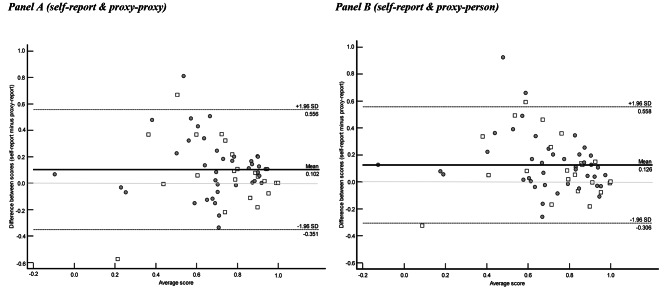
Methods: A cross-sectional study was undertaken with aged care residents and family member proxies. Residents completed the self-report QOL-ACC, while proxies completed two proxy versions: proxy-proxy perspective (their own opinion), and proxy-person perspective (how they believe the resident would respond). Interrater agreement was assessed using quadratic weighted kappas for dimension-level data and concordance correlation coefficients and Bland-Altman plots for utility scores.
Results: Sixty-three residents (22, no cognitive impairment; 41, mild-to-moderate cognitive impairment) and proxies participated. In the full sample and in the mild-to-moderate impairment group, the mean self-reported QOL-ACC utility score was significantly higher than the means reported by proxies, regardless of perspective (p < 0.01). Agreement with self-reported QOL-ACC utility scores was higher when proxies adopted a proxy-person perspective.
Conclusion: Regardless of cognition level and proxy perspective, proxies tend to rate quality of life lower than residents. Further research is needed to explore the impact of such divergences for quality assessment and economic evaluation in aged care.
Keywords: Family members; Long-term care; Older adults; Proxy assessment; QOL-ACC; Quality indicators; Quality of life; Residential aged care.
© 2024. The Author(s).
Conflict of interest statement
The authors declare that they have no competing interests.
Figures
References
-
- The Lancet Editorial. Aged care in Australia falls short. Lancet. 2019;394:1686. - PubMed
-
- Department of Health and Aged Care. National Aged Care Mandatory Quality Indicator Program (QI Program), Manual 3.01– Part A. Australian Government: Canberra. 2023 [cited 13 January 2023]; Available from: https://www.health.gov.au/sites/default/files/documents/2022/09/national...
-
- Care Quality Commission. Find a care home [webpage] (2023) [cited 23 January 2023]; Available from: https://www.cqc.org.uk/care-services/find-care-home
Publication types
MeSH terms
Grants and funding
LinkOut - more resources
Full Text Sources
Medical
