


Fire effects on pollination and plant reproduction: a quantitative review
- PMID: 38437644
- PMCID: PMC11805929
- DOI: 10.1093/aob/mcae033
Fire effects on pollination and plant reproduction: a quantitative review
Abstract
Background and aims: Fire may favour plant flowering by opening up the vegetation and increasing abiotic resource availability. Increased floral display size can attract more pollinators and increase absolute fruit and seed production immediately after a fire. However, anthropogenic increases in fire frequency may alter these responses. We aim to assess the effects of fire on the pollination and reproductive success of plants at the global scale.
Methods: We performed a systematic literature review and meta-analyses to examine overall fire effects as well as different fire parameters on pollination and on plant reproduction. We also explored to what extent the responses vary among pollinators, pollination vectors, plant regeneration strategies, compatibility systems, vegetation types and biomes.
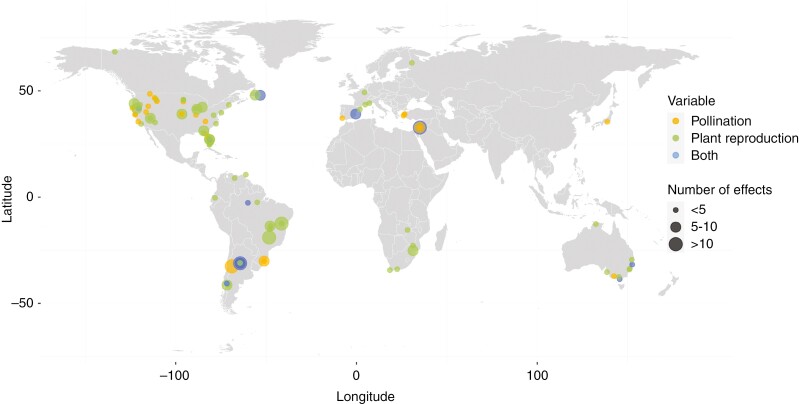
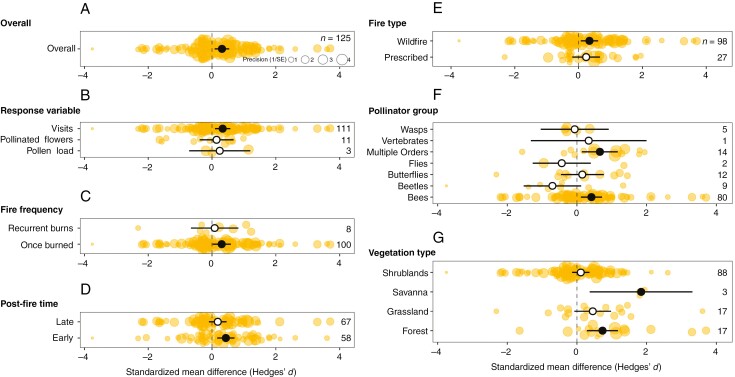
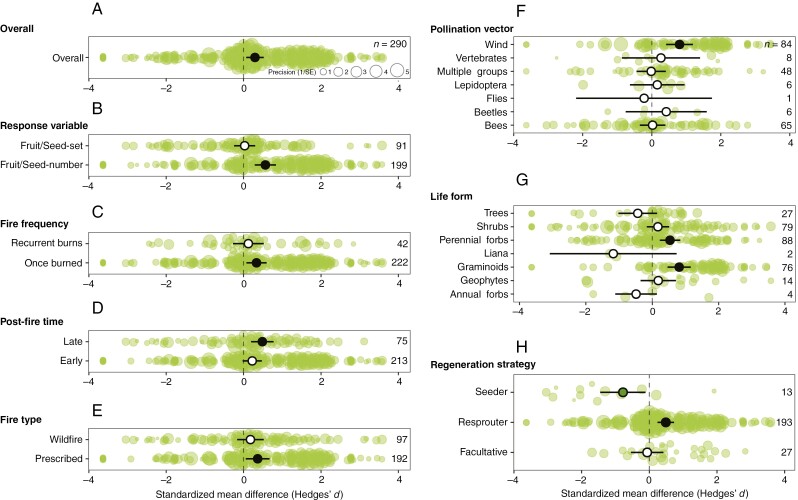
Key results: Most studies were conducted in fire-prone ecosystems. Overall, single fires increased pollination and plant reproduction but this effect was overridden by recurrent fires. Floral visitation rates of pollinators were enhanced immediately following a wildfire, and especially in bee-pollinated plants. Fire increased the absolute production of fruits or seeds but not fruit or seed set. The reproductive benefits were mostly observed in wind-pollinated (graminoids), herbaceous and resprouter species. Finally, fire effects on pollination were positively correlated with fire effects on plant reproductive success.
Conclusions: Fire has a central role in pollination and plant sexual reproduction in fire-prone ecosystems. The increase in the absolute production of fruits and seeds suggests that fire benefits to plant reproduction are probably driven by increased abiotic resources and the consequent floral display size. However, reproduction efficiency, as measured by fruit or seed set, does not increase with fire. In contrast, when assessed on the same plant simultaneously, fire effects on pollination are translated into reproduction. Increased fire frequency due to anthropogenic changes can alter the nature of the response to fire.
Keywords: Angiosperms; anthropic changes in fire regime; fire ecology; flowering plants; meta-analysis; plant fitness; plant sexual reproduction; plant–pollinator interaction; reproductive success.
© The Author(s) 2024. Published by Oxford University Press on behalf of the Annals of Botany Company. All rights reserved. For commercial re-use, please contact reprints@oup.com for reprints and translation rights for reprints. All other permissions can be obtained through our RightsLink service via the Permissions link on the article page on our site—for further information please contact journals.permissions@oup.com.
Conflict of interest statement
We have no conflicts of interest to declare.
Figures


References
-
- Aguilar R, Ashworth L, Galetto L, Aizen MA.. 2006. Plant reproductive susceptibility to habitat fragmentation: review and synthesis through a meta‐analysis. Ecology Letters 9: 968–980. - PubMed
-
- Aguilar R, Cristóbal‐Pérez EJ, Balvino‐Olvera FJ, et al. 2019. Habitat fragmentation reduces plant progeny quality: a global synthesis. Ecology Letters 22: 1163–1173. - PubMed
-
- Anderson JT. 2016. Plant fitness in a rapidly changing world. The New Phytologist 210: 81–87. - PubMed
-
- Araújo GM, Amaral AF, Bruna EM, Vasconcelos HL.. 2013. Fire drives the reproductive responses of herbaceous plants in a neotropical swamp. Plant Ecology 214: 1479–1484.
Publication types
MeSH terms
Grants and funding
LinkOut - more resources
Full Text Sources
