


Yeast mannan rich fraction positively influences microbiome uniformity, productivity associated taxa, and lay performance
- PMID: 38438939
- PMCID: PMC10913240
- DOI: 10.1186/s42523-024-00295-7
Yeast mannan rich fraction positively influences microbiome uniformity, productivity associated taxa, and lay performance
Erratum in
-
Correction: Yeast mannan rich fraction positively influences microbiome uniformity, productivity associated taxa, and lay performance.Anim Microbiome. 2024 May 2;6(1):22. doi: 10.1186/s42523-024-00310-x. Anim Microbiome. 2024. PMID: 38698466 Free PMC article. No abstract available.
Abstract
Background: Alternatives to antibiotic as growth promoters in agriculture, such as supplemental prebiotics, are required to maintain healthy and high performing animals without directly contributing to antimicrobial resistance bioburden. While the gut microbiota of broiler hens has been well established and successfully correlated to performance, to our knowledge, a study has yet to be completed on the effect of prebiotic supplementation on correlating the mature laying hen productivity and microbiota. This study focused on establishing the impact of a yeast derived prebiotic, mannan rich fraction (MRF), on the cecal microbiota of late laying hens. This study benefitted from large sample sizes so intra- and intergroup variation effects could be statistically accounted for.
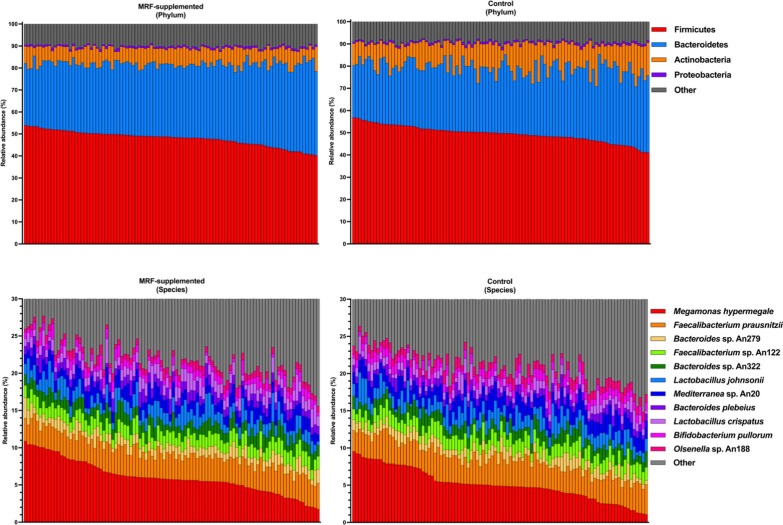
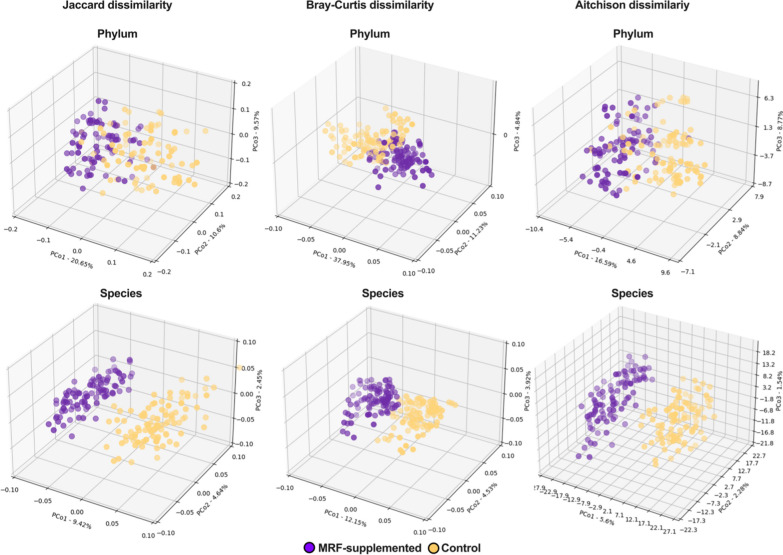
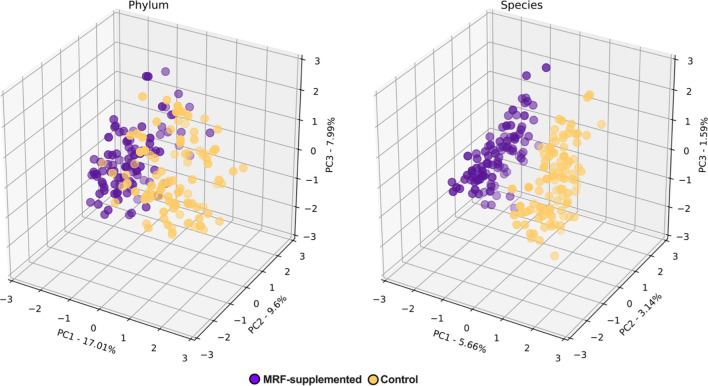
Results: Taxonomic richness was significantly greater at all taxonomic ranks and taxonomic evenness was significantly lower for all taxonomic ranks in MRF-supplemented birds (P < 0.005). Use of principal coordinate analyses and principal component analyses found significant variation between treatment groups. When assessed for compositional uniformity (an indicator of flock health), microbiota in MRF-supplemented birds was more uniform than control birds at the species level. From a food safety and animal welfare perspective, Campylobacter jejuni was significantly lower in abundance in MRF-supplemented birds. In this study, species associated with high weight gain (an anticorrelator of performance in laying hens) were significantly lower in abundance in laying hens while health-correlated butyrate and propionate producing species were significantly greater in abundance in MRF-supplemented birds.
Conclusions: The use of prebiotics may be a key factor in controlling the microbiota balance limiting agri-food chain pathogen persistence and in promoting uniformity. In previous studies, increased α- and β-diversity indices were determinants of pathogen mitigation and performance. MRF-supplemented birds in this study established greater α- and β-diversity indices in post-peak laying hens, greater compositional uniformity across samples, a lower pathogenic bioburden and a greater abundance of correlators of performance.
© 2024. The Author(s).
Conflict of interest statement
RL was in receipt of a Postdoctoral Fellowship funded by Alltech for the duration of this study. AC and RM were in receipt of salaries from Alltech for the duration of this study. Alltech is a manufacturer of animal feed and dietary supplements. CM and JTP are employees of Alltech which produces and markets Actigen®, the commercial product evaluated in this study.
Figures


References
-
- Aitchison J. The statistical analysis of compositional data. J Roy Stat Soc: Ser B (Methodol) 1982;44(2):139–160. doi: 10.1111/J.2517-6161.1982.TB01195.X. - DOI
-
- Anderson MJ. A new method for non-parametric multivariate analysis of variance. Austral Ecol. 2001;26(1):32–46. doi: 10.1111/j.1442-9993.2001.01070.pp.x. - DOI
-
- Andrews S et al. (2015) ‘FastQC. A quality control tool for high throughput sequence data. Babraham Bioinformatics’, 1(1), p. undefined-undefined. Available at: https://www.mendeley.com/catalogue/8057171e-e700-36a0-b936-1c307058462d/... (Accessed: 18 August 2021).
LinkOut - more resources
Full Text Sources
Miscellaneous