


Interventions to promote health literacy among working-age populations experiencing socioeconomic disadvantage: systematic review
- PMID: 38439762
- PMCID: PMC10909862
- DOI: 10.3389/fpubh.2024.1332720
Interventions to promote health literacy among working-age populations experiencing socioeconomic disadvantage: systematic review
Abstract
Background: Experiencing financial insecurity and being underserved is often associated with low health literacy, i.e., the ability to identify, obtain, interpret and act upon health information, which may result in poor health outcomes. Little is known about effective interventions for promoting health literacy among underserved populations. The objective of this systematic review is to summarize the literature on such interventions and identify characteristics that differentiate more effective interventions.
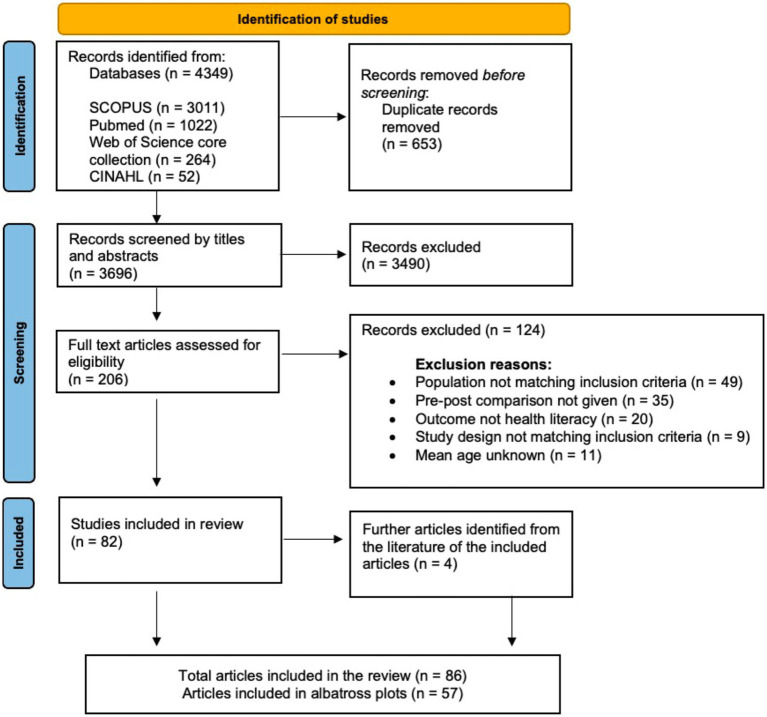
Methods: Following PRISMA guidelines we searched the databases SCOPUS, Pubmed, Web of Science core collection and CINAHL. We included primary studies with a quantitative study design and control groups testing interventions to increase health literacy or health knowledge in underserved populations between 18 and 65 years. Where possible, we converted effect sizes into Cohen's d and compared mean differences of intervention and control groups. Albatross plots were created to summarize the results according to different health literacy and health knowledge outcomes.
Results: We screened 3,696 titles and abstracts and 206 full texts. In total, 86 articles were analyzed, of which 55 were summarized in seven albatross plots. The majority of the studies (n = 55) were conducted in the United States and had a randomized controlled study design (n = 44). More effective intervention approaches assessed needs of participants through focus group discussions prior to conducting the intervention, used bilingual educational materials, and included professionals fluent in the first languages of the study population as intervention deliverers. Additionally, the use of educational materials in video and text form, fotonovelas and interactive group education sessions with role playing exercises were observed to be effective.
Discussion: Although the outcomes addressed in the included studies were heterogeneous, effective intervention approaches were often culturally sensitive and developed tailored educational materials. Interventions aiming to promote health literacy in underserved populations should hence consider applying similar approaches.Systematic review registration: https://www.crd.york.ac.uk/prospero/display_record.php?RecordID=323801, PROSPERO registration ID: CRD42022323801.
Keywords: albatross plots; face-to-face; health literacy; intervention strategies; multilingual education; socioeconomically disadvantaged; systematic review.
Copyright © 2024 Singh, Samkange-Zeeb, Kolschen, Herrmann, Hübner, Barnils, Brand, Zeeb and Schüz.
Conflict of interest statement
The authors declare that the research was conducted in the absence of any commercial or financial relationships that could be construed as a potential conflict of interest.
Figures


References
Publication types
MeSH terms
LinkOut - more resources
Full Text Sources
Medical
