. 2024 Mar 5;14(1):3369.
doi: 10.1038/s41598-024-53294-8.

Single-polyp metabolomics for coral health assessment

Affiliations

Single-polyp metabolomics for coral health assessment

Akira Iguchi et al. Sci Rep. .

Abstract

Coral reef ecosystems supported by environmentally sensitive reef-building corals face serious threats from human activities. Our understanding of these reef threats is hampered by the lack of sufficiently sensitive coral environmental impact assessment systems. In this study, we established a platform for metabolomic analysis at the single-coral-polyp level using state-of-the-art mass spectrometry (probe electrospray ionization/tandem mass spectrometry; PESI/MS/MS) capable of fine-scale analysis. We analyzed the impact of the organic UV filter, benzophenone (BP), which has a negative impact on corals. We also analyzed ammonium and nitrate samples, which affect the environmental sensitivity of coral-zooxanthella (Symbiodiniaceae) holobionts, to provide new insights into coral biology with a focus on metabolites. The method established in this study breaks new ground by combining PESI/MS/MS with a technique for coral polyps that can control the presence or absence of zooxanthellae in corals, enabling functions of zooxanthellae to be assessed on a polyp-by-polyp basis for the first time. This system will clarify biological mechanisms of corals and will become an important model system for environmental impact assessment using marine organisms.


Conflict of interest statement

The authors declare no competing interests.

Figures
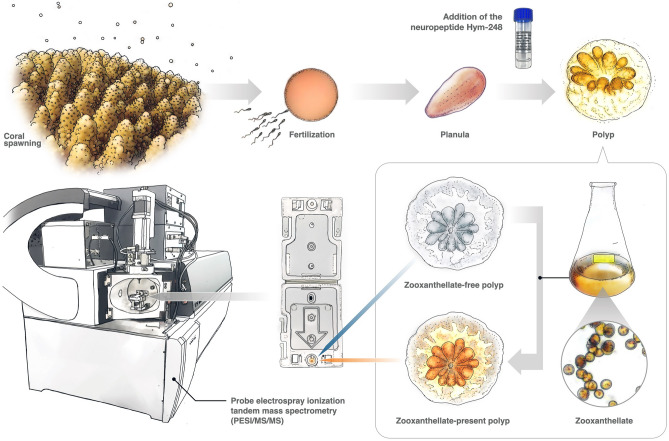
Figure 1
Figure 1
Schematic of the experimental flow using coral polyps and probe electrospray ionization/tandem mass spectrometry (PESI/MS/MS). Holobionts can be created by artificially adding zooxanthellate. Metabolomic data can be acquired within 2.4 min by fixing the sample plate under a fine needle that acquires metabolite data.
Figure 2
Figure 2
Principal component analysis (PCA) of the BP treatment. Dotted and solid circles in score plots indicate 95% and 99% confidence intervals for all plots, respectively. Colored circles indicate 95% confidence intervals for each group; (A) primary polyps without zooxanthellae; (B) primary polyps with zooxanthellae. PC1, first principal component; PC2, second principal component; BP, BP treatment, C, control and S, zooxanthellae present.
Figure 3
Figure 3
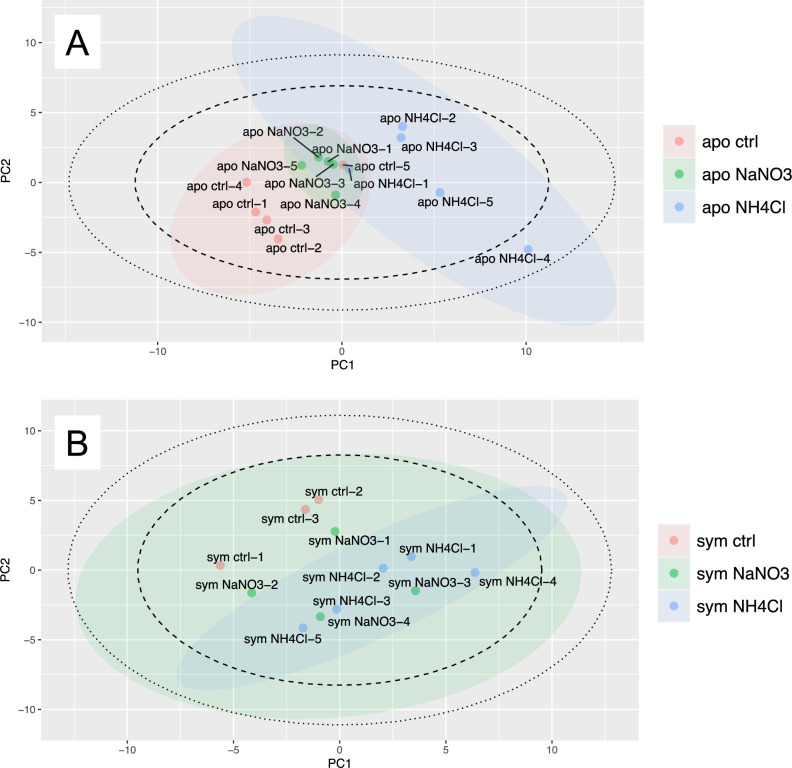
Principal component analysis (PCA) of nitrate and ammonium treatments. Dotted and solid circles in score plots indicate 95% and 99% confidence intervals for all plots, respectively. Colored circles indicate 95% confidence intervals for each group; (A) primary polyps without zooxanthellae; (B) primary polyps with zooxanthellae. PC1, first principal component; PC2, second principal component; apo, sym, without and with zooxanthellae, respectively; NaNO3, nitrate treatment; NH4Cl, ammonium treatment; ctrl, control.

References

    1. Richardson K, et al. Earth beyond six of nine planetary boundaries. Sci. Adv. 2023;9:eadh2458. doi: 10.1126/sciadv.adh2458. - DOI - PMC - PubMed
    1. Moberg F, Folke C. Ecological goods and services of coral reef ecosystems. Ecol. Econ. 1999;29:215–233. doi: 10.1016/S0921-8009(99)00009-9. - DOI
    1. Costanza R, et al. Changes in the global value of ecosystem services. Glob. Environ. Chang. 2014;26:152–158. doi: 10.1016/j.gloenvcha.2014.04.002. - DOI
    1. Hughes TP, et al. Coral reefs in the Anthropocene. Nature. 2017;546:82–90. doi: 10.1038/nature22901. - DOI - PubMed
    1. Hughes TP, et al. Global warming and recurrent mass bleaching of corals. Nature. 2017;543:373–377. doi: 10.1038/nature21707. - DOI - PubMed