


Facile encapsulation of cyanoacrylate-based bioadhesive by electrospray method and investigation of the process parameters
- PMID: 38443417
- PMCID: PMC10914717
- DOI: 10.1038/s41598-024-56008-2
Facile encapsulation of cyanoacrylate-based bioadhesive by electrospray method and investigation of the process parameters
Abstract
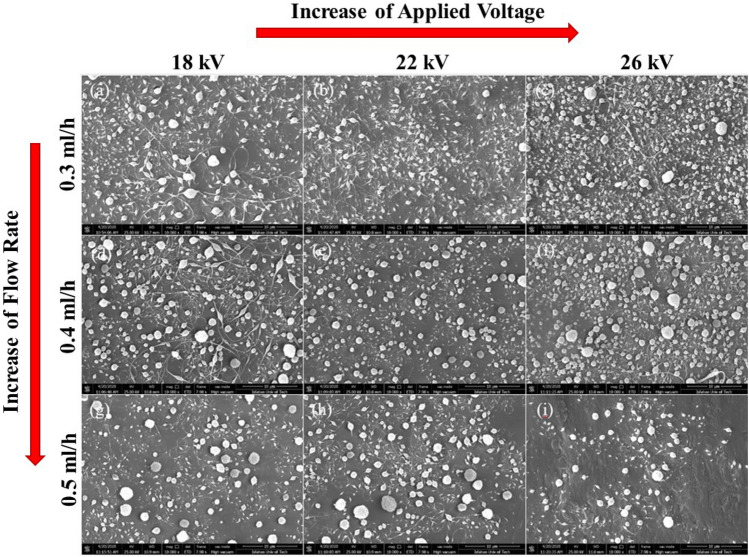
Polymer microcapsules containing cyanoacrylates have represented a promising option to develop self-healing biomaterials. This study aims to develop an electrospray method for the preparation of capsules using poly(methyl methacrylate) (PMMA) as the encapsulant and ethyl 2-cyanoacrylate (EC) as the encapsulate. It also aims to study the effect of the electrospray process parameters on the size and morphology of the capsules. The capsules were characterized using Fourier-transform infrared (FTIR) spectroscopy, thermogravimetric analysis (TGA), and field-emission scanning electron microscopy (FE-SEM). Moreover, the effects of electrospray process parameters on the size were investigated by Taguchi experimental design. FTIR and TGA approved the presence of both PMMA and EC without further reaction. FE-SEM micrograph demonstrated that an appropriate choice of solvents, utilizing an appropriate PMMA:EC ratio and sufficient PMMA concentration are critical factors to produce capsules dominantly with an intact and spherical morphology. Utilizing various flow rates (0.3-0.5 ml/h) and applied voltage (18-26 kV), capsules were obtained with a 600-1000 nm size range. At constantly applied voltages, the increase in flow rate increased the capsule size up to 40% (ANOVA, p ≤ 0.05), while at constant flow rates, the increase in applied voltage reduced the average capsule size by 3.4-26% (ANOVA, p ≤ 0.05). The results from the Taguchi design represented the significance of solution flow rate, applied voltage, and solution concentration. It was shown that the most effective parameter on the size of capsules is flow rate. This research demonstrated that electrospray can be utilized as a convenient method for the preparation of sub-micron PMMA capsules containing EC. Furthermore, the morphology of the capsules is dominated by solvents, PMMA concentration, and PMMA:EC ratio, while the average size of the capsules can be altered by adjusting the flow rate and applied voltage of the electrospray process.
Keywords: Bioadhesive; Electrospray; Encapsulation; Microcapsules; Taguchi design.
© 2024. The Author(s).
Conflict of interest statement
The authors declare no competing interests.
Figures




Similar articles
-
Synthesis of calcium carbonate microcapsules as self-healing containers.RSC Adv. 2019 Jul 30;9(41):23666-23677. doi: 10.1039/c9ra03804c. eCollection 2019 Jul 29. RSC Adv. 2019. PMID: 35530589 Free PMC article.
-
Preparation and investigation of poly(methylmethacrylate) nano-capsules containing haloxyfop-R-methyl and their release behavior.J Environ Sci Health B. 2020;55(4):301-309. doi: 10.1080/03601234.2019.1692614. Epub 2019 Dec 9. J Environ Sci Health B. 2020. PMID: 31814523
-
Preparation and tribological behaviour of poly(methyl methacrylate) (PMMA) microcapsules containing friction modifiers.J Microencapsul. 2020 Jun;37(4):314-323. doi: 10.1080/02652048.2020.1740805. Epub 2020 Mar 18. J Microencapsul. 2020. PMID: 32149534
-
Sub-micronic capsules based on gelatin and poly(maleic anhydride-alt-vinyl acetate) obtained by interfacial condensation with potential biomedical applications.J Nanosci Nanotechnol. 2013 Jun;13(6):3841-50. doi: 10.1166/jnn.2013.7224. J Nanosci Nanotechnol. 2013. PMID: 23862416
-
Investigation of the Shear Thickening Fluid Encapsulation in an Orifice Coagulation Bath.Polymers (Basel). 2019 Mar 19;11(3):519. doi: 10.3390/polym11030519. Polymers (Basel). 2019. PMID: 30960503 Free PMC article.
References
-
- Lomas H, et al. Biomimetic pH sensitive polymersomes for efficient DNA encapsulation and delivery. Adv. Mater. 2007;19:4238–4243. doi: 10.1002/adma.200700941. - DOI
-
- He Y, Zhang J, Cai Y, Yi L. Encapsulation of organic pigment via a facile dispersion approach and soap-free miniemulsion polymerization. Prog. Org. Coat. 2021;159:106403. doi: 10.1016/j.porgcoat.2021.106403. - DOI
-
- Sadeghi SAM, Borhani S, Zadhoush A, Dinari M. Self-healing performance of hybrid core-shell nanofibers mat containing epoxy-mercaptan at subroom temperature. Polym. Compos. 2021;42:2422–2431. doi: 10.1002/pc.25988. - DOI
-
- Neisiany, R. E., Aminoroaya, A., Farzi, G. & Das, O. in Principles of Biomaterials Encapsulation : Volume One Vol. 1 (eds Sefat, F., Farzi, G., & Mozafari, M.) 253–269 (Woodhead Publishing, 2023).
LinkOut - more resources
Full Text Sources
