Review
. 2024 Apr;21(4):315-331.
doi: 10.1038/s41423-024-01145-x. Epub 2024 Mar 5.

Development of NK cell-based cancer immunotherapies through receptor engineering

Affiliations
Review

Development of NK cell-based cancer immunotherapies through receptor engineering

Audrey Page et al. Cell Mol Immunol. 2024 Apr.

Abstract

Natural killer (NK) cell-based immunotherapies are attracting increasing interest in the field of cancer treatment. Early clinical trials have shown promising outcomes, alongside satisfactory product efficacy and safety. Recent developments have greatly increased the therapeutic potential of NK cells by endowing them with enhanced recognition and cytotoxic capacities. This review focuses on surface receptor engineering in NK cell therapy and discusses its impact, challenges, and future directions.Most approaches are based on engineering with chimeric antigen receptors to allow NK cells to target specific tumor antigens independent of human leukocyte antigen restriction. This approach has increased the precision and potency of NK-mediated recognition and elimination of cancer cells. In addition, engineering NK cells with T-cell receptors also mediates the recognition of intracellular epitopes, which broadens the range of target peptides. Indirect tumor peptide recognition by NK cells has also been improved by optimizing immunoglobulin constant fragment receptor expression and signaling. Indeed, engineered NK cells have an improved ability to recognize and destroy target cells coated with specific antibodies, thereby increasing their antibody-dependent cellular cytotoxicity. The ability of NK cell receptor engineering to promote the expansion, persistence, and infiltration of transferred cells in the tumor microenvironment has also been explored. Receptor-based strategies for sustained NK cell functionality within the tumor environment have also been discussed, and these strategies providing perspectives to counteract tumor-induced immunosuppression.Overall, receptor engineering has led to significant advances in NK cell-based cancer immunotherapies. As technical challenges are addressed, these innovative treatments will likely reshape cancer immunotherapy.

Keywords: CAR; Cell therapy; NK cells; Receptor engineering.


Conflict of interest statement

N.C. is an employee of ErVimmune, A.P. and J.V.-G. are consultants for ErVimmune, and S.D. is the founder and chairperson of ErVimmune. The authors declare that they have no other competing interests.

Figures
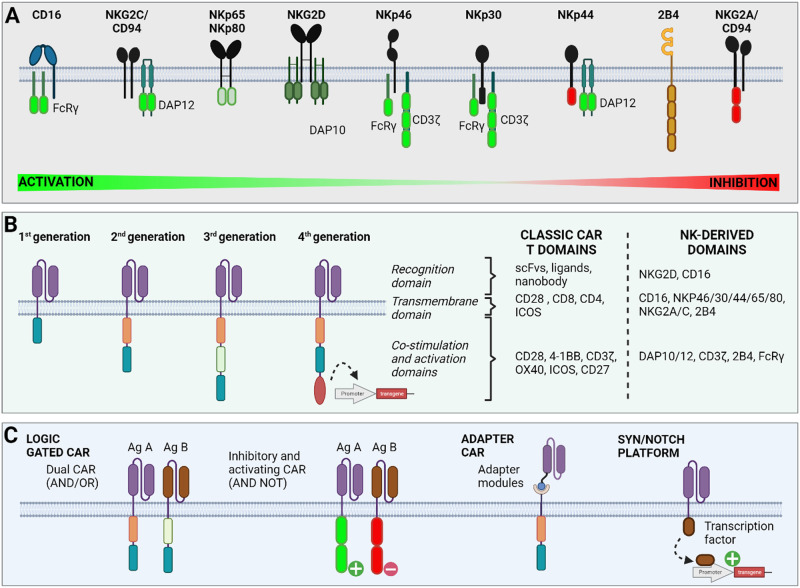
Fig. 1
Fig. 1
Structure of endogenous chimeric antigen receptors used in NK cell adoptive therapies. A NK cells harbor different activating or inhibitory receptors that directly contain activating (green) or inhibitory domains (red) or are associated with coreceptors required for signaling, such as DAP10/12 or CD3ζ. B Several generations of CAR constructs with recognition domains fused to transmembrane domains and intracellular signaling domains have been designed. Depending on the generation, one or multiple intracellular domains can be combined (either based on T-cell receptor domains or specifically derived from NK cell receptors to activate cells and enhance functionality). In the fourth generation, a transgene encoding cytokines is also inserted and placed under the regulation of an NFAT-sensitive promoter, which is activated upon recognition of the antigen by the CAR construct. C Logic-gated synthetic circuits, such as dual CARs or inhibitory CARs, have been combined in CAR-NK cells. Innovative approaches, including adapter CARs and Syn/notch receptors, are also compatible with the use of NK cells
Fig. 2
Fig. 2
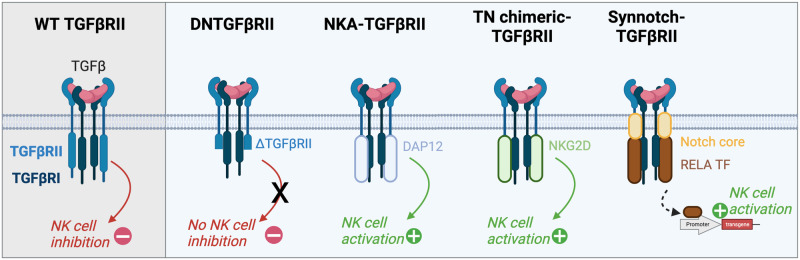
Hijacking the TGFβRII receptor promotes NK cell activation. Upon the recognition of TGFβ by the wild-type TGFβRII receptor, a signaling cascade is initiated, resulting in a compromised NK cell phenotype and reduced cytotoxicity. A dominant-negative mutant in which most of the intracellular domain of TGFβRII was deleted abrogated signaling in response to TGFβ, thus preventing NK cell inhibition. This intracellular region was also replaced by the intracellular domains of DAP12 and NKG2D, which mediate NK cell activation upon TGFβ recognition by the extracellular regions of TGFβRII. The Syn/notch platform was combined with TGFβRII: the transmembrane region of this receptor was fused to the Notch core domain and to the RELA transcription factor on the intracellular region. Upon recognition of TGFβ, a mechanical force is triggered, leading to the release of the RELA transcription factor, which induces genes involved in NK cell activation

References

    1. Gill S, Olson JA, Negrin RS. Natural killer cells in allogeneic transplantation: effect on engraftment, graft- versus-tumor, and graft-versus-host responses. Biol Blood Marrow Transplant. 2009;15:765–76. doi: 10.1016/j.bbmt.2009.01.019. - DOI - PMC - PubMed
    1. Freud AG, Mundy-Bosse BL, Yu J, Caligiuri MA. The broad spectrum of human natural killer cell diversity. Immunity. 2017;47:820–33. doi: 10.1016/j.immuni.2017.10.008. - DOI - PMC - PubMed
    1. Dogra P, Rancan C, Ma W, Toth M, Senda T, Carpenter DJ, et al. Tissue determinants of human NK cell development, function, and residence. Cell. 2020;180:749–763.e13. doi: 10.1016/j.cell.2020.01.022. - DOI - PMC - PubMed
    1. Buckle I, Johnson A, Rojas IL, Weinert V, Sester DP, Radford K, et al. High dimensional analysis reveals distinct NK cell subsets but conserved response to stimulation in umbilical cord blood and adult peripheral blood. Eur J Immunol. 2023;53:2250118. doi: 10.1002/eji.202250118. - DOI - PubMed
    1. Wang W. NK cell-mediated antibody-dependent cellular cytotoxicity in cancer immunotherapy. Front Immunol. 2015;6. 10.3389/fimmu.2015.00368. - PMC - PubMed

Substances