


Kinetic control over the chiral-selectivity in the formation of organometallic polymers on a Ag(110) surface
- PMID: 38443451
- PMCID: PMC10914819
- DOI: 10.1038/s42004-024-01137-y
Kinetic control over the chiral-selectivity in the formation of organometallic polymers on a Ag(110) surface
Abstract
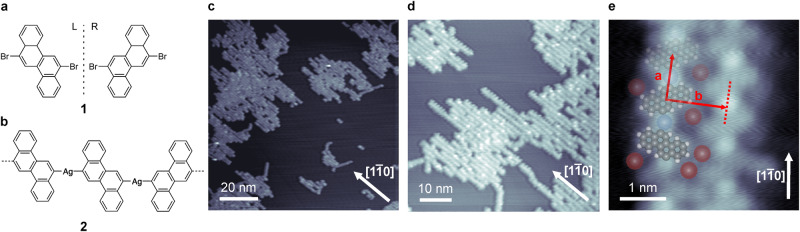
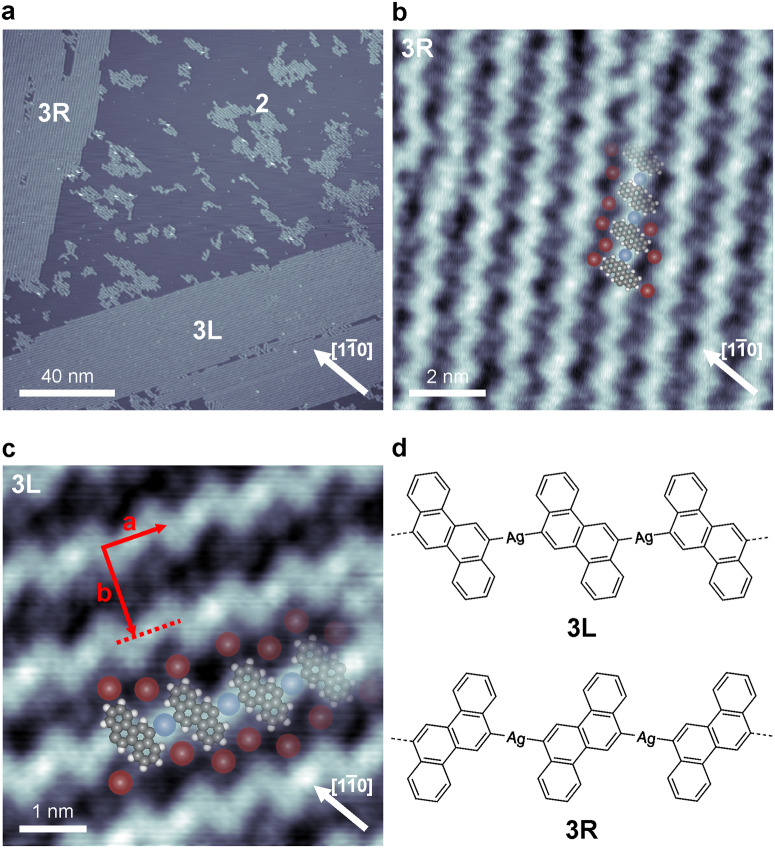
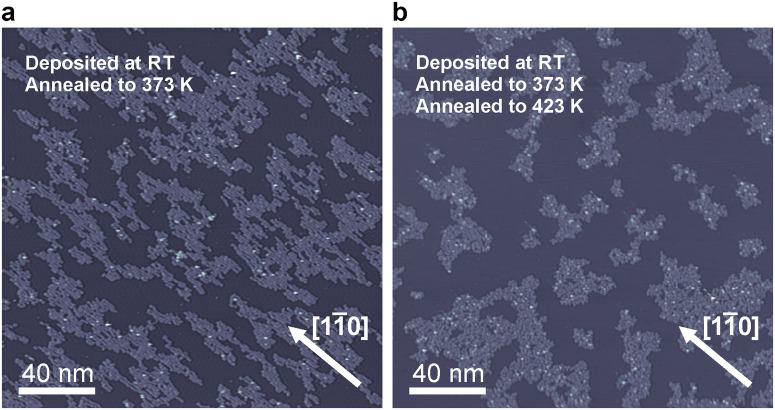
Methods to control chiral-selectivity in molecular reactions through external inputs are of importance, both from a fundamental and technological point of view. Here, the self-assembly of prochiral 6,12-dibromochrysene monomers on Ag(110) is studied using scanning tunneling microscopy. Deposition of the monomers on a substrate held at room temperature leads to the formation of 1D achiral organometallic polymers. When the monomers are instead deposited on a substrate held at 373 K, homochiral organometallic polymers consisting of either the left- or right-handed enantiomer are formed. Post-deposition annealing of room temperature deposited samples at >373 K does not transform the achiral 1D organometallic polymers into homochiral ones and thus, does not yield the same final structure as if depositing onto a substrate held at the same elevated temperature. Furthermore, annealing promotes neither the formation of 1D covalently-coupled polymers nor the formation of graphene nanoribbons. Our results identify substrate temperature as an important factor in on-surface chiral synthesis, thereby demonstrating the importance of considering kinetic effects and the decisive role they can play in structure formation.
© 2024. The Author(s).
Conflict of interest statement
The authors declare no competing interests.
Figures
References
-
- Ernst KH. Molecular chirality at surfaces. Phys. Status Solidi (B) 2012;249:2057–2088. doi: 10.1002/pssb.201248188. - DOI
Grants and funding
LinkOut - more resources
Full Text Sources
