


Barriers and facilitators to acceptance and implementation of eMental-health intervention among older adults: A qualitative systematic review
- PMID: 38444518
- PMCID: PMC10913496
- DOI: 10.1177/20552076241234628
Barriers and facilitators to acceptance and implementation of eMental-health intervention among older adults: A qualitative systematic review
Abstract
Objective: Electronic mental health interventions are effective but not well promoted currently among older adults. This study sought to systematically review and summarize the barriers and facilitators of accepting and implementing electronic mental health interventions among older adults.
Methods: We comprehensively retrieved six electronic databases from January 2012 to September 2022: PubMed, Web of Science, Embase, Scopus, PsycINFO, and CINAHL. The JBI-QARI was used to assess the quality of the research methodology of each publication. Eligible studies underwent data coding and synthesis aligned to inductive and deductive methods. The Consolidated Framework for Implementation Research 2.0 was used as a deductive framework to guide a more structured analysis.
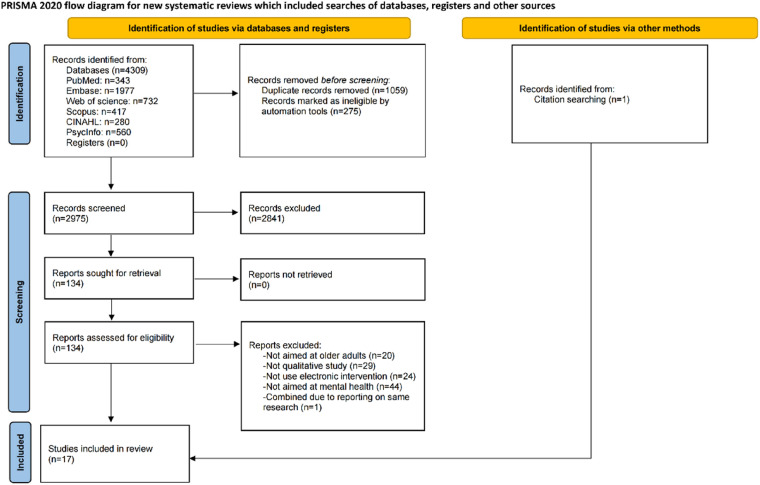
Results: The systematic review screened 4309 articles, 17 of which were included (eight with mixed methods and nine with qualitative methods). We identified and extracted the barriers and facilitators of accepting and implementing electronic mental health interventions among older adults: (1) innovation: technology challenges, optimized functions, and contents, security and privacy; (2) outer setting: community engagement and partnerships, financing; (3) inner setting: leadership engagement, available resources, incompatibility, intergenerational support, training and guidance; (4) individuals: perceptions, capability, motivation of older adults and healthcare providers; and (5) implementation process: recruit, external assistance, and team.
Conclusion: These findings are critical to optimizing, promoting, and expanding electronic mental health interventions among older adults. The systematic review also provides a reference for better evidence-based implementation strategies in the future.
Keywords: barriers; eMental health; facilitators; older adults; qualitative systematic review.
© The Author(s) 2024.
Conflict of interest statement
The author(s) declared no potential conflicts of interest with respect to the research, authorship, and/or publication of this article.
Figures
References
-
- Organization WH. Ageing and Health, 2022.
-
- Organization WH. Mental health of older adults, https://www.who.int/news-room/fact-sheets/detail/mental-health-of-older-... (2017).
-
- Lloyd CE, Nouwen A, Sartorius N, et al. Prevalence and correlates of depressive disorders in people with type 2 diabetes: results from the international prevalence and treatment of diabetes and depression (INTERPRET-DD) study, a collaborative study carried out in 14 countries. Diabet Med 2018; 35: 760–769. - PubMed
-
- Luo MS, Chui EWT, Li LW. The longitudinal associations between physical health and mental health among older adults. Aging Ment Health 2020; 24: 1990–1998. - PubMed
Publication types
LinkOut - more resources
Full Text Sources
