. 2023 Jun 1;49(6):288-298.
doi: 10.14745/ccdr.v49i06a06.

Surveillance for Ixodes scapularis and Ixodes pacificus ticks and their associated pathogens in Canada, 2020

Affiliations

Surveillance for Ixodes scapularis and Ixodes pacificus ticks and their associated pathogens in Canada, 2020

Christy Wilson et al. Can Commun Dis Rep. .

Abstract

Background: Ixodes scapularis and Ixodes pacificus ticks are the principal vectors of the agent of Lyme disease and several other tick-borne diseases in Canada. Tick surveillance data can be used to identify local tick-borne disease risk areas and direct public health interventions. The objective of this article is to describe the seasonal and spatial characteristics of the main Lyme disease vectors in Canada, and the tick-borne pathogens they carry, using passive and active surveillance data from 2020.

Methods: Passive and active surveillance data were compiled from the National Microbiology Laboratory Branch (Public Health Agency of Canada), provincial and local public health authorities, and eTick (an online, image-based platform). Seasonal and spatial analyses of ticks and their associated pathogens are presented, including infection prevalence estimates.

Results: In passive surveillance, I. scapularis (n=7,534) were submitted from all provinces except Manitoba and British Columbia, while I. pacificus (n=718) were submitted only from British Columbia. No ticks were submitted from the Territories. The seasonal distribution of I. scapularis submissions was bimodal, but unimodal for I. pacificus. Four tick-borne pathogens were identified in I. scapularis (Borrelia burgdorferi, Anaplasma phagocytophilum, Babesia microti and Borrelia miyamotoi) and one in I. pacificus (B. miyamotoi). In active surveillance, I. scapularis (n=688) were collected in Ontario, Québec and New Brunswick. Five tick-borne pathogens were identified: B. burgdorferi, A. phagocytophilum, B. microti, B. miyamotoi and Powassan virus.

Conclusion: This article provides a snapshot of the distribution of I. scapularis and I. pacificus and their associated human pathogens in Canada in 2020, which can help assess the risk of exposure to tick-borne pathogens in different provinces.

Keywords: Anaplasma; Babesia; Borrelia; Ixodes pacificus; Ixodes scapularis; Powassan virus; surveillance.


Conflict of interest statement

Competing interests None.

Figures
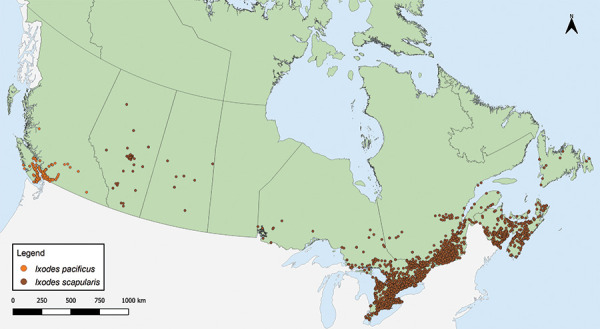
Figure 1
Figure 1
Ixodes pacificus and Ixodes scapularis ticks submitted through passive tick surveillance, Canada, 2020a a Each dot represents the probable location of acquisition for an I. pacificus (n=718) or I. scapularis (n=7,397) tick submitted through passive surveillance. Ticks from Alberta Health were mapped to the centroid of the forward sortation area (first three characters of the postal code) of acquisition. One hundred and thirty-seven ticks were not mapped because the probable location of acquisition could not be determined
Figure 2
Figure 2
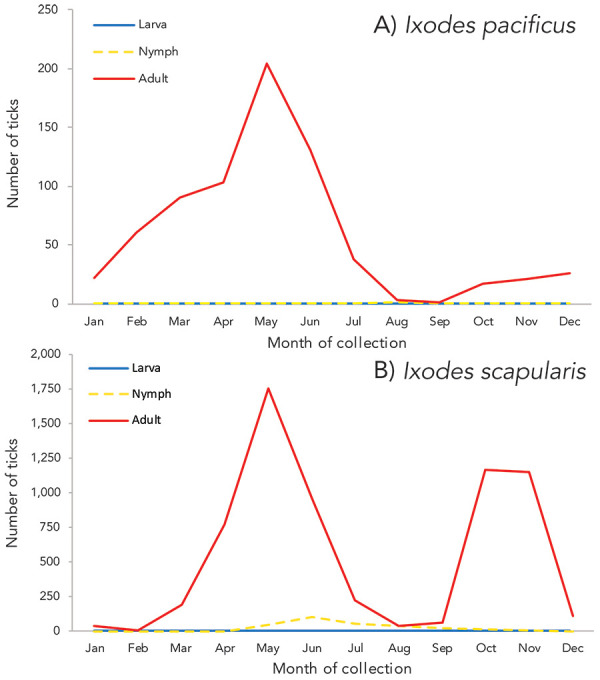
Number of Ixodes pacificus and Ixodes scapularis ticks submitted through passive surveillance, by month and tick instar, Canada, 2020a a Data are presented for I. pacificus (n=718) and I. scapularis (n=6,755) ticks submitted through passive surveillance. Month of submission or tick instar was not available for I. scapularis (n=779)
Figure 3
Figure 3
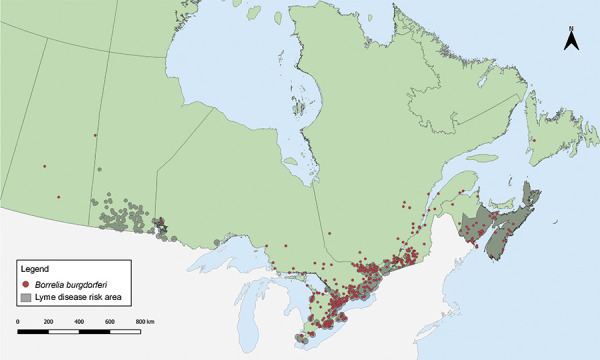
Ixodes scapularis ticks submitted through passive surveillance infected with Borrelia burgdorferi, Canada, 2020a,b a Each dot represents the probable location of acquisition of at least one I. scapularis (n=860) single or multiple tick submission submitted through passive surveillance that was infected with B. burgdorferi. Eight ticks were not mapped because the probable location of acquisition could not be determined b Lyme disease risk areas are identified by the provinces as of 2021 using the methods described in the 2016 national Lyme disease case definition ((22)). On the map, risk areas are identified as hatched gray areas
Figure 4
Figure 4
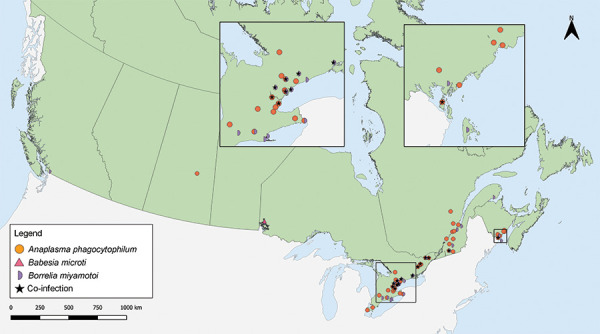
Ixodes pacificus and Ixodes scapularis ticks submitted through passive surveillance infected with Anaplasma phagocytophilum, Babesia microti, Borrelia miyamotoi and co-infections, Canada, 2020a a Each symbol represents the probable location of acquisition of an I. pacificus (n=1) or I. scapularis (n=67) single or multiple tick submission submitted through passive surveillance that tested positive for A. phagocytophilum (n=42), B. microti (n=1), B. miyamotoi (n=25) or a co-infection (n=14). Co-infections were limited to only single submissions of ticks and include B. burgdorferi + B. miyamotoi (n=7), B. burgdorferi + A. phagocytophilum (n=6) and A. phagocytophilum + B. miyamotoi (n=1) all in I. scapularis. Two ticks with A. phagocytophilum and one tick with B. miyamotoi were not mapped because the probable location of acquisition could not be determined
Figure 5
Figure 5
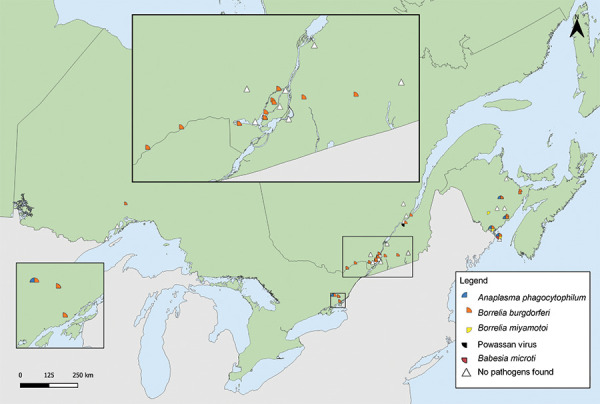
Ixodes scapularis ticks with associated pathogens collected through active surveillance, Canada, 2020a,b a Each symbol represents an active surveillance site where A. phagocytophilum (n=31), B. microti (n=1), B. burgdorferi (n=200), B. miyamotoi (n=3), or Powassan virus (n=1) were found in I. scapularis ticks. There were 17 sites where no tick-borne pathogens were identified in I. scapularis ticks b Number of ticks tested: Ontario (n=128), Québec (n=110) and New Brunswick (n=445)

References

    1. Bouchard C, Dibernardo A, Koffi J, Wood H, Leighton PA, Lindsay LR. N Increased risk of tick-borne diseases with climate and environmental changes. Can Commun Dis Rep 2019;45(4):83–9. 10.14745/ccdr.v45i04a02 - DOI - PMC - PubMed
    1. Robinson EL, Jardine CM, Koffi JK, Russell C, Lindsay LR, Dibernardo A, Clow KM. Range expansion of Ixodes scapularis and Borrelia burgdorferi in Ontario, Canada, from 2017 to 2019. Vector Borne Zoonotic Dis 2022;22(7):361–9. 10.1089/vbz.2022.0015 - DOI - PubMed
    1. Ogden NH, Koffi JK, Pelcat Y, Lindsay LR. Environmental risk from Lyme disease in central and eastern Canada: a summary of recent surveillance information. Can Commun Dis Rep 2014;40(5):74–82. 10.14745/ccdr.v40i05a01 - DOI - PMC - PubMed
    1. Ogden NH, Mechai S, Margos G. Changing geographic ranges of ticks and tick-borne pathogens: drivers, mechanisms and consequences for pathogen diversity. Front Cell Infect Microbiol 2013;3:46. 10.3389/fcimb.2013.00046 - DOI - PMC - PubMed
    1. Ogden NH, Radojević M, Wu X, Duvvuri VR, Leighton PA, Wu J. Estimated effects of projected climate change on the basic reproductive number of the Lyme disease vector Ixodes scapularis. Environ Health Perspect 2014;122(6):631–8. 10.1289/ehp.1307799 - DOI - PMC - PubMed