


Penehyclidine for Prevention of Postoperative Nausea and Vomiting in Patients Undergoing Gynecological Laparoscopic Surgery Under Combined Intravenous and Inhalation Anesthesia: A Randomized, Double-Blind, Placebo-Controlled Trial
- PMID: 38445065
- PMCID: PMC10913797
- DOI: 10.2147/DDDT.S453327
Penehyclidine for Prevention of Postoperative Nausea and Vomiting in Patients Undergoing Gynecological Laparoscopic Surgery Under Combined Intravenous and Inhalation Anesthesia: A Randomized, Double-Blind, Placebo-Controlled Trial
Abstract
Purpose: We designed this study to investigate the effect of intravenous use of penehyclidine on postoperative nausea and vomiting (PONV) after gynecological laparoscopic surgery.
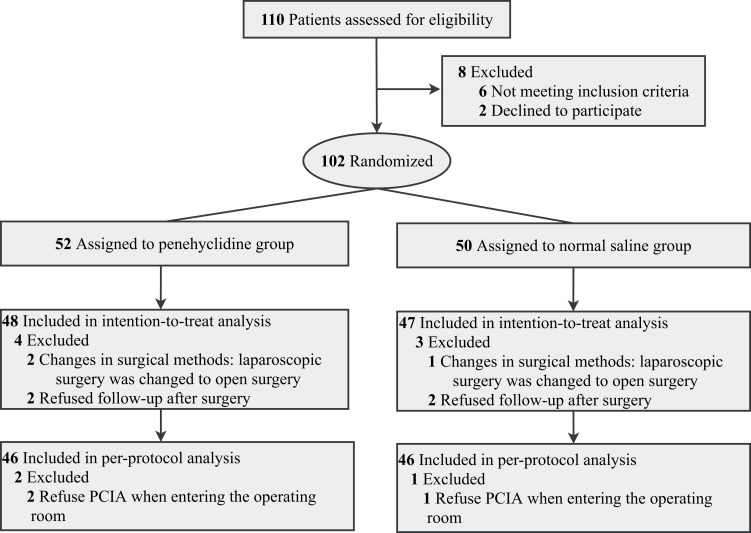
Patients and methods: Ninety-two Women Patients (Aged ≥ 18) Scheduled for Elective Gynecologic Laparoscopy Were Enrolled in the Current Study. Patients Were Equally Randomized Assigned Into Penehyclidine group (PHC group: received a bolus of penehyclidine 10 μg/kg during the induction of anesthesia, then followed by a continuous infusion of 10 μg/kg penehyclidine at a fixed rate of 2.0 mL/h in postoperative intravenous analgesia pump over 48h, 0.5 mg upper limit respectively) or Control group (received 0.9% saline in replace of penehyclidine at the same time points). The primary outcome measure was the incidence of postoperative nausea and vomiting in the postanesthesia care unit and ward area. Quality of Recovery-15 (QoR-15) scores and general comfort questionnaire (GCQ) scores were assessed on postoperative day (POD) 1, 2.
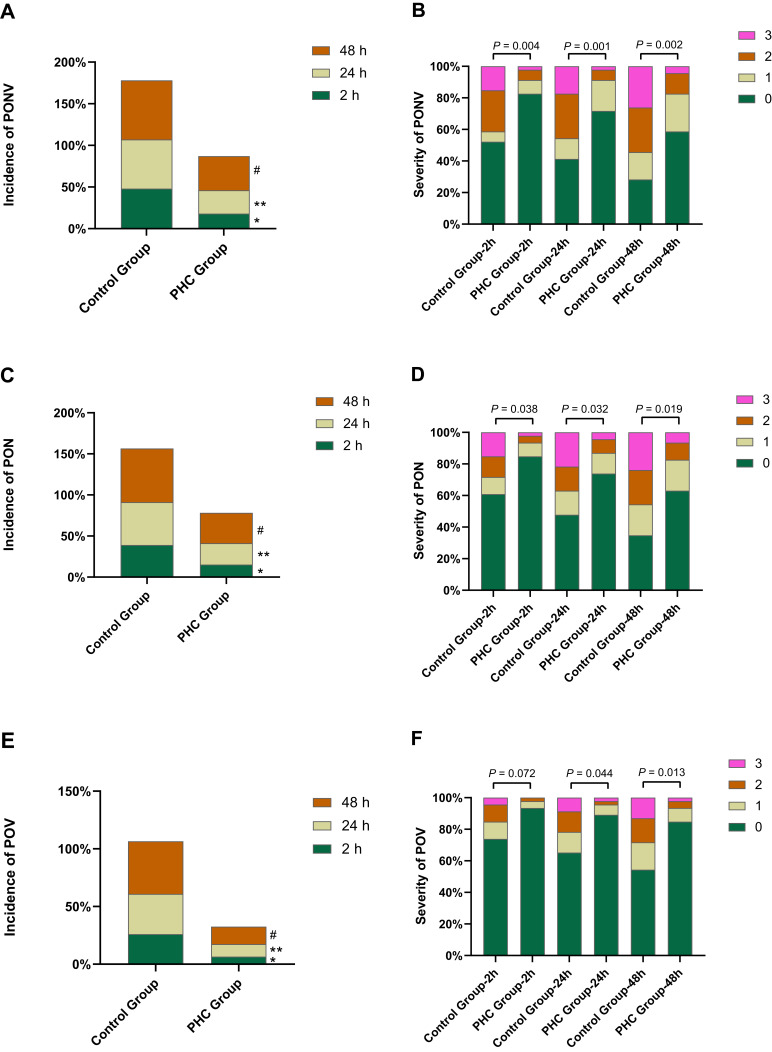
Results: Patients between two groups had comparable baseline characteristics. Compared with the Control group, the incidence and severity of PONV, postoperative nausea (PON), and postoperative vomiting (POV) were significantly lower in the PHC group at 2h (PONV: P = 0.002, P = 0.004, respectively; PON: P = 0.018, P = 0.038, respectively; POV: P = 0.011, P = 0.072, respectively), 24h (PONV: P = 0.003, P = 0.001, respectively; PON: P = 0.010, P = 0.032, respectively; POV: P = 0.006, P = 0.044, respectively), and 48h (PONV: P = 0.003, P = 0.002, respectively; PON: P = 0.007, P = 0.019, respectively; POV: P = 0.002, P = 0.013, respectively) after surgery. The QoR-15 and GCQ scores of the PHC group were significantly higher than those of the Control group at POD 1, 2 (P < 0.001; P < 0.001, respectively).
Conclusion: Our findings suggest that perioperative intravenous application of penehyclidine can effectively prevent postoperative nausea and vomiting in gynecological laparoscopic surgery patients and improve postoperative recovery.
Keywords: gynecologic laparoscopy; penehyclidine; postoperative nausea and vomiting; quality of recovery.
© 2024 Zhao et al.
Conflict of interest statement
All authors have no conflicts of interest in this work.
Figures
References
Publication types
MeSH terms
Substances
LinkOut - more resources
Full Text Sources
Miscellaneous
