


Slower speed of blood pressure recovery after standing is associated with accelerated brain aging: Evidence from The Irish Longitudinal Study on Ageing (TILDA)
- PMID: 38445293
- PMCID: PMC10912350
- DOI: 10.1016/j.cccb.2024.100212
Slower speed of blood pressure recovery after standing is associated with accelerated brain aging: Evidence from The Irish Longitudinal Study on Ageing (TILDA)
Abstract
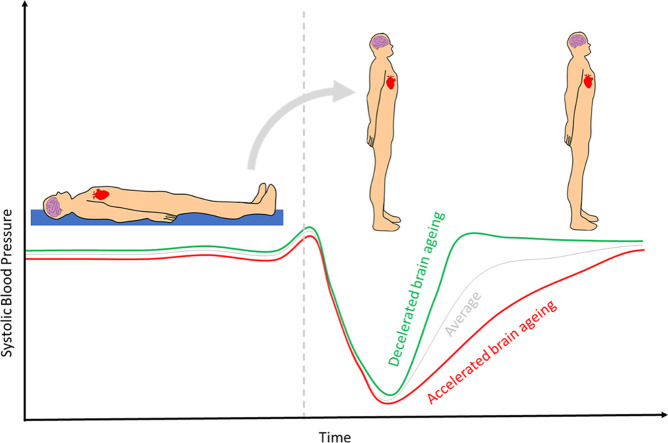
Background: Impaired recovery of blood pressure (BP) in response to standing up is a prevalent condition in older individuals. We evaluated the relationship between the early recovery of hemodynamic responses to standing and brain health in adults over 50.
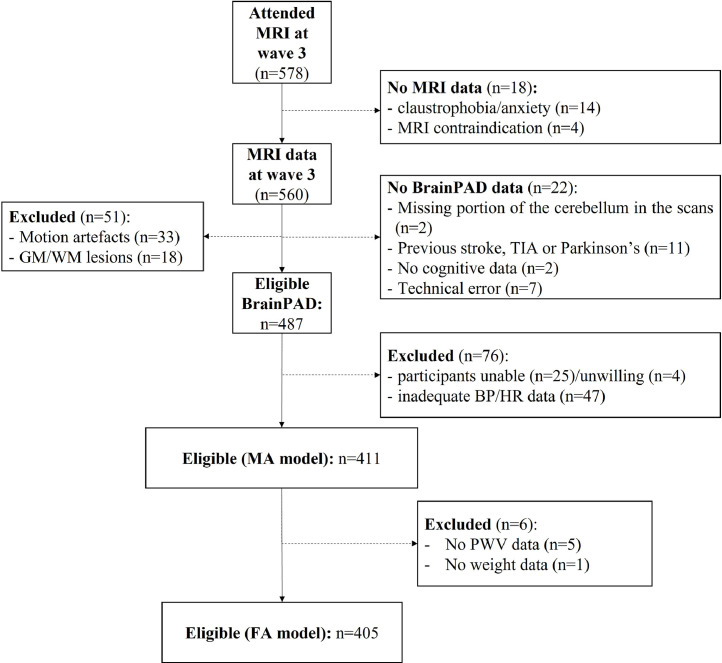
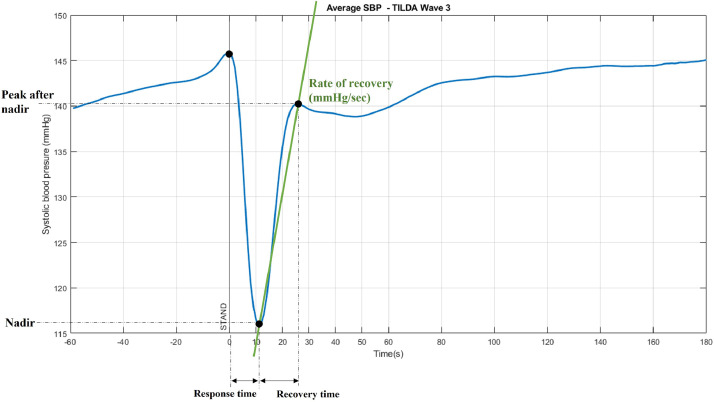
Methods: Participants from The Irish Longitudinal Study on Ageing (TILDA) (n=411; age 67.6 ± 7.3 years; 53.4 % women) performed an active stand challenge while blood pressure and heart rate were continuously monitored. The recovery of these parameters was determined as the slope of the BP and HR response, following the initial drop/rise after standing. We have previously reported a novel and validated measure of brain ageing using MRI data, which measures the difference between biological brain age and chronological age, providing a brain-predicted age difference (brainPAD) score.
Results: Slower recovery of systolic and diastolic BP was found to be significantly associated with higher brainPAD scores (i.e., biologically older brains), where a one-year increase in brainPAD was associated with a decrease of 0.02 mmHg/s and 0.01 mmHg/s in systolic and diastolic BP recovery, respectively, after standing. Heart rate (HR) recovery was not significantly associated with brainPAD score.
Conclusion: These results demonstrate that slower systolic and diastolic BP recovery in the early phase after standing is associated with accelerated brain aging in older individuals. This suggests that the BP response to standing, measured using beat-to-beat monitoring, has the potential to be used as a marker of accelerated brain aging, relying on a simple procedure and devices that are easily accessible.
Keywords: Active stand; Brain aging; Cerebral autoregulation; Orthostatic hypotension.
© 2024 The Authors. Published by Elsevier B.V.
Conflict of interest statement
The authors declare that they have no known competing financial interests or personal relationships that could have appeared to influence the work reported in this paper.
Figures
References
-
- Boyle Rory, Jollans Lee, Rueda-Delgado Laura M, Rizzo Rossella, Yener Görsev G, McMorrow Jason P, Knight Silvin P, Carey Daniel, Robertson Ian H, Emek-Savaş Derya D. Brain-predicted age difference score is related to specific cognitive functions: a multi-site replication analysis. Brain ImAging Behav. 2021;15(1):327–345. - PMC - PubMed
-
- Bruïne Eline S.de, Reijnierse Esmee M., Trappenburg Marijke C., Pasma Jantsje H., de Vries Oscar J., Meskers Carel G.M.M., Maier Andrea B. Diminished dynamic physical performance is associated with orthostatic hypotension in geriatric outpatients. J. Geriatr. Phys. Ther. 2018;42(3):E28–E34. doi: 10.1519/JPT.0000000000000186. - DOI - PubMed
-
- Buckley Anne, Carey Daniel, Meaney James M, Kenny RoseAnne, Harbison Joseph. Is there an association between orthostatic hypotension and cerebral white matter hyperintensities in older people? The irish longitudinal study on ageing. JRSM. Cardiovasc. Dis. 2020;9(January) doi: 10.1177/2048004020954628. - DOI - PMC - PubMed
LinkOut - more resources
Full Text Sources
