


ACTION: a randomized phase 3 study of ONC201 (dordaviprone) in patients with newly diagnosed H3 K27M-mutant diffuse glioma
- PMID: 38445964
- PMCID: PMC11066938
- DOI: 10.1093/neuonc/noae031
ACTION: a randomized phase 3 study of ONC201 (dordaviprone) in patients with newly diagnosed H3 K27M-mutant diffuse glioma
Abstract
Background: H3 K27M-mutant diffuse glioma primarily affects children and young adults, is associated with a poor prognosis, and no effective systemic therapy is currently available. ONC201 (dordaviprone) has previously demonstrated efficacy in patients with recurrent disease. This phase 3 trial evaluates ONC201 in patients with newly diagnosed H3 K27M-mutant glioma.
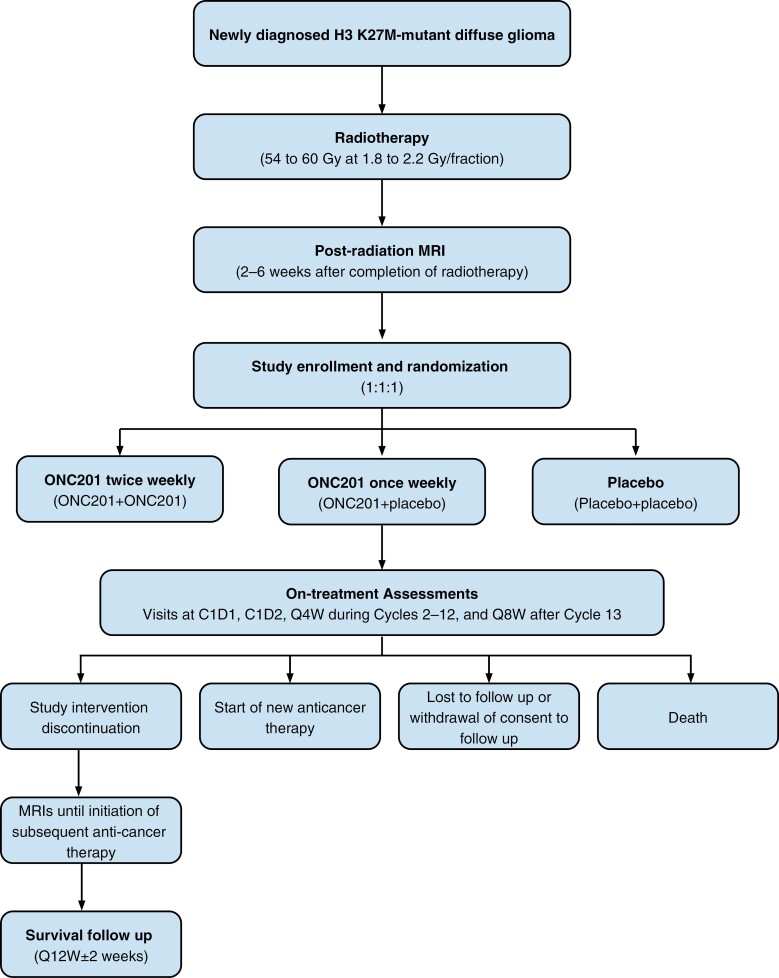
Methods: ACTION (NCT05580562) is a randomized, double-blind, placebo-controlled, parallel-group, international phase 3 study of ONC201 in newly diagnosed H3 K27M-mutant diffuse glioma. Patients who have completed standard frontline radiotherapy are randomized 1:1:1 to receive placebo, once-weekly dordaviprone, or twice-weekly dordaviprone on 2 consecutive days. Primary efficacy endpoints are overall survival (OS) and progression-free survival (PFS); PFS is assessed by response assessment in neuro-oncology high-grade glioma criteria (RANO-HGG) by blind independent central review. Secondary objectives include safety, additional efficacy endpoints, clinical benefit, and quality of life. Eligible patients have histologically confirmed H3 K27M-mutant diffuse glioma, a Karnofsky/Lansky performance status ≥70, and completed first-line radiotherapy. Eligibility is not restricted by age; however, patients must be ≥10 kg at time of randomization. Patients with a primary spinal tumor, diffuse intrinsic pontine glioma, leptomeningeal disease, or cerebrospinal fluid dissemination are not eligible. ACTION is currently enrolling in multiple international sites.
Keywords: H3 K27M; ONC201; Phase 3; diffuse glioma; dordaviprone.
© The Author(s) 2024. Published by Oxford University Press on behalf of the Society for Neuro-Oncology.
Conflict of interest statement
I.A.-R. has received research funding Chimerix, Inc. A.L. has served on advisory board for Chimerix, Inc. and received equipment, materials, or medical writing support from Chimerix, Inc. S.L.M. has served on an advisory board for Chimerix, Inc. S.M. has no relevant conflicts of interest to declare. B.N. has served on an advisory board for Chimerix, Inc. M.v.d.B. has no relevant conflicts of interest to declare. M.V. has served on an advisory board for Chimerix, Inc. J.E.A., A.S.M., and R.S.T. are employees of and have stock ownership in Chimerix, Inc. J.E.A. has patents related to ONC201. P.Y.W. has received research funding from Chimerix, Inc., served as a consultant for Chimerix, Inc., and served on an advisory board for Chimerix, Inc. T.C. has received research funding from Chimerix, Inc, owns stock in Chimerix, Inc, and receives milestone payments and possible future royalties from Chimerix, Inc.
Figures
References
-
- Di Nunno V, Franceschi E, Gatto L, et al.. How to treat histone 3 altered gliomas: molecular landscape and therapeutic developments. Expert Rev Clin Pharmacol. 2023;16(1):17–26. - PubMed
-
- Feng J, Hao S, Pan C, et al.. The H3.3 K27M mutation results in a poorer prognosis in brainstem gliomas than thalamic gliomas in adults. Hum Pathol. 2015;46(11):1626–1632. - PubMed
-
- Louis DN, Perry A, Reifenberger G, et al.. The 2016 World Health Organization classification of tumors of the central nervous system: a summary. Acta Neuropathol. 2016;131(6):803–820. - PubMed
Publication types
MeSH terms
Substances
Grants and funding
LinkOut - more resources
Full Text Sources
Medical
