


Psychosocial working conditions and mental health among medical assistants in Germany: a scoping review
- PMID: 38448891
- PMCID: PMC10916249
- DOI: 10.1186/s12889-024-17798-2
Psychosocial working conditions and mental health among medical assistants in Germany: a scoping review
Abstract
Background: Medical assistants (MA) constitute one of the largest professions in outpatient health care in Germany. The psychosocial working conditions of health care staff are generally believed to be challenging and to thereby increase the risk of poor mental health. A review of MA's psychosocial working conditions and mental health is lacking, however. We aimed to systematically identify and summarize existing research on psychosocial working conditions and mental health of MA by addressing (1) Which methods, concepts, and instruments have been used to capture the psychosocial working conditions and mental health among MA in Germany? (2) What findings are available? and (3) What are the research gaps?
Methods: We systematically searched Medline, Scopus, CCMed and Google Scholar. Using the Population Concept Context (PCC)-framework, we applied the following eligibility criteria: (a) Language: English or German, (b) publication between 2002-2022, (c) original study, (d) study population: mainly MA (i.e., ≥ 50% of the study population), (e) concept: psychosocial working conditions and/or mental health, and (f) context: Germany. Two reviewers extracted data independently, results were compared for accuracy and completeness.
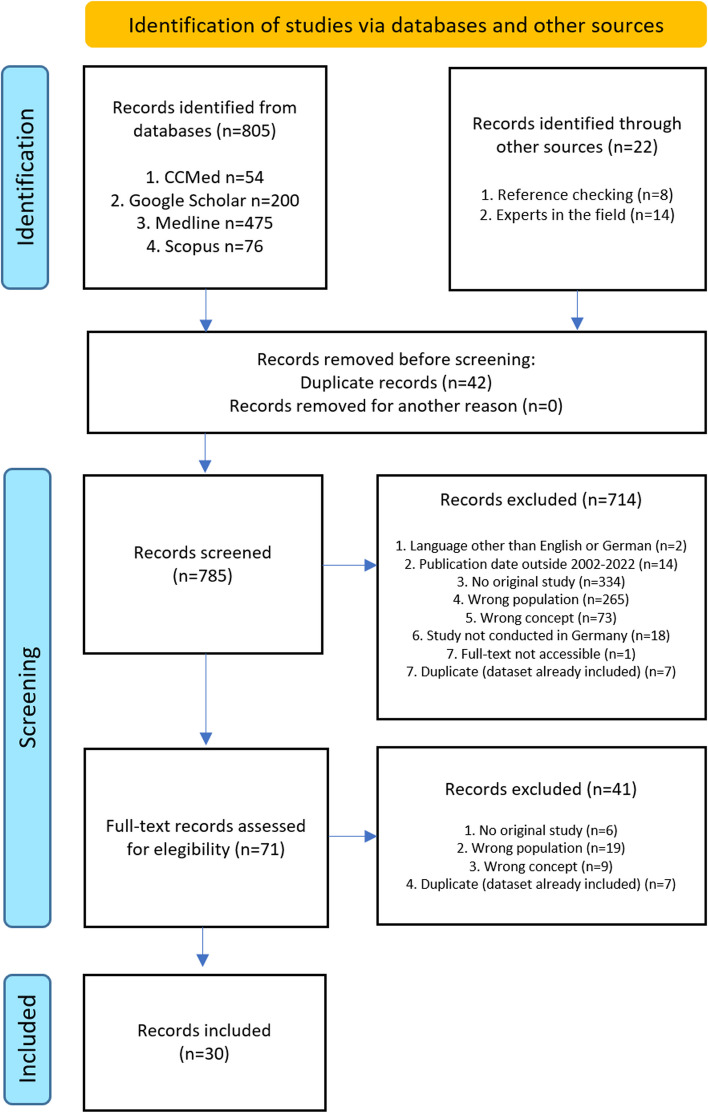
Results: Eight hundred twenty-seven sources were identified. We included 30 publications (19 quantitative, 10 qualitative, and one mixed methods study). Quantitative studies consistently reported high job satisfaction among MA. Quantitative and mixed methods studies frequently reported aspects related to job control as favorable working conditions, and aspects related to job rewards as moderate to unfavorable. Qualitative studies reported low job control in specific work areas, high demands in terms of workload, time pressure and job intensity, and a desire for greater recognition. Social interactions seemed to be important resources for MA. Few studies (n = 8) captured mental health, these reported inconspicuous mean values but high prevalences of anxiety, burnout, depression, and stress among MA. Studies suggested poorer psychosocial working conditions and mental health among MA during the COVID-19 pandemic.
Conclusions: Quantitative studies tend to suggest more favorable psychosocial working conditions among MA than qualitative studies. We suggest mixed methods to reconcile this alleged inconsistency. Future research should examine discrepancies between job satisfaction and unfavorable working conditions and if psychosocial working conditions and mental health remain changed after the COVID-19 pandemic.
Keywords: Germany; Medical assistants; Mental health; Psychosocial working conditions.
© 2024. The Author(s).
Conflict of interest statement
AL has presented findings related to the health and working conditions of MA at meetings or workshops of professional associations or companies (i.e., ABF-Synergie GmbH) and has received honoraria. Our review has included the following studies authored by AD and AL, constituting a potential non-financial competing interest:
• [40] Dreher A, Pietrowsky R, Loerbroks A. Pandemic-related attitudes, stressors and work outcomes among medical assistants during the SARS-CoV-2 ("Coronavirus") pandemic in Germany: A cross-sectional Study. PLoS One 2021; 16(1): e0245473
• [35] Scharf, J; Vu-Eickmann, P; Li, J; Müller, A; Wilm, S; Angerer, P; Loerbroks, A. Desired improvements of working conditions among medical assistants in Germany: a cross-sectional study. J Occup Med Toxicol 2019; 14: 18 [10.1186/s12995-019-0237-x] [PMID: 31168312]
• [58] Vu-Eickmann P, Loerbroks A. Psychosoziale Arbeitsbedingungen Medizinischer Fachangestellter: Ergebnisse einer qualitativen Studie zu den berufsspezifischen Belastungen, Ressourcen, Präventionsmöglichkeiten und Interventionsbedürfnissen. Z Evid Fortbild Qual Gesundhwes 2017; 126: 43–51
• [62] Vu-Eickmann P, Loerbroks A. Psychosoziale Arbeitsbedingungen und Versorgungsqualität: Ergebnisse einer qualitativen Studie unter Medizinischen Fachangestellten (MFAs). Gesundheitswesen 2018; 80: 1084–7.
• [49] Vu-Eickmann P, Li J, Müller A, Angerer P, Loerbroks A. Associations of psychosocial working conditions with health outcomes, quality of care and intentions to leave the profession: results from a cross-sectional study among physician assistants in Germany. Int Arch Occup Environ Health 2018; 91(5): 643–54
KS and VM declare no competing interests.
Figures
References
-
- Association of Medical Professions. Career aspiration: Medical assistant (MFA): Requirements, training, prospects. Association of Medical Professions; 2020. Cited 12th July 2023. Available from: https://www.vmf-online.de/download/berufsbild-berufswunsch-mfa-medizinis....
-
- German Federal Office of Statistics (Destatis), Genesis-Online. Healthcare workforce: Germany, years, employment, facilities, gender, healthcare professions, 2021: 23621–0004: German Federal Office of Statistics; 2021. Cited 2023 July 25. Available from: https://www-genesis.destatis.de/genesis/online?operation=previous&leveli....
-
- Central Institute of the Statutory Medical Care in the Federal Republic of Germany. Staffing situation in clinics of statutory health care and psychotherapeutic health care. Berlin: Central Institute of the Statutory Medical Care in the Federal Republic of Germany; 2021.
-
- Oettel J, Zschille M, Leibner M. Training of medical assistants (MA) in practices and facilities of statutory health insurance physicians Berlin: Central Institute of the Statutory Medical Care in the Federal Republic of Germany; 2023.
Publication types
MeSH terms
Grants and funding
LinkOut - more resources
Full Text Sources
Medical
