


A 20-year overview of fertility preservation in boys: new insights gained through a comprehensive international survey
- PMID: 38449521
- PMCID: PMC10914450
- DOI: 10.1093/hropen/hoae010
A 20-year overview of fertility preservation in boys: new insights gained through a comprehensive international survey
Abstract
Study question: Twenty years after the inception of the first fertility preservation programme for pre-pubertal boys, what are the current international practices with regard to cryopreservation of immature testicular tissue?
Summary answer: Worldwide, testicular tissue has been cryopreserved from over 3000 boys under the age of 18 years for a variety of malignant and non-malignant indications; there is variability in practices related to eligibility, clinical assessment, storage, and funding.
What is known already: For male patients receiving gonadotoxic treatment prior to puberty, testicular tissue cryopreservation may provide a method of fertility preservation. While this technique remains experimental, an increasing number of centres worldwide are cryopreserving immature testicular tissue and are approaching clinical application of methods to use this stored tissue to restore fertility. As such, standards for quality assurance and clinical care in preserving immature testicular tissue should be established.
Study design size duration: A detailed survey was sent to 17 centres within the recently established ORCHID-NET consortium, which offer testicular tissue cryopreservation to patients under the age of 18 years. The study encompassed 60 questions and remained open from 1 July to 1 November 2022.
Participants/materials setting methods: Of the 17 invited centres, 16 completed the survey, with representation from Europe, Australia, and the USA. Collectively, these centres have cryopreserved testicular tissue from patients under the age of 18 years. Data are presented using descriptive analysis.
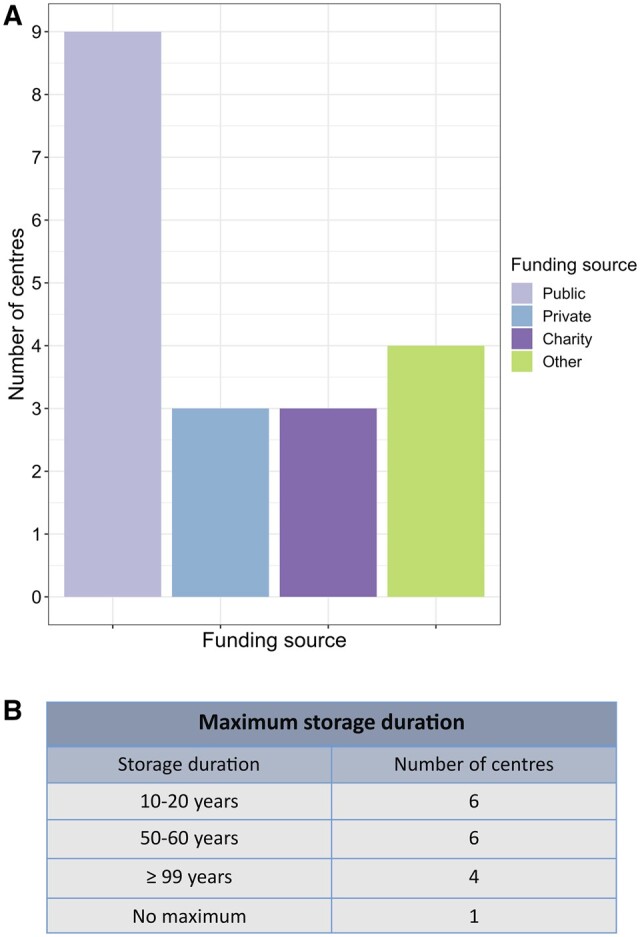
Main results and the role of chance: Since the establishment of the first formal fertility preservation programme for pre-pubertal males in 2002, these 16 centres have cryopreserved tissue from 3118 patients under the age of 18 years, with both malignant (60.4%) and non-malignant (39.6%) diagnoses. All centres perform unilateral biopsies, while 6/16 sometimes perform bilateral biopsies. When cryopreserving tissue, 9/16 centres preserve fragments sized ≤5 mm3 with the remainder preserving fragments sized 6-20 mm3. Dimethylsulphoxide is commonly used as a cryoprotectant, with medium supplements varying across centres. There are variations in funding source, storage duration, and follow-up practice. Research, with consent, is conducted on stored tissue in 13/16 centres.
Limitations reasons for caution: While this is a multi-national study, it will not encompass every centre worldwide that is cryopreserving testicular tissue from males under 18 years of age. As such, it is likely that the actual number of patients is even higher than we report. Whilst the study is likely to reflect global practice overall, it will not provide a complete picture of practices in every centre.
Wider implications of the findings: Given the research advances, it is reasonable to suggest that cryopreserved immature testicular tissue will in the future be used clinically to restore fertility. The growing number of patients undergoing this procedure necessitates collaboration between centres to better harmonize clinical and research protocols evaluating tissue function and clinical outcomes in these patients.
Study funding/competing interests: K.D. is supported by a CRUK grant (C157/A25193). R.T.M. is supported by an UK Research and Innovation (UKRI) Future Leaders Fellowship (MR/S017151/1). The MRC Centre for Reproductive Health at the University of Edinburgh is supported by MRC (MR/N022556/1). C.L.M. is funded by Kika86 and ZonMW TAS 116003002. A.M.M.v.P. is supported by ZonMW TAS 116003002. E.G. was supported by the Research Program of the Research Foundation-Flanders (G.0109.18N), Kom op tegen Kanker, the Strategic Research Program (VUB_SRP89), and the Scientific Fund Willy Gepts. J.-B.S. is supported by the Swedish Childhood Cancer Foundation (TJ2020-0026). The work of NORDFERTIL is supported by the Swedish Childhood Cancer Foundation (PR2019-0123; PR2022-0115), the Swedish Research Council (2018-03094; 2021-02107), and the Birgitta and Carl-Axel Rydbeck's Research Grant for Paediatric Research (2020-00348; 2021-00073; 2022-00317; 2023-00353). C.E is supported by the Health Department of the Basque Government (Grants 2019111068 and 2022111067) and Inocente Inocente Foundation (FII22/001). M.P.R. is funded by a Medical Research Council Centre for Reproductive Health Grant No: MR/N022556/1. A.F. and N.R. received support from a French national research grant PHRC No. 2008/071/HP obtained by the French Institute of Cancer and the French Healthcare Organization. K.E.O. is funded by the University of Pittsburgh Medical Center and the US National Institutes of Health HD100197. V.B-L is supported by the French National Institute of Cancer (Grant Seq21-026). Y.J. is supported by the Royal Children's Hospital Foundation and a Medical Research Future Fund MRFAR000308. E.G., N.N., S.S., C.L.M., A.M.M.v.P., C.E., R.T.M., K.D., M.P.R. are members of COST Action CA20119 (ANDRONET) supported by COST (European Cooperation in Science and Technology). The Danish Child Cancer Foundation is also thanked for financial support (C.Y.A.). The authors declare no competing interests.
Trial registration number: N/A.
Keywords: chemotherapy; childhood cancer; children; cryopreservation; fertility preservation; male; oncofertility; spermatogonia; testicular sperm extraction; testicular tissue.
© The Author(s) 2024. Published by Oxford University Press on behalf of European Society of Human Reproduction and Embryology.
Conflict of interest statement
The authors declare no competing interests.
Figures


References
-
- Ahler A, Gook D, Moussaoui D, Archer J, Zacharin M, D’Arcy CE, Sullivan M, Jayasinghe Y.. Metastatic neuroblastoma in fertility preservation biopsy of clinically normal testis: a case report. Reprod Biomed Online 2023;47:103232. - PubMed
-
- Bittinger SE, Nazaretian SP, Gook DA, Parmar C, Harrup RA, Stern CJ.. Detection of Hodgkin lymphoma within ovarian tissue. Fertil Steril [Internet] 2011;95:803.e3–803–e6. - PubMed
Grants and funding
LinkOut - more resources
Full Text Sources
Medical
Research Materials
Miscellaneous