


Current State of Food Prescriptions Used to Treat Cardiometabolic Risk Factors in the US Adult Population
- PMID: 38449980
- PMCID: PMC10915688
- DOI: 10.7759/cureus.53629
Current State of Food Prescriptions Used to Treat Cardiometabolic Risk Factors in the US Adult Population
Abstract
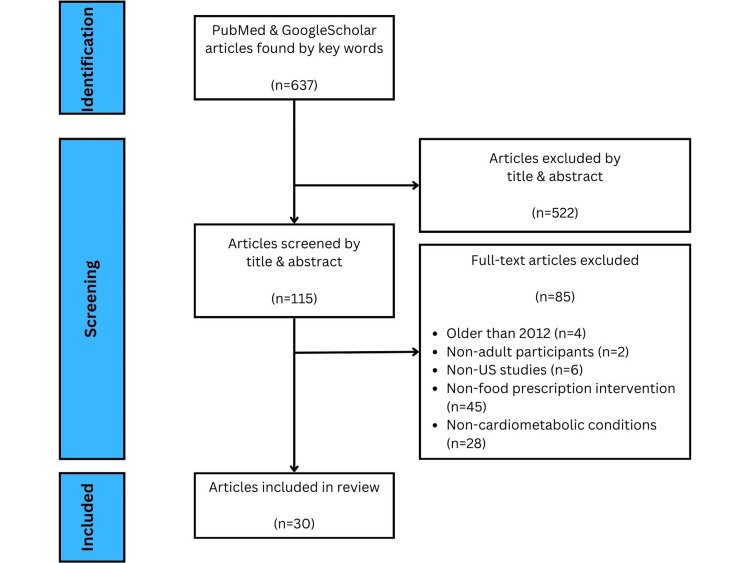
Cardiometabolic syndrome is unfortunately widely prevalent in medically underserved areas with one possible non-pharmacological solution being food prescriptions from food pharmacies. Food prescriptions are defined as when a physician prescribes certain foods as a treatment for health conditions. There seems to be a promising future for food prescriptions; however, there is a huge literature gap. Given this lack of knowledge regarding this burgeoning practice, we decided to review the current state of food prescriptions used to treat cardiometabolic conditions in the US adult clinical setting. A thorough search of PubMed and Google Scholar databases for articles written about food prescriptions' impact on cardiometabolic risk factors was done. The keywords used included "food prescriptions, vegetables prescription, produce prescription, fruit prescriptions, food pharmacy, food as medicine, cardiometabolic, blood pressure, glucose, insulin, cholesterol, obesity, BMI, body mass index, triglycerides, and microalbuminuria." Of the 637 articles found with the associated keywords, 115 were kept after being screened by title and abstract. Finally, after a full-text record screening, 30 articles were deemed eligible based on our inclusion criteria. We analyzed the health markers, patient populations, methods of food procurement, and financial incentives in food prescription programs. On average, the implementation of food prescription programs decreased participants' BMI, waist circumference, blood pressure, and HbA1c. Participants in the programs were primarily comprised of African American, Hispanic, underinsured, low-income, older, and women groups. Programs with subsidies and vouchers had a higher compliance rate, and food sourced from farmers' markets, grocers, and mobile vendors had the best program compliance rates. According to the literature, adherence to food prescription programs on average decreases the BMI, blood pressure, waist circumference, and Hb1Ac of participants. However, those are the only biomarkers being studied currently, and future studies should incorporate other markers of chronic conditions. For example, a reliable indicator of cardiometabolic health is total cholesterol/HDL cholesterol, which should be measured in future experiments. Additionally, insulin, glucose, triglycerides, and LDL cholesterol are all great markers of cardiometabolic health that can be measured in the future. The current implementation of many food prescription programs is in medically underserved areas. The patient populations are typically low-income, under- or uninsured, food insecure, and originating from diverse ethnic backgrounds. In the future, food prescription studies should be done on other ethnic populations including but not limited to Native Americans who also carry a large burden of preventable and chronic illnesses.
Keywords: blood pressure; body mass index; cardiometabolic; food pharmacy; food prescriptions; fruits and vegetable; hemoglobin a1c (hba1c).
Copyright © 2024, Bourenane et al.
Conflict of interest statement
The authors have declared that no competing interests exist.
Figures
References
-
- CDC. (2021, February 16). Only 1 in 10 Adults Get Enough Fruits or Vegetables. Only 1 in 10 adults get enough fruits or vegetables. [ Feb; 2024 ]. 2021. https://www.cdc.gov/nccdphp/dnpao/division-information/media-tools/adult... https://www.cdc.gov/nccdphp/dnpao/division-information/media-tools/adult...
-
- Cardiometabolic syndrome: a global health issue. Saljoughian M. https://www.uspharmacist.com/article/cardiometabolic-syndrome-a-global-h... US Pharm. 2016;41:0–21.
-
- 2021 dietary guidance to improve cardiovascular health: a scientific statement from the American Heart Association. Lichtenstein AH, Appel LJ, Vadiveloo M, et al. Circulation. 2021;144:0–87. - PubMed
Publication types
LinkOut - more resources
Full Text Sources
Miscellaneous