


The relationship between sense of coherence and emotional intelligence as individual health assets for mental health promotion in students and healthcare professionals: a scoping review
- PMID: 38450140
- PMCID: PMC10916004
- DOI: 10.3389/fpubh.2024.1304310
The relationship between sense of coherence and emotional intelligence as individual health assets for mental health promotion in students and healthcare professionals: a scoping review
Abstract
Introduction: Workplace Mental health promotion in healthcare sector, is a global priority due to the stress associated with caregiving environments and the increase of mental health problems among health professionals and students. The role of emotional intelligence (EI) and sense of coherence (SOC) have been identified as critical health protectors. However, the relationship between them as well as the underlying mechanisms of these relationships on health benefits in this population is still unclear.
Aim: To synthetize the existing literature on the relationship between emotional intelligence and sense of coherence, as well as their mutual impact on healthcare workers' and student's well-being.
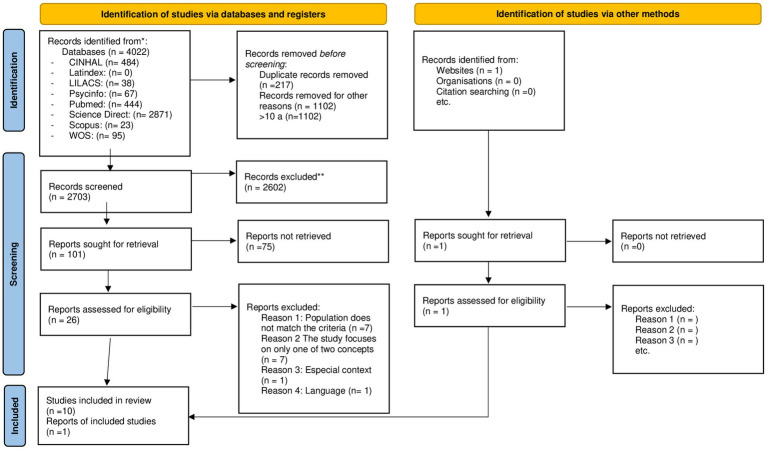
Method: A scoping review was conducted following the Joanna Briggs Institute guidelines. A systematic search was conducted in PsyCINFO, CINHAL, SCOPUS and PUBMED databases, using key-terms such as students, health professionals, emotional intelligence, and sense of coherence.
Results: A total of 11 articles were included, with a range of years from 2014 to 2022. Evidence was found to support the positive relationship between sense of coherence and emotional intelligence. The use of EI as a training pathway to improve SOC and health promoting behaviors is suggested. The benefits of intervening on these factors contribute to improved health professionals' and students' general well-being and motivation for a better performance, either in their studies or clinical work.
Conclusion: The positive relationship between emotional intelligence and a sense of coherence has direct and indirect benefits on students' and healthcare professionals' well-being. Future studies should address longitudinal and experimental analysis to confirm these findings.
Keywords: emotional intelligence; healthcare professionals; scoping review; sense of coherence; students.
Copyright © 2024 Urtubia-Herrera, Navarta-Sánchez, Palmar-Santos, Pedraz-Marcos, García-Gomez, Luis and Bermejo-Martins.
Conflict of interest statement
The authors declare that the research was conducted in the absence of any commercial or financial relationships that could be construed as a potential conflict of interest.
Figures
References
-
- World Health Organization . WHO guidelines on mental health at work. Geneva: World Health Organization; (2022).
-
- World Health Organization . Comprehensive mental health action plan 2013–2030. Geneva: World Health Organization; (2021).
-
- De Simone S. Wellbeing at work: a survey on perception of health care workers. Riv Int Sci Sociali. (2015) 123:395–412.
-
- World Health Organization . Occupational health: health workers. Geneva: World Health Organization; (2022).
Publication types
MeSH terms
LinkOut - more resources
Full Text Sources
