A Novel Approach for Conducting a Catchment Area Analysis of Breast Cancer by Age and Stage for a Community Cancer Center
- PMID: 38451180
- PMCID: PMC11062816
- DOI: 10.1158/1055-9965.EPI-23-1125
A Novel Approach for Conducting a Catchment Area Analysis of Breast Cancer by Age and Stage for a Community Cancer Center
Abstract
Background: The U.S. Preventive Services Task Force recently issued an updated draft recommendation statement to initiate breast cancer screening at age 40, reflecting well-documented disparities in breast cancer-related mortality that disproportionately impact younger Black women. This study applied a novel approach to identify hotspots of breast cancer diagnosed before age 50 and/or at an advanced stage to improve breast cancer detection within these communities.
Methods: Cancer registry data for 3,497 women with invasive breast cancer diagnosed or treated between 2012 and 2020 at the Helen F. Graham Cancer Center and Research Institute (HFGCCRI) and who resided in the HFGCCRI catchment area, defined as New Castle County, Delaware, were geocoded and analyzed with spatial intensity. Standardized incidence ratios stratified by age and race were calculated for each hotspot.
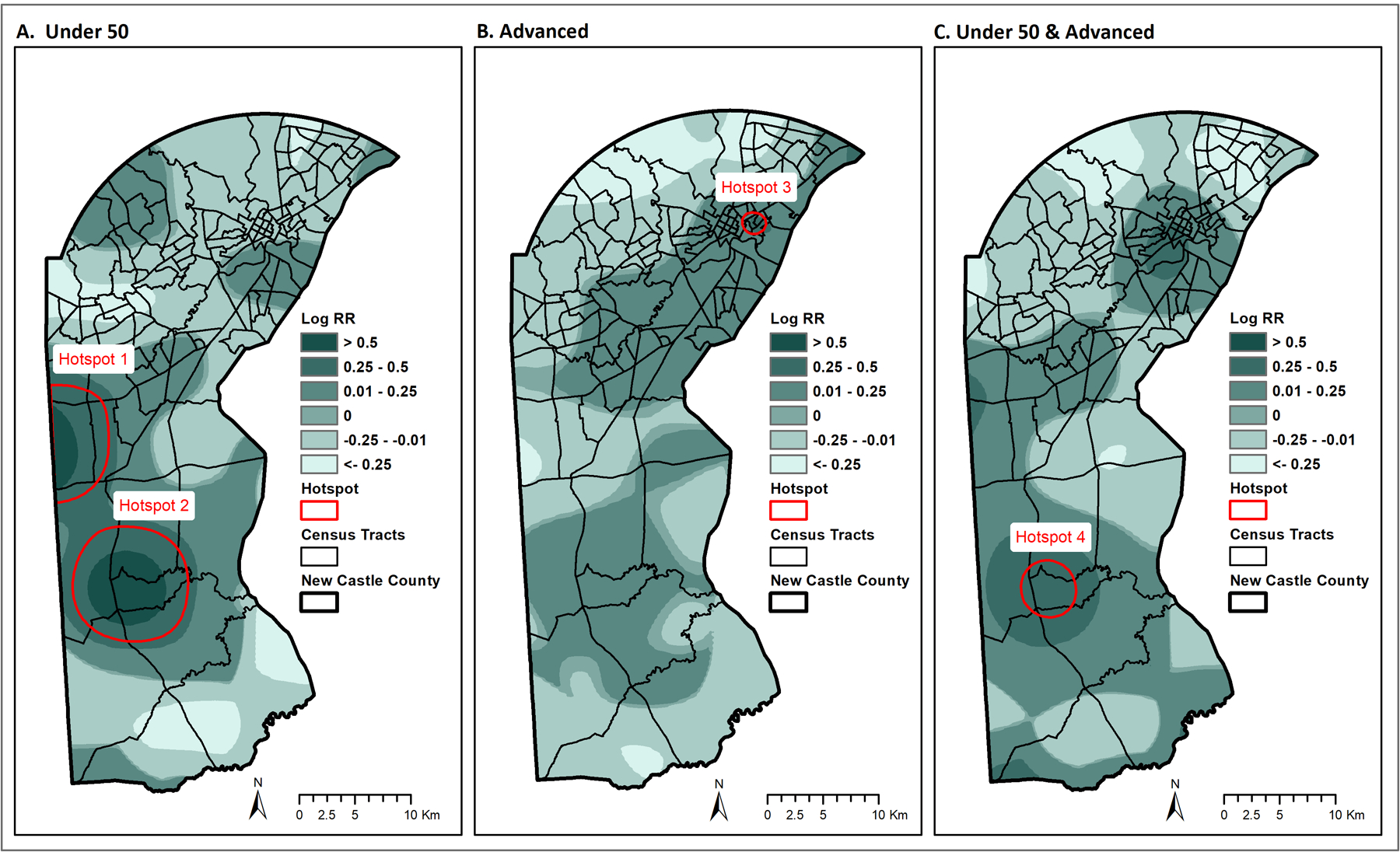
Results: Four hotspots were identified, two for breast cancer diagnosed before age 50, one for advanced breast cancer, and one for advanced breast cancer diagnosed before age 50. Younger Black women were overrepresented in these hotspots relative to the full-catchment area.
Conclusions: The novel use of spatial methods to analyze a community cancer center catchment area identified geographic areas with higher rates of breast cancer with poor prognostic factors and evidence that these areas made an outsized contribution to racial disparities in breast cancer.
Impact: Identifying and prioritizing hotspot breast cancer communities for community outreach and engagement activities designed to improve breast cancer detection have the potential to reduce the overall burden of breast cancer and narrow racial disparities in breast cancer.
©2024 American Association for Cancer Research.
Conflict of interest statement
Conflicts of Interest
All authors declare that they have no conflicts of interest.
Figures
References
-
- U.S. Preventive Services Task Force. Breast Cancer: Screening [Internet]. [cited 2023 Apr 24]. Available from: https://www.uspreventiveservicestaskforce.org/uspstf/draft-update-summar...
-
- Siu AL. Screening for breast cancer: U.S. Preventive services task force recommendation statement. Ann Intern Med. 2016;164(4):279–96. - PubMed
-
- Duffy SW, Tabár L, Yen AMF, Dean PB, Smith RA, Jonsson H, et al. Beneficial effect of consecutive screening mammography examinations on mortality from breast cancer: A prospective study. Radiology. 2021;299(3):541–7. - PubMed
Publication types
MeSH terms
Grants and funding
LinkOut - more resources
Full Text Sources
Medical