


The prevalence of and factors associated with depressive and anxiety symptoms during the COVID-19 pandemic among healthcare workers in South Africa
- PMID: 38451982
- PMCID: PMC10919616
- DOI: 10.1371/journal.pone.0299584
The prevalence of and factors associated with depressive and anxiety symptoms during the COVID-19 pandemic among healthcare workers in South Africa
Abstract
Introduction: Healthcare workers globally have experienced increased social and occupational stressors in their working environments and communities because of COVID-19 which has increased the risk of mental health concerns. This study aimed to explore the prevalence and correlates of depression and anxiety amongst healthcare workers during the COVID-19 pandemic in the Western Cape, South Africa. In addition, role-related stressors and coping strategies were explored.
Material and methods: We conducted a cross-sectional survey of doctors and nurses working in public healthcare facilities across the Western Cape, South Africa. Participants completed the Generalized Anxiety Disorder-7 (GAD-7), the Center for Epidemiologic Studies Depression (CES-D), the Professional Quality of Life (PROQL-R-IV), and the Brief Coping Orientation to Problems Experienced (COPE-R) scales. Data were analysed using multivariable logistic regression analysis.
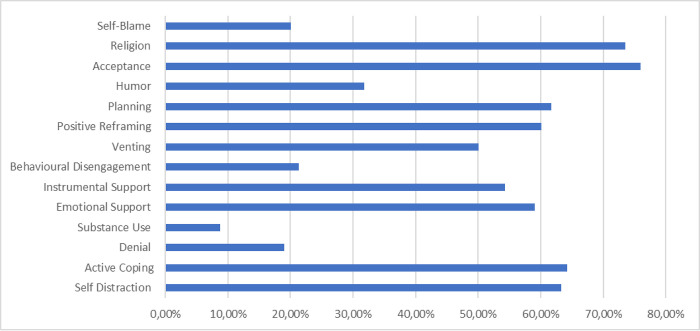
Results: The sample comprised 416 health workers (303 nurses, 113 doctors). Almost 40% of the sample (n = 161) had CES-D scores suggestive of probable depression, and 45.9% (n = 186) had GAD-7 scores suggestive of anxiety. In the logistic regression model, the odds of probable depression were higher for female participants compared to men (OR = 2.26, 95% CI 1.00-5.10) and for participants who used behavioural disengagement as a coping strategy (OR = 1.50, 95% CI 1.14-1.97). More time spent working with COVID patients was associated with increased odds of having high levels of anxiety [OR = 1.13, 95% CI (1.02-1.25). Substance use (OR = 1.39, 95% CI 1.08-1.81), venting (OR = 1.31, 95% CI 1.01-1.70), and self-blame (OR = 1.42, 95% CI 1.08-1.87) were some of the coping strategies used by healthcare workers. High levels of secondary traumatic stress and burnout were found to increase the odds of both depression and anxiety.
Conclusion: Findings of this study suggest that there is a high prevalence of mental health issues among healthcare workers, and a critical need to focus on workplace mental health interventions to support these frontline workers.
Copyright: © 2024 Pool et al. This is an open access article distributed under the terms of the Creative Commons Attribution License, which permits unrestricted use, distribution, and reproduction in any medium, provided the original author and source are credited.
Conflict of interest statement
The authors have declared that no competing interests exist.
Figures
References
-
- Every-Palmer S, Jenkins M, Gendall P, Hoek J, Beaglehole B, Bell C, et al. Psychological distress, anxiety, family violence, suicidality, and wellbeing in New Zealand during the COVID-19 lockdown: A cross-sectional study. PLOS ONE. 2020;15(11):e0241658. doi: 10.1371/journal.pone.0241658 - DOI - PMC - PubMed
MeSH terms
Supplementary concepts
Grants and funding
LinkOut - more resources
Full Text Sources
Medical
Research Materials
