


Organophosphorus pesticide exposure from house dust and parent-reported child behavior in Latino children from an orchard community
- PMID: 38453034
- PMCID: PMC11684323
- DOI: 10.1016/j.neuro.2024.03.001
Organophosphorus pesticide exposure from house dust and parent-reported child behavior in Latino children from an orchard community
Abstract
Background: Organophosphorus pesticide (OP) exposure is known to have adverse effects on the nervous system. Children from agricultural communities are at risk of exposure to these chemicals from their indoor environments that can lead to neurological and developmental problems, including changes in behavior.
Objective: The aim of this study is to evaluate whether the take-home pathway exposure is associated with behavioral and emotional problems in Latino Orchid Community children.
Method: The study was implemented over a period of two years (2008-2010) in an orchard farming community with a total of 324 parents who had children between the ages of 5-12 years old. Mothers of the children were asked to complete the Child Behavior Checklist (CBCL) and dust from their carpets was collected. Emotional and behavioral deficits were assessed based on the CBCL and house dust was assessed for OP concentrations. In this study, correlations between OPs in house dust and CBCL subscales were estimated using linear regression models with total OP concentrations classified by tertiles. This study also facilitated the comparison between the agricultural and non-agricultural families in terms of behavioral deficits and house dust concentrations of pesticides.
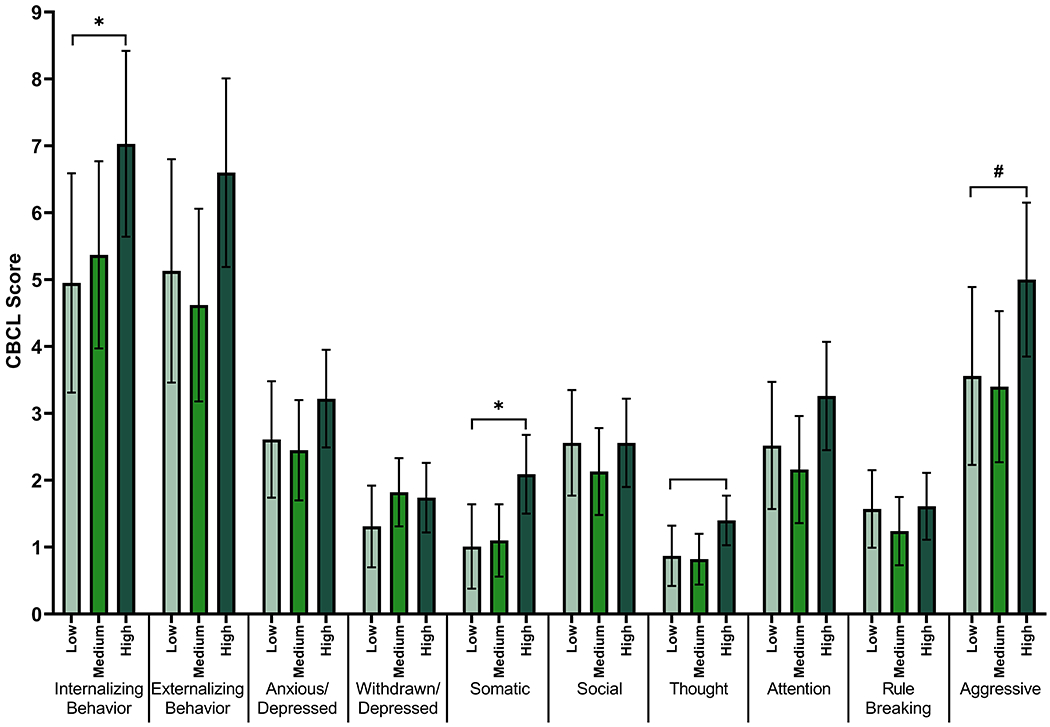
Results: The data from the study shows that there was a positive association between the concentration of OP residues in house dust and internalizing behavior (β=2.06, p=0.05) whereas the association with externalizing behavior was not significant after accounting for sociocultural covariates. Significant positive associations of OP residues with somatic problems (p=0.02) and thought problems (p=0.05) were also found.
Conclusion: The data support a potential role of OP exposure in childhood development, with a specific focus on internalizing behavior. Future work focused on longitudinal studies may uncover the long-term consequences of OP exposure and behavior.
Keywords: Agricultural communities; Behavioral deficits; Children; Organophosphorus pesticides; Take-home exposure pathways.
Copyright © 2024 Elsevier B.V. All rights reserved.
Conflict of interest statement
Declaration of Competing Interest The authors declare the following financial interests/personal relationships which may be considered as potential competing interests:Diane Rohlman reports financial support was provided by National Institute for Occupational Safety and Health. Marie Gaine reports financial support was provided by University of Iowa Environmental Health Sciences Research Center. Khalid Khan reports financial support was provided by College of Health Sciences of Sam Houston State University. Diane Rohlman is currently an editor for Neurotoxicology Declaration of competing interests The authors have no conflicts of interest to declare.
Figures
References
-
- Achenbach TM, Rescorla L, 2001. Manual for the ASEBA school-age forms & profiles : an integrated system of multi-informant assessment. ASEBA, Burlington, VT.
MeSH terms
Substances
Grants and funding
LinkOut - more resources
Full Text Sources
Medical
Miscellaneous
