. 2024 Mar 7;15(1):70.
doi: 10.1186/s13287-024-03650-2.

PLOD2, a key factor for MRL MSC metabolism and chondroprotective properties

Affiliations

PLOD2, a key factor for MRL MSC metabolism and chondroprotective properties

Sarah Bahraoui et al. Stem Cell Res Ther. .

Abstract

Background: Initially discovered for its ability to regenerate ear holes, the Murphy Roth Large (MRL) mouse has been the subject of multiple research studies aimed at evaluating its ability to regenerate other body tissues and at deciphering the mechanisms underlying it. These enhanced abilities to regenerate, retained during adulthood, protect the MRL mouse from degenerative diseases such as osteoarthritis (OA). Here, we hypothesized that mesenchymal stromal/stem cells (MSC) derived from the regenerative MRL mouse could be involved in their regenerative potential through the release of pro-regenerative mediators.

Method: To address this hypothesis, we compared the secretome of MRL and BL6 MSC and identified several candidate molecules expressed at significantly higher levels by MRL MSC than by BL6 MSC. We selected one candidate, Plod2, and performed functional in vitro assays to evaluate its role on MRL MSC properties including metabolic profile, migration, and chondroprotective effects. To assess its contribution to MRL protection against OA, we used an experimental model for osteoarthritis induced by collagenase (CiOA).

Results: Among the candidate molecules highly expressed by MRL MSC, we focused our attention on procollagen-lysine,2-oxoglutarate 5-dioxygenase 2 (PLOD2). Plod2 silencing induced a decrease in the glycolytic function of MRL MSC, resulting in the alteration of their migratory and chondroprotective abilities in vitro. In vivo, we showed that Plod2 silencing in MRL MSC significantly impaired their capacity to protect mouse from developing OA.

Conclusion: Our results demonstrate that the chondroprotective and therapeutic properties of MRL MSC in the CiOA experimental model are in part mediated by PLOD2.

Keywords: Chondroprotection; MRL mouse; Mesenchymal stem cells; Metabolism; PLOD2; Regeneration.


Conflict of interest statement

The authors declare no competing interests. Co-author Christian Jorgensen is a member of the Editorial board of the journal.

Figures
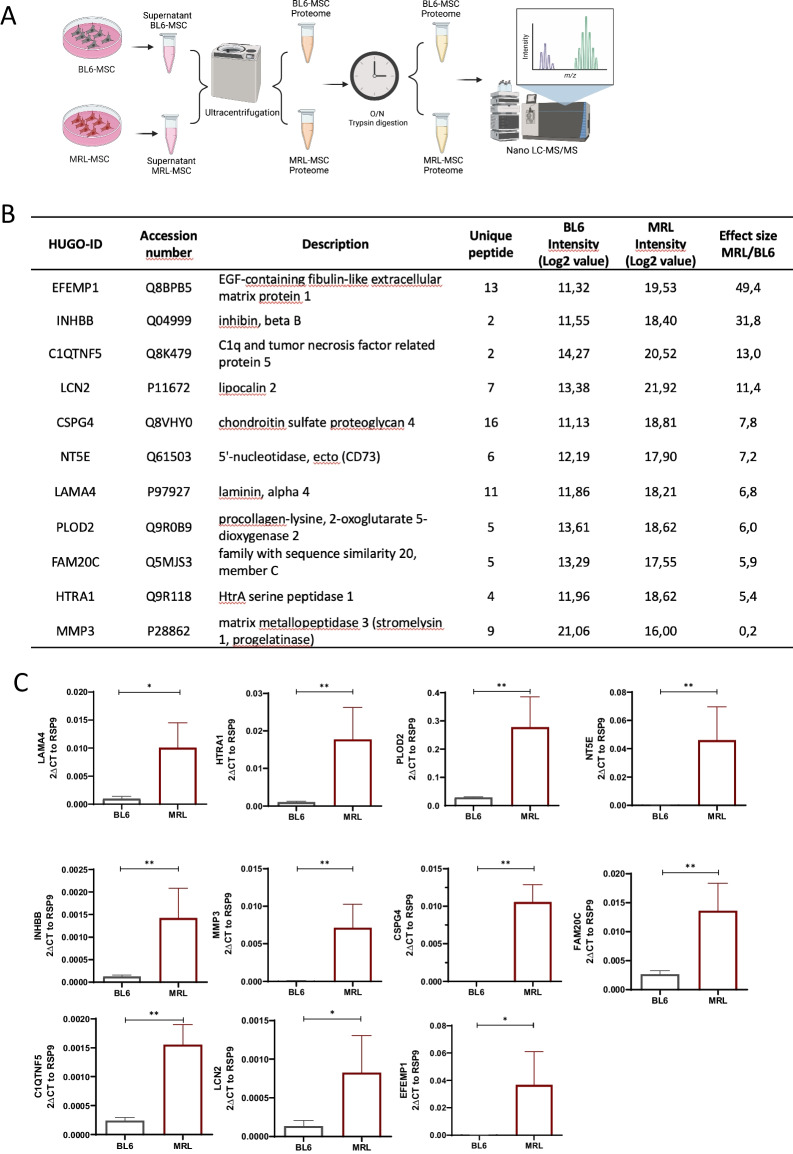
Fig. 1
Fig. 1
Secretome and expression profiles of MRL MSC and BL6 MSC. A and B Proteomic analysis of differential expression of Plod2, Inhbb, Efemp1, Lama4, Mmp3, Htra1, Nt5e, Lcn2, C1qtnf5, Fam20c in MRL MSC compared to BL6 MSC. “Effect size” indicates the standardized mean difference in protein expression level between MRL MSC and BL6 MSC. The median intensity levels (Log 2 value) in MRL MSC and BL6 MSC are indicated for each protein. Normalized protein intensities were used to calculate the Effect size MRL/BL6. C Plod2, Inhbb, Efemp1, Lama4, Mmp3, Htra1, Nt5e, Lcn2, C1qtnf5, Fam20c expression levels in MRL MSC compared to in MRL MSC compared to BL6 MSC. Error bars represent mean ± SEM. *P < 0.05; **P < 0.01; ***P < 0.001, (n = 6)
Fig. 2
Fig. 2
PLOD2 contributes to the specificity of MRL MSC metabolism. Analysis of OCR and ECAR was performed using Seahorse XF analyzer to assess mitochondrial respiration and glycolysis. A Schematic workflow illustrates the experimental procedure. Seahorse respirometry assays were performed on control BL6 MSC and MRL MSC, comparing untreated or transfected cells with PLOD2 siRNA and PLOD2 plasmid. B and D OCR was compared between BL6 MSC and MRL MSC, G and I between MRL MSCsiCTL and MRL MSCsiPLOD2, L and N between BL6 MSC and BL6 MSC+cmv PLOD2, with sequential addition of D-Glucose 25 mM, oligomycin (Oligo, complex V inhibitor), FCCP (protonophore), and antimycin A (complex III inhibitor)/rotenone (complex I inhibitor) to analyze ATP-linked respiration, basal respiration, maximal respiratory capacity and spare respiratory capacity. B, G and L represent the global OCR profiles. D, I and N illustrate baseline OCR. C and E ECAR was compared between BL6 MSC and MRL MSC, H and J between MRL MSCsiCTL and MRL MSCsiPLOD2, M and O between MSC BL6 and MSC BL6+CM PLOD2 with serial addition of glucose and oligomycin to measure basal glycolysis, glycolytic reserve, maximal glycolysis. C, H, and M represent the global ECAR profiles. E, J and O illustrate ECAR after acute injection of glucose. F, K and P show L-Lactate concentration in the culture media harvested after 24 h of culture. The concentration was measured using a colorimetric L-Lactate Assay Kit (n = 4). D, E, I, J, N and O all the bar values represent means ± SEM of 5 to 10 technical replicates. *P < 0.05; **P < 0.01; ***P < 0.001, Mann–Whitney unpaired t test, two-tailed
Fig. 3
Fig. 3
PLOD2 direct MRL MSC migratory ability. A Workflow. B Representative images of MSC MRLsiCTL and MSC MRLsiPLOD2 and D BL6 MSC and BL6 MSC+CM PLOD2 scratch assay. The images were taken immediately after the scratches had been made and then after 24 h. The orange line indicates the initiatory and final areas without migrating cells. C and E Quantitative analysis of the open wound area was performed at 0 and 24 h after wounding using Image J software. 100% corresponds to the highest wound area measured at 0 h. Error bars represent mean ± SEM. *P < 0.05; **P < 0.01; ***P < 0.001, Mann–Whitney unpaired t test, two-tailed (n = 4–5)
Fig. 4
Fig. 4
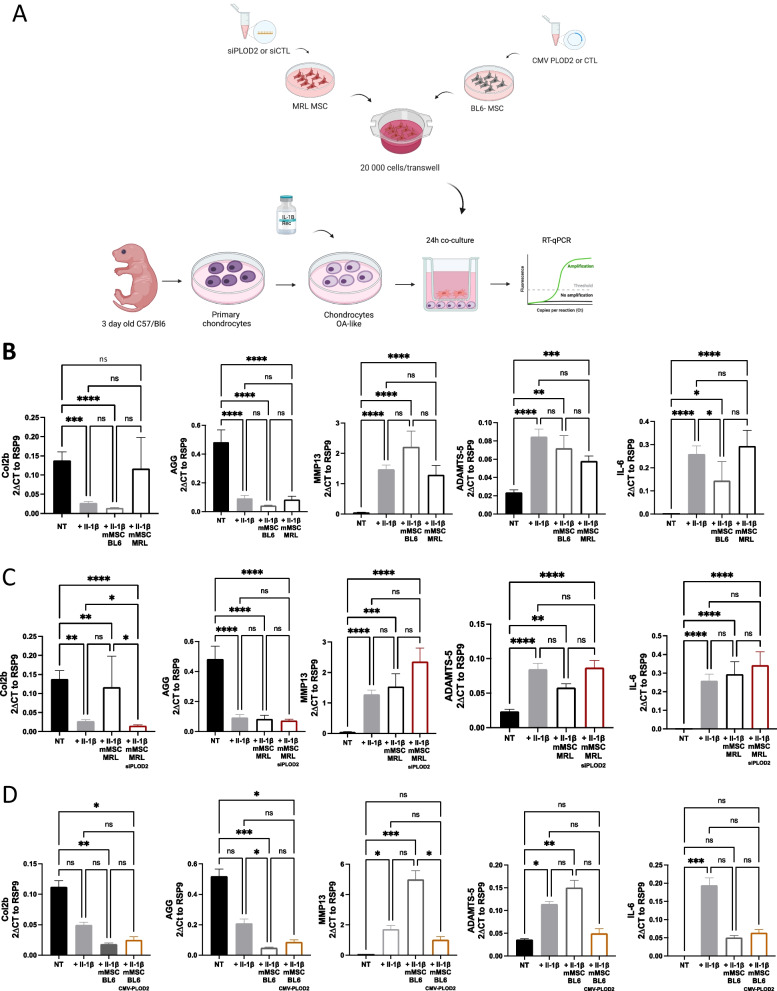
Effect of PLOD2 on chondrocyte gene expression on OA-like chondrocytes. A Workflow for the generation of OA-like chondrocytes by incubation with IL1β and their co-culture. B RT-qPCR analysis of different chondrocyte and inflammatory markers in control (NT) and OA-like chondrocytes (IL1β) co-cultured or not with MRL MSC and BL6 MSC (n = 19). C RT-qPCR analysis of different chondrocyte and inflammatory markers in control (NT) and OA-like chondrocytes (IL1β) co-cultured or not with MRL MSCsiCTL and MSC MRLsiPLOD2 (n = 19). D RT-qPCR analysis of different chondrocyte and inflammatory markers in control (NT) and OA-like chondrocytes (IL1β) co-cultured or not with MSC BL6 and BL6 MSC+CM PLOD2 (n = 6). Error bars represent mean ± SEM. One-way paired ANOVA, followed by Friedman test for multiple comparison test was performed. ns: 0.1234; *: P = 0.332; **: P = 0.0021; ***: P:0;002 or ****: P < 0.0001
Fig. 5
Fig. 5
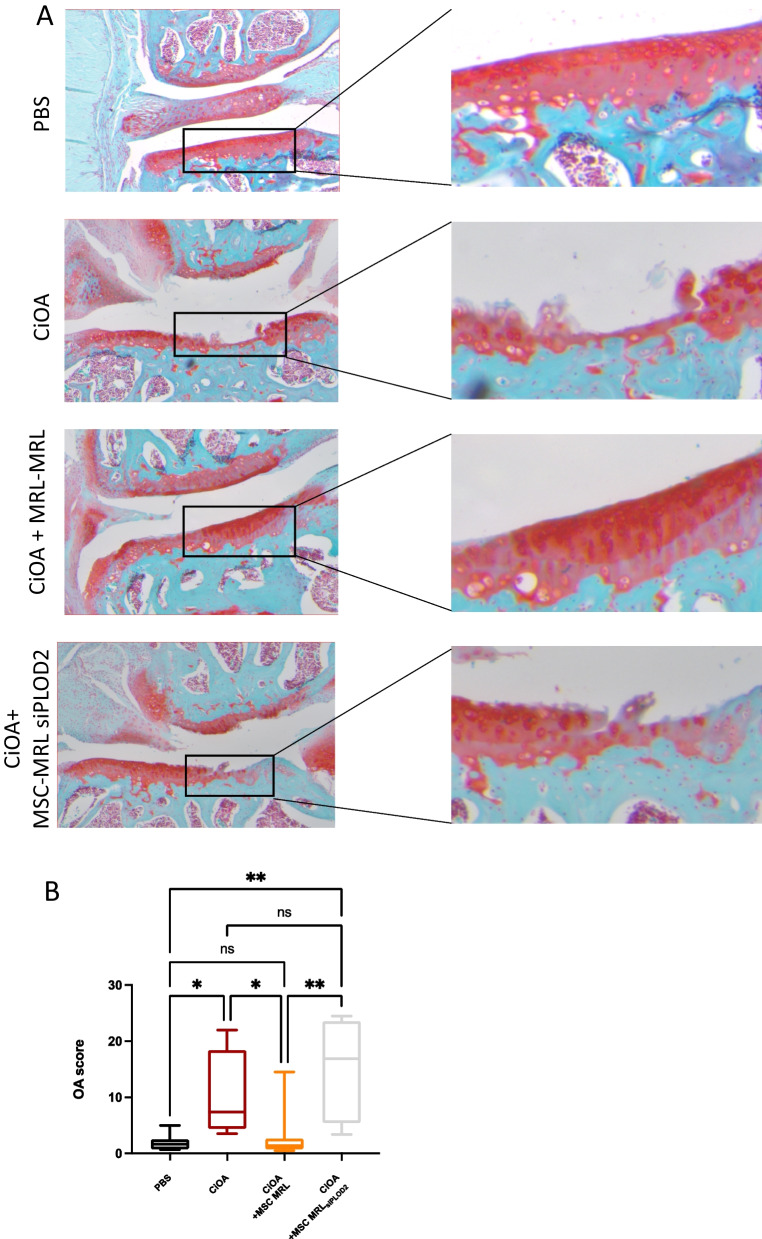
Plod2 mediates MRL MSC chondroprotective effect from osteoarthritis. A Histological sections of CiOA mice not treated (PBS), treated with collagenase only (CiOA), collagenase, MRL MSC (CiOA + MSC MR) and MRL MSC With siRNA for PLOD2 (CiOA + MSC MRLsiPLOD2) (B). OA score of histological sections of knee joints of the mice described in (A) Error bars represent mean ± SEM. One-way ANOVA, (Kruskal–Wallis test) was performed. ns: 0.1234; *: P = 0.332; **: P = 0.0021; ***: P: 0;002 or ****: P < 0.0001. n = 8 for PBS, CiOA an CiOA + MSC MRLsiPLOD2and n = 9 for CiOA + MSC MRL. Scale bars, 200 µm

References

    1. D. Jiang, Y. Rinkevich, Scars or Regeneration?-Dermal Fibroblasts as Drivers of Diverse Skin Wound Responses, Int J Mol Sci, 21 (2020). - PMC - PubMed
    1. Londono R, Sun AX, Tuan RS, Lozito TP. Tissue repair and epimorphic regeneration: an overview. Curr Pathobiol Rep. 2018;6:61–69. doi: 10.1007/s40139-018-0161-2. - DOI - PMC - PubMed
    1. Godwin JW, Pinto AR, Rosenthal NA. Macrophages are required for adult salamander limb regeneration. Proc Natl Acad Sci USA. 2013;110:9415–9420. doi: 10.1073/pnas.1300290110. - DOI - PMC - PubMed
    1. Gemberling M, Bailey TJ, Hyde DR, Poss KD. The zebrafish as a model for complex tissue regeneration. Trends Genet. 2013;29:611–620. doi: 10.1016/j.tig.2013.07.003. - DOI - PMC - PubMed
    1. Bosch TC. Why polyps regenerate and we don't: towards a cellular and molecular framework for Hydra regeneration. Dev Biol. 2007;303:421–433. doi: 10.1016/j.ydbio.2006.12.012. - DOI - PubMed

Publication types

MeSH terms

Substances